
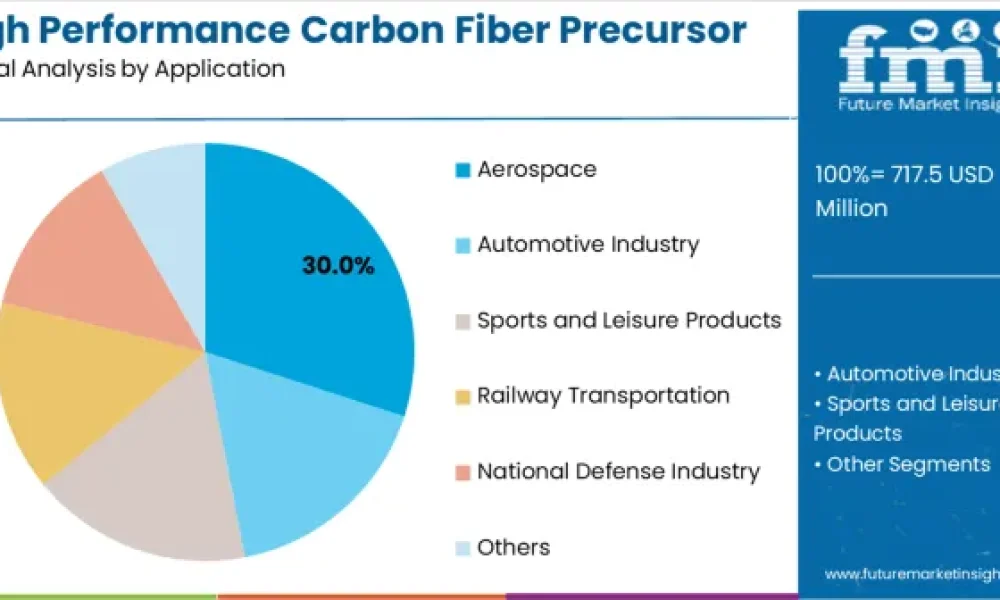
The high-performance carbon fiber precursor market is entering a decade of accelerated industrial transformation, projected to grow from USD 717.5 million in 2025 to USD 2,288.8 million by 2035, reflecting a robust CAGR of 12.3%, according to the latest analysis by Future Market Insights (FMI). Rapid advancements in aerospace engineering, automotive electrification, and renewable energy manufacturing are reshaping demand across APAC, Europe, the United States, and Saudi Arabia, positioning carbon fiber precursors as a cornerstone of next-generation composite technologies.
Three Breakpoints Define the Market’s Decade-Long Growth Path
FMI’s breakpoint analysis identifies 2025–2028 as the first inflection point, driven by accelerating adoption in aerospace, automotive, and wind energy. Carbon fiber precursors transition from niche applications toward mainstream industrial use as manufacturers prioritize lightweight, high-strength materials for enhanced efficiency and sustainability.
A second breakpoint emerges during 2028–2032, where scaling production capacities, improving stabilization technologies, and supply chain efficiencies reduce precursor costs. This phase opens opportunities in sports equipment, infrastructure reinforcement, industrial machinery, and precision electronics.
Subscribe for Year-Round Insights → Stay ahead with quarterly and annual data updates: https://www.futuremarketinsights.com/reports/sample/rep-gb-26929
By 2032–2035, the market stabilizes as high-performance composites become fully embedded into major industrial systems. Most high-value sectors—including aerospace, defense, electric mobility, and renewable energy—integrate precursors into standardized manufacturing ecosystems.
Market Highlights – 2025 to 2035
| Metric | Value |
| 2025 Market Value | USD 717.5 million |
| 2035 Market Forecast | USD 2,288.8 million |
| CAGR (2025–2035) | 12.3% |
| Leading Precursor Type | PAN-Based Precursors |
| Key Growth Regions | APAC, North America, Europe |
The market is dominated by PAN-based precursors, accounting for around 65% of consumption due to their 3.5–4.5 GPa tensile strength, 55–60% carbon yield, and reliable thermal stability up to 300°C.
Aerospace & Defense Lead with 38% Share
Application segmentation shows:
- Aerospace & Defense: 38%
- Automotive Lightweighting: 27%
- Wind Energy: 16%
- Industrial & Sporting Goods: 11%
- Specialty Electronics & Medical Devices: 8%
The aerospace industry remains the largest revenue driver, fueled by next-generation aircraft development and defense modernization initiatives. Electric vehicle programs globally are intensifying automotive demand for lightweight structural composite components, especially in battery housings and body panels.
Why the Market Is Accelerating – Structural Drivers
- Lightweighting Imperatives in Aviation & Automotive
OEMs are expanding carbon fiber precursor usage to reduce overall mass, enabling:
- better fuel efficiency,
- extended EV range,
- enhanced structural performance.
- Renewable Energy Momentum
Wind turbine manufacturers depend on high-performance fibers to support larger blade sizes and higher load-bearing requirements.
- Sustainability and ESG Alignment
Manufacturers increasingly adopt:
- energy-efficient precursor stabilization technologies,
- greener carbonization processes,
- bio-based precursor alternatives.
This creates premium opportunities for suppliers aligned with ESG mandates.
Opportunity Pathways: Seven Growth Tracks Through 2035
FMI identifies multiple revenue pools:
- Advanced PAN Precursor Technologies: USD 1.4–1.8 billion
- Aerospace & Defense Leadership: USD 800–1,200 million
- Automotive Lightweighting Solutions: USD 400–700 million
- Asian Manufacturing Expansion: USD 600–900 million
- Sustainable Precursor Innovations: USD 300–500 million
- Specialty Applications (Sports, Electronics): USD 250–400 million
- Vertical Integration Strategies: USD 400–600 million
APAC—particularly China (16.6% CAGR) and India (15.4% CAGR)—is expected to be the largest contributor to global expansion, supported by government-led investments in aerospace, defense, and advanced materials.
Need tailored insights? Request report customization to match your specific business objectives: https://www.futuremarketinsights.com/customization-available/rep-gb-26929
Regional and Country-Level Insights
APAC
- China: Fastest-growing market globally at 16.6% CAGR; driven by aerospace industrialization and wind energy projects.
- India: Expected to grow at 15.4%, propelled by defense modernization and EV growth.
- Japan: Growth at 9.2%, backed by precision manufacturing and composite innovation.
Europe
The European market is forecasted to rise from USD 180.2 million (2025) to USD 570.3 million (2035), at 12.2% CAGR.
- Germany: 32.1% share in 2025; continues leading through aerospace and automotive composite adoption.
- UK: 24% share, supported by aerospace R&D strength.
- France, Italy, Spain: Increasing composite use across mobility, aviation, and industrial applications.
United States
The U.S. market grows at 11.7%, driven by long-term aerospace programs, defense aircraft upgrades, and integration of automated composite manufacturing systems.
Saudi Arabia & Middle East
Saudi Arabia emerges as a strategic growth hub in the Middle East as national industrial diversification accelerates demand for advanced materials for:
- aerospace maintenance facilities,
- defense modernization projects,
- renewable energy installations,
- composite manufacturing investments.
Competitive Landscape
The market comprises leading global precursor suppliers, carbon fiber producers, and vertically integrated material innovators. According to FMI, companies are prioritizing:
- precursor purity enhancement,
- automated production capabilities,
- capacity expansion in APAC and the Middle East,
- sustainable manufacturing technologies.
Key companies profiled by FMI include:
- Toray Industries
- Mitsubishi Chemical
- Teijin
- Hexcel Corporation
- SGL Carbon
- Hyosung
- AKSA
- Kemrock
- Advanced Connection Technology
- Jilin Carbon Valley
- Runjust Carbon
- Jiangsu Hengshen
Future Outlook
With rising demand across aerospace, electric vehicles, industrial machinery, and renewable energy systems, high-performance carbon fiber precursors will play a crucial strategic role over the next decade. FMI highlights that investment in advanced precursor technologies, ESG-ready production, and regional manufacturing expansion will distinguish the market’s top-performing companies through 2035.
About Future Market Insights (FMI)
Future Market Insights, Inc. (FMI) is an ESOMAR-certified, ISO 9001:2015 market research and consulting organization, trusted by Fortune 500 clients and global enterprises. With operations in the U.S., UK, India, and Dubai, FMI provides data-backed insights and strategic intelligence across 30+ industries and 1200 markets worldwide.
Why Choose FMI: Empowering Decisions that Drive Real-World Outcomes: https://www.futuremarketinsights.com/why-fmi



