
Commercial Seaweed Market Overview:
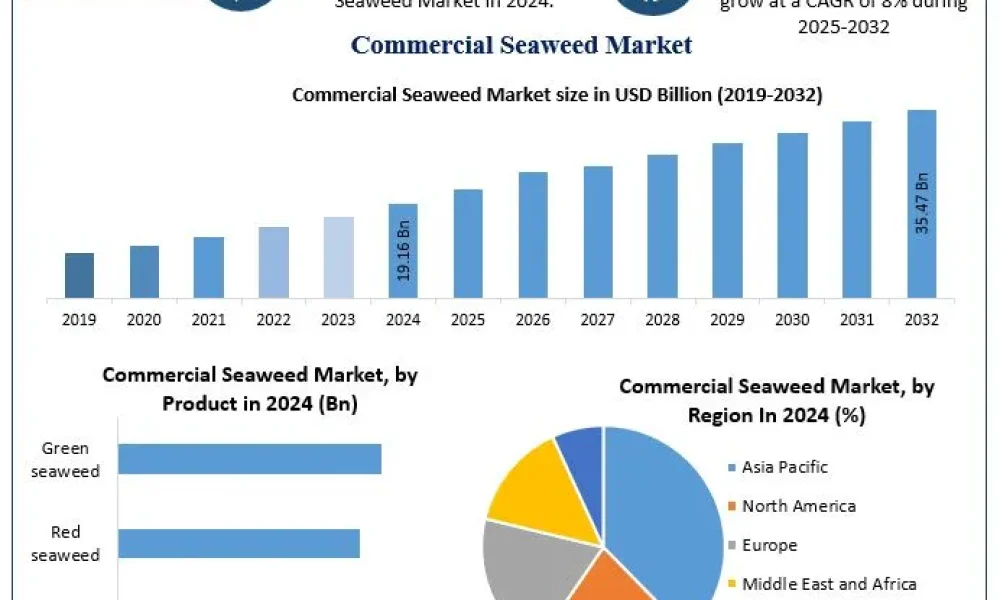
Commercial Seaweed Market is exhibiting rapid growth, with a projected value surging from USD 19.16 billion in 2024 to USD 35.47 billion by 2032, reflecting a CAGR of 8% over the forecast period. This expansion is powered by the surging demand for sustainable, healthy, and plant-based products across industries, including food, cosmetics, pharmaceuticals, animal feed, and agriculture. Asia Pacific remains the dominant region, supported by vast production capacity, strong consumer demand, and technological innovation.
Key Highlights & Insights
Market Size & Growth: The market size is anticipated to grow from USD 19.16 billion (2024) to USD 35.47 billion (2032), with an annual CAGR of 8%.
Dominating Region: Asia Pacific holds over 60% of the global market share, driven by large-scale production and consumption in China, Japan, South Korea, and Indonesia. Robust infrastructure and cultural integration of seaweed in diets fuel regional supremacy.
Leading Segment: Brown seaweed is the most widely cultivated and consumed segment, followed by red and green seaweed. Carrageenan and alginates, derived from red and brown seaweed respectively, dominate as high-value products used as thickeners and stabilizers in foods, cosmetics, and medicines.
Key Driver: Growing demand for natural, sustainable, and healthy products in food and cosmetics sectors, coupled with technological advancements and increasing plant-based diet trends globally.
► Get a sample of the report:https://www.maximizemarketresearch.com/request-sample/26523/
Recent Developments
2024-2025: Companies such as Cargill, DuPont, Qingdao Gather Great Ocean, and Gelymar expand large-scale seaweed farming and enhance production capacity internationally.
Technological innovations in seaweed processing, including offshore farming and bioreactors, boost yield, quality, and sustainability.
Governments in Asia Pacific and Europe provide research funding, tax incentives, and regulatory support to bolster industry growth and address sustainability and quality issues.
Key players strengthen portfolios through mergers, acquisitions, and partnerships for diversified applications, from food additives to biofuels and pharmaceuticals.
Market Dynamics
Growth Drivers:
Rising consumer demand for plant-based, vegan, and healthy food alternatives.
Expansion in cosmetics and personal care, leveraging seaweed’s antioxidant and anti-inflammatory properties.
Technological advancements enable efficient, sustainable cultivation and processing methods.
Government policies promoting sustainable food production and environmental responsibility.
Challenges:
Dependence on natural climatic conditions affects production levels.
Lack of standardized product quality and grading disrupts supply chains.
Regulatory compliance varies widely by region, complicating international operations.
Competitive market landscape and need for additional processing infrastructure.
Regional Analysis
Asia Pacific: Dominates global market, led by China, Japan, South Korea, and Indonesia, benefiting from strong demand and extensive seaweed farming operations.
North America & Europe: Mature and emerging markets for seaweed-based products, especially in health food, cosmetics, and pharmaceutical sectors. The U.S., France, Ireland, and Norway are significant producers and consumers.
South America: Growing segment led by Brazil, primarily in food industry; faces infrastructure and awareness challenges.
Middle East & Africa: Emerging markets with slow but increasing uptake, supported by new product launches and investments.
Product Segmentation
By Product Type: Brown seaweed (largest share), red seaweed, green seaweed.
By Application: Human consumption, agriculture, animal feed, pharmaceuticals, cosmetics, biofuel, and others.
By Form: Leaf, powder, flakes, liquid extracts.
By Region: Asia Pacific, North America, Europe, South America, Middle East & Africa.
Key Trends
Growing incorporation of seaweed in plant-based food products, snacks, and condiments.
Expanding role in natural cosmetics and personal care, including skincare and haircare.
Use of cutting-edge cultivation techniques (offshore farming, bioreactors) for higher efficiency and sustainability.
Development of new seaweed-based products in pharmaceuticals and nutraceuticals.
Increased industry focus on regulatory compliance and sustainability certification.
Quote
“Asia Pacific’s dominance in the commercial seaweed market underscores its essential role in the global transition to sustainable, plant-based industries. Driven by innovative cultivation and the rising demand for healthy products, seaweed is poised to become an indispensable ingredient in tomorrow’s food, cosmetics, and biofuel sectors.”
Contact Maximize Market Research:
3rd Floor, Navale IT Park, Phase 2
Pune Bangalore Highway, Narhe,
Pune, Maharashtra 411041, India
[email protected]
+91 96071 95908, +91 9607365656
About Maximize Market Research:
Maximize Market Research is a multifaceted market research and consulting company with professionals from several industries. Some of the industries we cover include medical devices, pharmaceutical manufacturers, science and engineering, electronic components, industrial equipment, technology and communication, cars and automobiles, chemical products and substances, general merchandise, beverages, personal care, and automated systems. To mention a few, we provide market-verified industry estimations, technical trend analysis, crucial market research, strategic advice, competition analysis, production and demand analysis, and client impact studies.




