
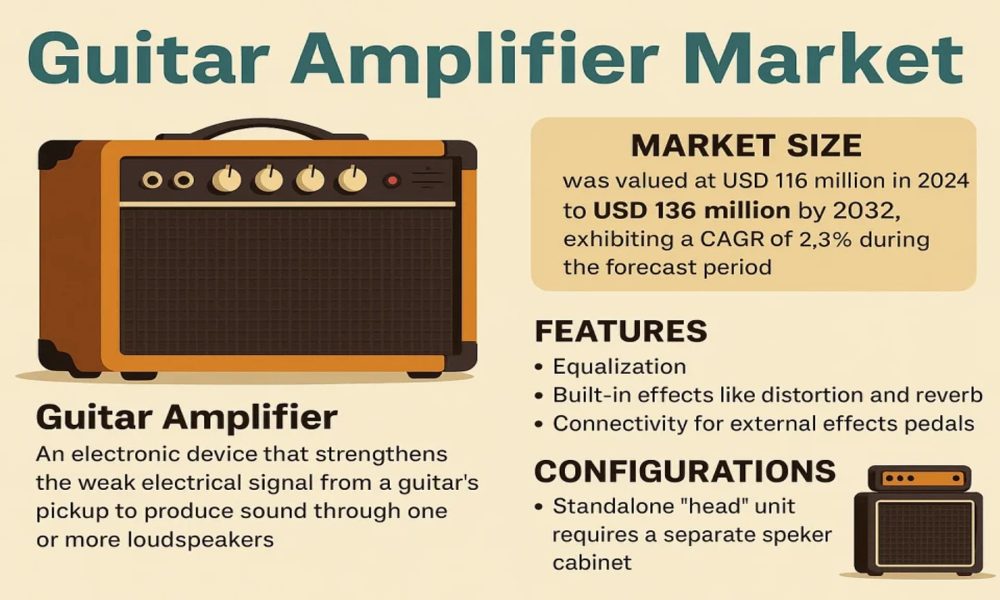
Guitar Amplifier Market size was valued at USD 116 million in 2024 to USD 136 million by 2032, exhibiting a CAGR of 2.3% during the forecast period.
A guitar amplifier is an electronic device that strengthens the weak electrical signal from a guitar’s pickup so that it can produce sound through one or more loudspeakers. These devices are fundamental for shaping a guitarist’s signature tone, offering capabilities such as equalization, built-in effects like distortion and reverb, and connectivity for external effects pedals. Amplifiers come in two primary configurations: standalone “head” units that require a separate speaker cabinet and “combo” amplifiers that integrate both the amplifier and speakers into a single cabinet.
The market is experiencing steady growth, primarily driven by a consistent global base of musicians and the enduring popularity of electric guitars. However, the market faces challenges from the increasing adoption of digital amp modeling software and hardware, which offer a wide range of tones in a compact form factor. Despite this, the demand for traditional amplifiers remains robust, particularly in the professional and enthusiast segments, where combo amplifiers dominate with over 75% market share. Key players such as Fender and Marshall Amplification continue to lead the market, collectively holding a significant portion of the global revenue.
Claim Your Free Sample Report- Guitar Amplifier Market
MARKET DRIVERS
Rising Disposable Income and Music Education Expansion
The increasing disposable income globally, especially in emerging economies, allows more consumers to invest in musical instruments and equipment, including guitar amplifiers. Additionally, the expansion of music education programs in schools and universities is creating a new generation of musicians who need amplification equipment.
Growth of Live Music and Entertainment Industry
With the resurgence of live music events post-pandemic, there’s increased demand for amplification equipment both for performances and rehearsals. The entertainment industry’s growth directly correlates with sales of musical equipment, including amplifiers for both electric and acoustic guitars.
➤ Digital Integration and Multi-functional Devices
Modern guitar amplifiers increasingly incorporate digital technology, Bluetooth connectivity, and built-in effects that appeal to modern musicians. This convergence of traditional amplification with modern technology is driving adoption among both amateur and professional musicians.
Sustainability and Energy Efficiency
With growing environmental consciousness, manufacturers are developing more energy-efficient amplifiers using Class D amplification technology. These amplifiers generate less heat, last longer, and appeal to environmentally conscious consumers, driving market growth through sustainable innovation.
Recent Developments in the Guitar Amplifier Market:
Integration of Smart Features:
Major manufacturers are integrating Bluetooth connectivity, mobile app control, and wireless streaming options into amplifiers. Brands like Fender and Boss have introduced smart amp models that allow tone customization and preset sharing through dedicated apps.Rise of Compact and Portable Amplifiers:
The demand for battery-powered and mini amplifiers is growing among gigging musicians and hobbyists. Portable amplifiers from Yamaha and Positive Grid have gained popularity due to their lightweight design and ease of transport.Hybrid and Digital Modeling Technology:
Companies are increasingly focusing on digital modeling amplifiers that replicate the tone of classic tube amps while offering flexibility and reliability. Line 6 and Kemper are leading this shift with advanced tone-shaping technology.Sustainability Initiatives:
Several amplifier manufacturers are adopting eco-friendly materials and energy-efficient designs to align with sustainability goals, reducing power consumption and environmental impact.Expansion in the E-commerce Distribution Channel:
Online platforms such as Amazon, Sweetwater, and Thomann are driving sales growth by offering wider access to a global customer base, easy comparison, and competitive pricing.Artist Collaborations and Signature Models:
Brands like Marshall, Orange, and Blackstar are releasing signature amplifier series in collaboration with popular musicians to attract brand loyalty and niche audiences.
MARKET OPPORTUNITIES
Emerging Markets Growth
Rapid economic development in Asia-Pacific countries, particularly China and India, is creating a new generation of musicians with disposable income to invest in quality amplification equipment. This represents the fastest growing market segment with the highest growth potential for the coming decade.
Hybrid and Multi-functional Products
The integration of traditional amplification with modern features like Bluetooth, USB connectivity, and built-in effects processors creates new product categories that appeal to both traditionalists and modern musicians. This convergence creates opportunities for innovation and market expansion.
Direct-to-Consumer Sales Channels
The growth of e-commerce and social media marketing allows manufacturers to reach customers directly, reducing distribution costs and improving margins. This is particularly effective for boutique and specialized amplifier manufacturers who can now reach global niche markets directly.
List of Key Guitar Amplifier Companies
- Fender Musical Instruments Corporation
- Marshall Amplification
- Orange Music Electronic Company Ltd.
- Vox Amplification (Korg)
- Peavey Electronics
- Roland Corporation (BOSS)
- Yamaha Corporation
- Laney Amplification
- PRS Guitars
- Fishman
- Mesa/Boogie
- Hughes & Kettner
- Blackstar Amplification
- Music Tribe (Behringer)
Claim Your Free Sample Report- Guitar Amplifier Market
Segment Analysis:
Segment CategorySub-SegmentsKey InsightsBy Type
Tube Amplifiers
Solid-State Amplifiers
Hybrid Amplifiers
Modeling Amplifiers
Tube Amplifiers remain highly valued among professional musicians and audiophiles for their warm, organic tone and natural compression despite higher costs and maintenance requirements, while modeling amplifiers gain traction for their versatility and convenience.
By Application
Live Performances
Studio Recording
Home Practice
Music Education
Live Performances drive demand for high-wattage, reliable amplifiers with robust feature sets, while home practice applications fuel demand for compact, low-wattage amplifiers with headphone compatibility and built-in effects.
By End User
Professional Musicians
Hobbyists & Enthusiasts
Music Students & Educators
Collectors & Vintage Enthusiasts
Professional Musicians typically invest in higher-end, road-worthy amplifier systems and often maintain collections for different tonal requirements, while hobbyists and enthusiasts show strong interest in affordable, versatile amplifiers with modern features.
By Distribution Channel
Music Retail Stores
Online Marketplaces
Direct from Manufacturers
Specialty & Vintage Shops
Online Marketplaces have transformed amplifier sales through detailed product information, user reviews, and global reach, while specialty retailers maintain relevance through hands-on demos, trade-in programs, and expert advice particularly for high-end and vintage equipment.
By Technology
Analog Tube Technology
Digital Modeling Technology
Hybrid Systems
Emerging Innovations
Digital Modeling Technology continues to advance with improved amp modeling, effects processing, and integration capabilities, while traditional tube technology maintains strong appeal for its organic response and dynamic range, creating a diverse technological landscape.
About Semiconductor Insight:
Established in 2016, Semiconductor Insight specializes in providing comprehensive semiconductor industry research and analysis to support businesses in making well-informed decisions within this dynamic and fast-paced sector. From the beginning, we have been committed to delivering in-depth semiconductor market research, identifying key trends, opportunities, and challenges shaping the global semiconductor industry.
Our expertly developed semiconductor market reports offer actionable intelligence, including detailed semiconductor industry analysis, market forecasts, competitive analysis, and insights into technological advancements, enabling our clients to maintain a competitive edge. With nearly a decade of expertise, we remain at the forefront of innovation, delivering strategic clarity to businesses in the semiconductor sector.
Our commitment to providing insights into semiconductor market share and industry trends ensures that our clients have the information they need to succeed in the ever-evolving semiconductor market.
CONTACT US:
City vista, 203A, Fountain Road, Ashoka Nagar, Kharadi, Pune, Maharashtra 411014
[+91 8087992013]
[email protected]




