
Will the Automotive Adhesives & Sealants Market Hit USD 6.40 Billion by 2032 Amid EV and Lightweight Boom?
Introduction: Market Significance in Modern Life
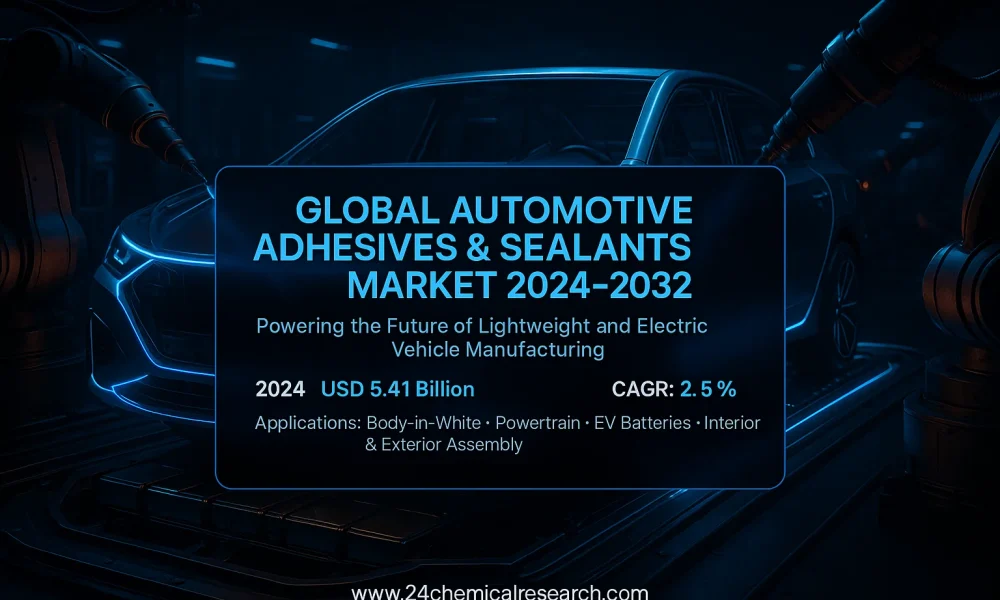
Global Automotive Adhesives and Sealants Market continues its steady ascent, reaching a valuation of USD 5.41 billion in 2024. Projected to grow at a CAGR of 2.5% to approximately USD 6.40 billion by 2032, this market plays a pivotal role in the evolving automotive landscape. Automotive adhesives and sealants are no longer just auxiliary materials—they are critical to modern vehicle safety, efficiency, and performance. Their application is particularly crucial in the era of electric vehicles (EVs) and lightweight automotive designs, where traditional mechanical fasteners fall short in delivering structural integrity, weight reduction, and vibration damping.
Why This Market Matters Today
- EV Revolution: Each EV battery pack demands 5-8 kg of specialized adhesives for thermal management and structural bonding.
- Sustainability & Lightweighting: Adhesives reduce vehicle weight significantly, enhancing fuel efficiency and lowering emissions.
- Safety and Performance: Superior bonding ensures enhanced crashworthiness, component longevity, and reduced noise, vibration, and harshness (NVH).
Recent Developments Driving Market Growth
- Technological innovations in adhesives now provide extended temperature resistance (-40°C to 200°C) and vibration damping, essential for modern vehicles’ performance.
- Aftermarket demand remains robust, supported by a global vehicle parc exceeding 1.4 billion units and increasing vehicle lifespan.
- OEMs increasingly adopt multi-material bonding solutions combining aluminum, composites, and advanced steels for optimized vehicle design.
Geographical Importance and Regional Insights
- Asia-Pacific: Dominates global production, contributing over 30% of market volume. China leads as a hub for both manufacturing and consumption, supported by Japan, South Korea, and India’s strong automotive sectors.
- Europe: Germany and France drive technology innovation with advanced adhesive formulations meeting stringent EU environmental standards.
- North America: Steady growth fueled by EV adoption, lightweight vehicle initiatives, and supportive infrastructure in the U.S.
- Emerging Markets: Latin America and Africa present high-growth potential as local automotive production expands.
Key Market Drivers and Opportunities
- Vehicle lightweighting has increased adhesive usage from 15 kg per premium vehicle a decade ago to 35 kg today.
- EV adoption drives demand for specialized adhesives in battery packs and thermal management applications.
- Material science advancements enhance adhesive performance across extreme temperatures and multi-material bonding requirements.
Challenges & Restraints
- Raw material price volatility affects acrylics and polyurethanes, fluctuating 15-25% annually.
- Supply chain disruptions extend lead times to 12-16 weeks for premium formulations.
- Environmental regulations, while spurring innovation, increase compliance costs and R&D investments.
- Technical complexities arise due to curing time management and bonding diverse materials with varying thermal expansion.
Market Segmentation by Type
- Epoxy Adhesives
- Polyurethane Adhesives
- Silicone Adhesives
- Acrylic Adhesives
- Polyurethane Sealants
- Silicone Sealants
- Butyl Sealants
Market Segmentation by Application
- Body-in-White
- Interior Assembly
- Exterior Trim
- Powertrain
- Electric Vehicle Batteries
- Aftermarket Repairs
Key Players and Competitive Landscape
- Henkel AG & Co. KGaA
- Sika AG
- 3M Company
- H.B. Fuller Company
- PPG Industries, Inc.
- Bostik
- DuPont de Nemours, Inc.
- LORD Corporation
- Illinois Tool Works Inc.
- Yokohama Rubber Co., Ltd.
- Hubei Huitian New Materials Co., Ltd.
- Ashland Global Holdings Inc.
Frequently Asked Questions (FAQ)
Q1: Why are automotive adhesives preferred over mechanical fasteners?
A1: They reduce weight, improve structural integrity, enhance safety, and allow bonding of dissimilar materials which is critical in modern EVs and lightweight vehicles.
Q2: Which regions are expected to drive the highest market growth?
A2: Asia-Pacific leads in production and demand, while Europe focuses on technology innovation, and North America benefits from EV adoption.
Q3: How is EV adoption impacting adhesive demand?
A3: Each EV requires 5-8 kg of adhesives for battery packs, thermal management, and structural bonding, significantly boosting overall consumption.
Q4: What are the key challenges facing the market?
A4: Raw material price volatility, supply chain disruptions, multi-material bonding complexity, and increased compliance costs due to environmental regulations.
Research Scope and Insights
This report offers a comprehensive analysis of the global and regional automotive adhesives and sealants markets from 2024 to 2032, including:
- Sales volume and revenue forecasts
- Detailed segmentation by type and application
- Company profiles with production capacity, sales, pricing, and gross margins
- Strategic insights, market drivers, challenges, and risks
- Competitive landscape analysis highlighting leading vendors
Access the Full Report:
Get Full Report Here
Contact Information:
International: +1(332) 2424 294 | Asia: +91 9169162030
Website: https://www.24chemicalresearch.com/
LinkedIn: https://www.linkedin.com/company/24chemicalresearch




