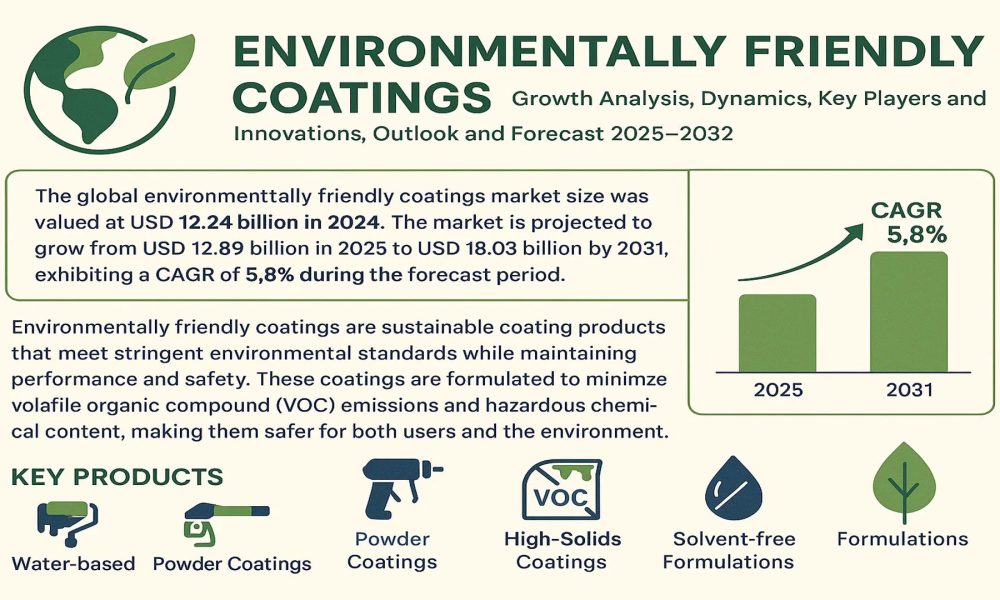
Environmentally Friendly Coatings Market size was valued at USD 12.24 billion in 2024. The market is projected to grow from USD 12.89 billion in 2025 to USD 18.03 billion by 2031, exhibiting a CAGR of 5.8% during the forecast period.
Environmentally friendly coatings are sustainable coating products that meet stringent environmental standards while maintaining performance and safety. These coatings are formulated to minimize volatile organic compound (VOC) emissions and hazardous chemical content, making them safer for both users and the environment. The market includes key product types such as water-based paints, powder coatings, high-solids coatings, and solvent-free formulations.
The market growth is driven by increasing environmental regulations globally, rising consumer awareness about sustainable products, and growing demand from key end-use industries like construction and automotive. Asia currently dominates the global coatings market with 45% share, followed by Europe (23%) and North America (19%). Major players like AkzoNobel, PPG Industries, and BASF are actively expanding their eco-friendly product portfolios through innovations in bio-based materials and low-VOC technologies to capitalize on this growing segment.
Get Your Free Sample Report Today- https://www.intelmarketresearch.com/download-free-sample/9018/environmentally-friendly-coatings-market
MARKET DYNAMICS
MARKET DRIVERS
Stringent Environmental Regulations Accelerate Adoption of Eco-Friendly Coatings
Governments worldwide are implementing stricter environmental regulations to reduce volatile organic compound (VOC) emissions, driving demand for sustainable coating solutions. The European Union’s REACH regulations and the U.S. Environmental Protection Agency’s strict VOC limits have compelled manufacturers to shift from conventional solvent-based coatings to environmentally friendly alternatives. These regulations have resulted in a significant expansion of the eco-friendly coatings market, with water-based coatings alone accounting for nearly 45% of the architectural coatings segment in 2024. Furthermore, emerging economies in Asia are adopting similar standards, creating new growth avenues for compliant coating solutions across multiple industries.
Growing Consumer Preference for Sustainable Products Boosts Market Growth
Environmental consciousness among consumers has reached unprecedented levels, with nearly 65% of global consumers willing to pay premium prices for sustainable products according to validated market studies. This shift in consumer behavior is particularly evident in the construction sector, where green building certifications such as LEED and BREEAM have increased demand for low-VOC coatings. The residential segment has shown particular responsiveness, with eco-friendly coatings experiencing a 12% annual growth in renovation projects. Manufacturers are responding to this demand by expanding their sustainable product portfolios and investing in green chemistry innovations.
Technological Advancements Enhance Performance of Sustainable Coatings
Recent breakthroughs in formulation technologies have significantly improved the performance characteristics of environmentally friendly coatings. Innovations in waterborne resin technology have achieved drying times and durability comparable to traditional solvent-based products, overcoming previous limitations. High-performance bio-based epoxy resins now offer corrosion resistance meeting industrial standards, with some formulations achieving protection durations exceeding 10 years. These technological improvements have been crucial in expanding the application scope of eco-friendly coatings beyond architectural uses into demanding industrial and automotive sectors.
MARKET OPPORTUNITIES
Expansion in Emerging Economies Presents Significant Growth Potential
Rapid urbanization and industrialization in developing nations, particularly in Asia-Pacific, offer substantial opportunities for market expansion. As environmental awareness grows and regulatory frameworks strengthen in these regions, demand for sustainable coatings is projected to increase at rates exceeding the global average. The construction boom in countries like India and Indonesia, combined with increasing automotive production in Southeast Asia, creates fertile ground for environmentally friendly coating solutions tailored to local market needs and climatic conditions.
Development of Circular Economy Models
The growing emphasis on circular economy principles presents innovative opportunities for the coatings industry. Some pioneering companies have introduced take-back programs for paint containers and developed technologies for recycling coating materials. These initiatives not only address environmental concerns but also create new revenue streams and strengthen brand reputation among environmentally conscious consumers. The potential for collaboration with waste management sectors to develop comprehensive recovery and recycling systems represents a promising avenue for industry growth and sustainability leadership.
Advancements in Smart and Functional Coatings
The integration of smart technologies with environmentally friendly formulations opens new possibilities for value-added products. Self-cleaning, air-purifying, and thermoregulating coatings based on sustainable chemistry are gaining traction in both residential and commercial applications. These high-value innovations command premium pricing and help overcome the cost barrier associated with eco-friendly alternatives. The development of photocatalytic coatings that actively reduce air pollution while maintaining low environmental impact presents particularly compelling opportunities in urban environments.
Segment Analysis:
By Type
- Solvent-Free Coatings
- Water-Based Paint
- Powder Coating
- High Solids Coatings
Water-Based Paint dominates the market due to its low VOC emissions, ease of application, and stringent environmental regulations favoring sustainable alternatives.
By Application
- Building
- Industry
- Automobile
- Others
Building applications lead the segment owing to rising demand for green construction materials and government mandates for eco-friendly infrastructure projects.
By End User
- Architectural
- Industrial
- Automotive
- Consumer Goods
Architectural end users comprise the largest segment, driven by increasing adoption in residential and commercial building projects to comply with sustainability certifications.
List of Major Environmentally Friendly Coatings Manufacturers
- AkzoNobel N.V. (Netherlands)
- PPG Industries, Inc. (U.S.)
- BASF SE (Germany)
- Nippon Paint Holdings Co., Ltd. (Japan)
- Hempel A/S (Denmark)
- 3TREES (China)
- Guangdong Huarun Paints Co. (China)
- Carpoly Chemical Group Co. (China)
- SKK Pte Ltd. (Singapore)
- STO SE & Co. KGaA (Germany)
- Yip’s Chemical Holdings Limited (China)
- ASIA Cuanon Technology (Shanghai) Co. (China)
The competitive intensity is further amplified by increasing M&A activity, with at least six significant transactions completed in 2023-2024 targeting companies with patented sustainable formulations. This consolidation trend is expected to continue as market players seek to combine technological expertise with geographical reach in this growing $12.24 billion industry.
ENVIRONMENTALLY FRIENDLY COATINGS MARKET TRENDS
Stringent Environmental Regulations Driving Adoption of Eco-Friendly Coatings
The global demand for environmentally friendly coatings is experiencing significant growth due to increasingly stringent environmental regulations aimed at reducing volatile organic compound (VOC) emissions. Governments worldwide are enforcing policies that restrict the use of traditional solvent-based coatings, which has led to a surge in demand for low-VOC alternatives. For instance, the global environmentally friendly coatings market is projected to grow from $12.24 billion in 2024 to $18.03 billion by 2031, at a compound annual growth rate (CAGR) of 5.8%. This trend is particularly strong in regions with strict environmental policies, such as Europe and North America, where water-based coatings now represent over 60% of the market share. Meanwhile, the construction industry’s shift toward green building certifications like LEED further accelerates this transition.
Other Trends
Rise of Nanotechnology in Coating Formulations
Nanotechnology is revolutionizing the coatings industry by enabling the development of high-performance, eco-friendly coatings with enhanced durability and functionality. Nano-coatings offer superior scratch resistance, UV protection, and self-cleaning properties, making them particularly valuable in automotive and industrial applications. Research indicates that nearly 40% of newly developed coatings now incorporate nanomaterials to improve performance while maintaining sustainability. Additionally, bio-based nanomaterials derived from renewable resources are gaining traction, reducing dependency on petroleum-derived raw materials and further lowering the environmental footprint.
Get Your Free Sample Report Today- https://www.intelmarketresearch.com/download-free-sample/9018/environmentally-friendly-coatings-market
Recent Developments in the Environmentally Friendly Coatings Market
- Shift Towards Waterborne Coatings
- Leading coatings manufacturers are increasingly investing in waterborne and low-VOC (Volatile Organic Compounds) coatings to comply with stringent environmental regulations globally.
- Companies like PPG Industries and Sherwin-Williams have launched new lines of waterborne coatings that reduce harmful emissions while maintaining performance and durability.
- This trend is particularly strong in Europe and North America, where regulatory frameworks such as REACH and EPA standards are strict.
- Adoption of Bio-Based and Renewable Materials
- Manufacturers are moving from traditional petroleum-based resins to bio-based alternatives, such as coatings derived from soy, corn, and other plant-based materials.
- Recent research shows bio-based coatings not only reduce carbon footprint but also offer enhanced corrosion resistance and adhesion, making them viable for industrial and automotive applications.
- Technological Advancements in Powder Coatings
- Powder coatings, which produce minimal or zero VOC emissions, are gaining traction in automotive, construction, and consumer goods sectors.
- Innovations in UV-curable powder coatings have enabled faster curing times and lower energy consumption, aligning with sustainability goals.
- Strategic Partnerships and Collaborations
- Several key players are entering strategic partnerships to accelerate R&D for eco-friendly coatings.
- Example: AkzoNobel and BASF have jointly developed new coating solutions that reduce environmental impact while maintaining industrial performance.
- Government Regulations Driving Market Growth
- Strict emission standards in the U.S., Europe, and parts of Asia have accelerated the adoption of low-VOC and environmentally friendly coatings.
- Incentives for sustainable manufacturing practices are motivating small and medium enterprises to transition from solvent-based to eco-friendly coating systems.
- Emergence of Smart and Functional Eco-Coatings
- Recent development includes self-cleaning, anti-bacterial, and anti-corrosive environmentally friendly coatings.
- These coatings not only enhance sustainability but also offer added functional benefits, making them attractive in construction, healthcare, and transportation sectors.
- Market Expansion in Asia-Pacific
- Asia-Pacific, particularly China, India, and Japan, is witnessing rapid adoption of eco-friendly coatings due to industrial growth, urbanization, and increasing awareness of environmental sustainability.
- Local manufacturers are collaborating with global firms to produce cost-effective, eco-friendly alternatives to traditional coatings.
About Intel Market Research
Intel Market Research delivers actionable insights in technology and infrastructure markets. Our data-driven analysis leverages:
- Real-time infrastructure monitoring
- Techno-economic feasibility studies
Competitive intelligence across 100+ countries
Trusted by Fortune 500 firms, we empower strategic decisions with precision.
International: +1(332) 2424 294 | Asia: +91 9169164321
Website: https://www.intelmarketresearch.com
Follow us on LinkedIn: https://www.linkedin.com/company/intel-market-research




