
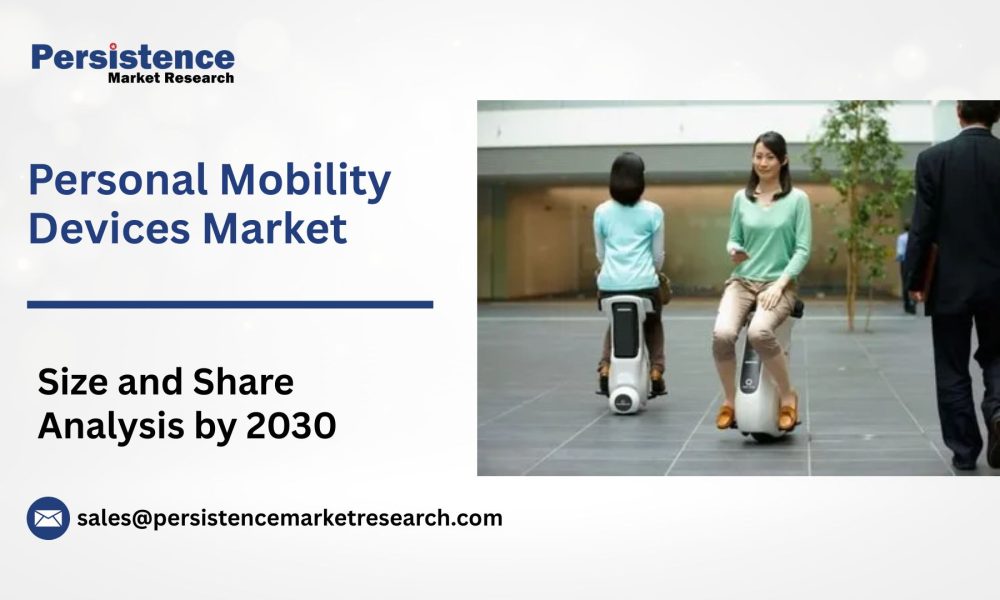
The personal mobility devices market plays a crucial role in enhancing independence, convenience, and accessibility for individuals with mobility challenges. These devices include powered wheelchairs, mobility scooters, electric bicycles, and other assistive transport solutions, widely used in healthcare facilities, urban mobility, and home care settings. According to the latest study by Persistence Market Research, the global personal mobility devices market is forecast to expand at a CAGR of 9.7% and thereby increase from a value of US$11.5 Bn in 2023, to US$22 Bn by the end of 2030. cx Growth is mainly fueled by the rising geriatric population, increasing prevalence of physical disabilities, and growing awareness about the benefits of assisted mobility solutions.
Market expansion is further supported by technological advancements, including lightweight materials, enhanced battery efficiency, and smart connectivity features. Among the product categories, powered wheelchairs emerge as the leading segment, offering high customization and superior mobility for users with severe physical limitations. Geographically, North America dominates the global market due to the presence of advanced healthcare infrastructure, high disposable income, and well-established reimbursement policies. Countries like the United States and Canada are central to this dominance, while Europe and Asia Pacific are emerging as key growth regions driven by rising aging populations and urbanization.
Request a Sample: https://www.persistencemarketresearch.com/samples/33969
Key Market Insights
- The market is forecast to expand at a CAGR of 9.7% and thereby increase from a value of US$11.5 Bn in 2023, to US$22 Bn by the end of 2030.
• Powered wheelchairs remain the leading product type due to their essential role in assisting users with severe mobility impairments.
• North America dominates the market, supported by advanced healthcare infrastructure and reimbursement policies.
• Increasing adoption of smart, connected mobility devices is shaping product innovation.
• Rising geriatric population and prevalence of disabilities are creating sustained demand.
What are the main drivers of the personal mobility devices market?
The primary drivers of the personal mobility devices market include the aging population, increasing incidence of physical disabilities, and rising urbanization that demands convenient mobility solutions. Technological advancements such as improved battery life, lightweight materials, and smart connectivity features are enhancing product functionality. Additionally, government initiatives, insurance coverage, and rising consumer awareness about quality-of-life improvements are further driving adoption.
Market Dynamics
Drivers: The market is driven by growing demand from elderly and disabled populations, increasing urban mobility challenges, and advancements in device technology. Rising disposable incomes and supportive policies for accessibility also contribute to growth.
Market Restraining Factor: High costs of advanced mobility devices, limited insurance coverage in certain regions, and lack of awareness in emerging economies pose constraints.
Key Market Opportunity: Development of AI-powered, smart, and customizable mobility devices offers significant opportunities for market players to differentiate and expand.
Market Segmentation
The personal mobility devices market can be segmented by product type and application. By product type, the market includes powered wheelchairs, mobility scooters, electric bicycles, and other devices. Among these, powered wheelchairs dominate due to their critical role in providing mobility to users with severe disabilities. Mobility scooters are also gaining traction for short-distance travel in urban areas and healthcare facilities.
By application, the market is categorized into home care, healthcare facilities, public transportation, and outdoor/urban mobility. Home care accounts for the largest market share, as the growing elderly population prefers assisted mobility devices for independent living. Healthcare facilities, including hospitals and rehabilitation centers, represent another key segment benefiting from increasing patient numbers and mobility-focused treatments. Urban mobility applications, particularly in developed cities, are expanding due to demand for eco-friendly, electric-assisted transport solutions.
Regional Insights
North America remains the largest and fastest-growing region, driven by advanced healthcare infrastructure, high adoption rates of mobility devices, and government reimbursement programs. Europe follows, supported by aging populations and well-established accessibility regulations. Asia Pacific is emerging as a key market, led by urbanization, growing geriatric populations, and increasing disposable incomes. Latin America and the Middle East & Africa are also showing growth potential due to rising awareness and adoption of assistive mobility solutions.
Competitive Landscape
The personal mobility devices market is competitive, with players focusing on technological innovation, regional expansion, and partnerships with healthcare providers to strengthen market positions.
Company Insights
✦ Invacare Corporation
✦ Sunrise Medical
✦ Pride Mobility Products Corp.
✦ Permobil AB
✦ Drive DeVilbiss Healthcare
✦ GF Health Products, Inc.
✦ Ottobock SE & Co. KGaA
✦ Hoveround Corporation
✦ TiLite (part of Permobil)
✦ WHILL, Inc.
Key Industry Developments
In recent years, companies have focused on smart and connected mobility solutions, integrating IoT and AI-based functionalities to enhance user safety and convenience. Collaborations with healthcare providers and technology firms are expanding innovation pipelines. Expanding production and distribution in Asia Pacific and Latin America is a common trend to cater to growing demand.
Innovation and Future Trends
The future of the personal mobility devices market lies in AI-powered, lightweight, and customizable solutions. Innovations include voice-controlled devices, obstacle detection sensors, enhanced battery performance, and app-based connectivity features. These advancements aim to improve user independence, comfort, and accessibility, positioning the market for long-term growth.
Explore the Latest Trending Research Reports:




