
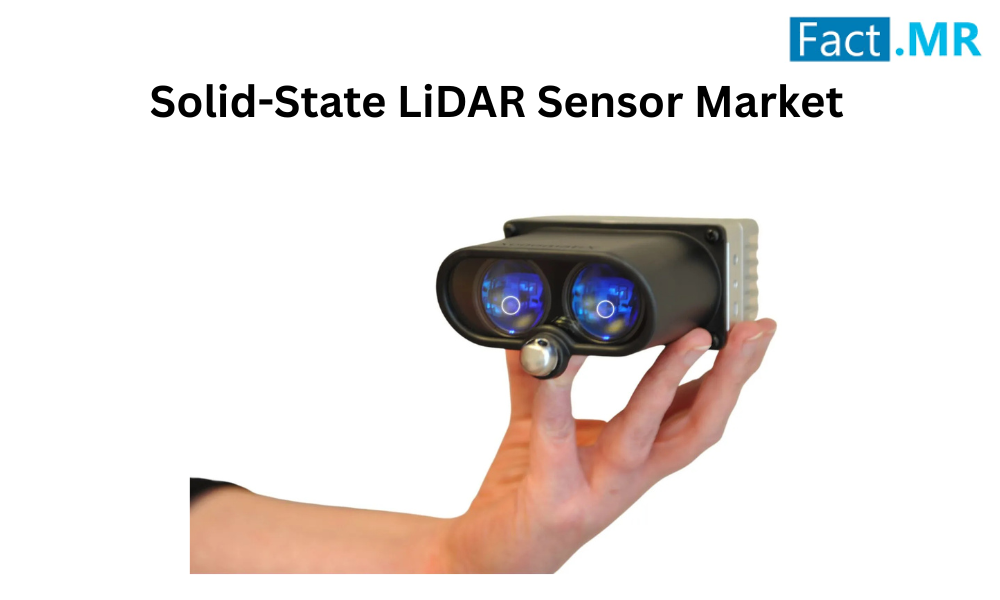
The global solid-state LiDAR sensor market is on a dynamic growth trajectory, valued at USD 1,971.8 million in 2025 and projected to reach USD 14,761.7 million by 2035. This expansion reflects a robust compound annual growth rate (CAGR) of 22.3% over the forecast period from 2025 to 2035. The surge is driven by rapid advancements in technological innovation, artificial intelligence, and industrial automation. As industries such as automotive, electronics, and aerospace & defense demand high-precision sensing for autonomous systems, solid-state LiDAR sensors are becoming indispensable for 3D mapping, object detection, and environmental perception. This market evolution is further fueled by investments in smart infrastructure and collaborations between LiDAR developers and OEMs, positioning solid-state LiDAR as a key enabler in ADAS, robotics, and surveillance applications.
Solid-State LiDAR Sensor Market Segmentation and Trends
The solid-state LiDAR sensor market is segmented by product type, technology, range, application, end-use industry, and region, offering a nuanced understanding of its structure. By product type, segments include 2D Solid-State LiDAR, 3D Solid-State LiDAR, and Multi-channel LiDAR, with 3D variants gaining traction for their comprehensive imaging capabilities. By technology, the market covers MEMS-based LiDAR, Optical Phased Array, Flash LiDAR, and Beam Steering LiDAR, where Beam Steering LiDAR is projected to grow at a 23.9% CAGR due to its precision in dynamic environments. By range, options are short-range, medium-range, and long-range, catering to varied operational needs.
By application, segments encompass Advanced Driver Assistance Systems (ADAS), Robots, Smartphones, Navigation & Mapping, Security & Surveillance, and Surgery, with ADAS leading for its role in autonomous mobility. By end-use industry, the market includes Automotive, Electronics, Aerospace & Defense, Healthcare, Industrial, Logistics & Warehousing, and Construction, with Automotive commanding a significant share. Regionally, East Asia is set to hold a prominent position, driven by manufacturing and smart city projects.
Market trends highlight the dominance of Flash LiDAR for its full imaging capacity and integration suitability in ADAS and robotics, supported by CMOS technology. The market is also seeing increased adoption in smart cities for traffic and pedestrian detection, alongside innovations in system miniaturization and edge-processing for enhanced performance.
Full Market Report Available for Delivery. For Purchase or Customization, Please Request Here: https://www.factmr.com/connectus/sample?flag=S&rep_id=10858
Driving Factors Behind Market Growth:
The solid-state LiDAR sensor market is propelled by multiple drivers. The rising adoption of autonomous and semi-autonomous vehicle technology necessitates high-resolution LiDAR for real-time object detection and environmental perception. Government policies, subsidies, and safety regulations in countries like the USA, EU, China, and Japan support autonomous vehicle testing and smart city projects. Investments in smart infrastructure, including sensor-based mobility for traffic and pedestrian detection, are key catalysts.
Heavy R&D investments by industrialists aim to maximize performance, minimize costs, and enhance integration with AI and edge computing. Collaboration between LiDAR developers and OEMs facilitates integration into vehicles, meeting design and price requirements. The expansion of industrial automation and robotics in warehousing and construction further boosts demand for reliable, compact sensors.
Recent Developments and Key Players:
The solid-state LiDAR sensor market is competitive, with key players emphasizing R&D, partnerships, and innovation to capture share. Recent developments reflect the industry’s focus on advanced applications. In June 2025, Innoviz Technologies launched InnovizSMART Long-Range, a LiDAR sensor for smart cities, robotics, and traffic systems, designed for harsh environments and scalable sensing. In July 2025, Aeva Technologies raised US$50 million from LG Innotek to ramp up its 4D FMCW LiDAR for automotive, robotics, and consumer applications.
Key players include Leishen Intelligent Systems, SSLiDAR, Cygbot, XenomatiX, Aeva Technologies, RoboSense, Hesai Technology, Ouster, Innoviz Technologies, Valeo, Ibeo, Cepton Technologies, Luminar Technologies, Riegl, Beamagine, Ommatidia LiDAR, Voyant Photonics, LightIC Technologies, SOS LAB, and LeddarTech. Competitor analysis shows a focus on technological differentiation, with firms investing in high-precision LiDAR and forming alliances to enhance platforms.
Regional Insights and Opportunities:
North America leads the solid-state LiDAR sensor market, driven by policy-inspired innovation and defense-led autonomy initiatives in the USA, with federal grants supporting startups and early commercialization in cities like San Francisco. East Asia, particularly China, is fast-growing due to national digital infrastructure aspirations and EV market expansion, with the 14th Five-Year Plan promoting smart cities. Japan focuses on automotive-grade LiDAR and factory automation.
Europe integrates LiDAR into autonomous vehicle prototypes and smart infrastructure, driven by the European Green Deal. South Asia & Pacific is emerging with infrastructure proliferation and drone regulations, while Latin America and the Middle East & Africa offer opportunities through modernization of public transport. Partnerships with local manufacturers are key to tapping these markets.
Challenges and Future Outlook:
The solid-state LiDAR sensor market faces challenges, including high R&D costs for advanced features and integration complexities in compact systems. Regulatory hurdles in telecom and defense sectors add delays, while competition from alternative sensing technologies poses threats.
However, the future outlook is optimistic, with opportunities in autonomous vehicles, robotics, and smart cities. As industries prioritize precision and efficiency, the market is positioned for sustained growth, transforming applications through innovative LiDAR solutions by 2035.
Check out More Related Studies Published by Fact.MR:
Biofilms Treatment Market: https://www.factmr.com/report/biofilms-treatment-market
Cellulite Treatment Market: https://www.factmr.com/report/cellulite-treatment-market
Contact:
US Sales Office
11140 Rockville Pike
Suite 400
Rockville, MD 20852
United States
Tel: +1 (628) 251-1583, +353-1-4434-232
Email: [email protected]
About Fact.MR
We are a trusted research partner of 80% of fortune 1000 companies across the globe. We are consistently growing in the field of market research with more than 1000 reports published every year. The dedicated team of 400-plus analysts and consultants is committed to achieving the utmost level of our client’s satisfaction.



