
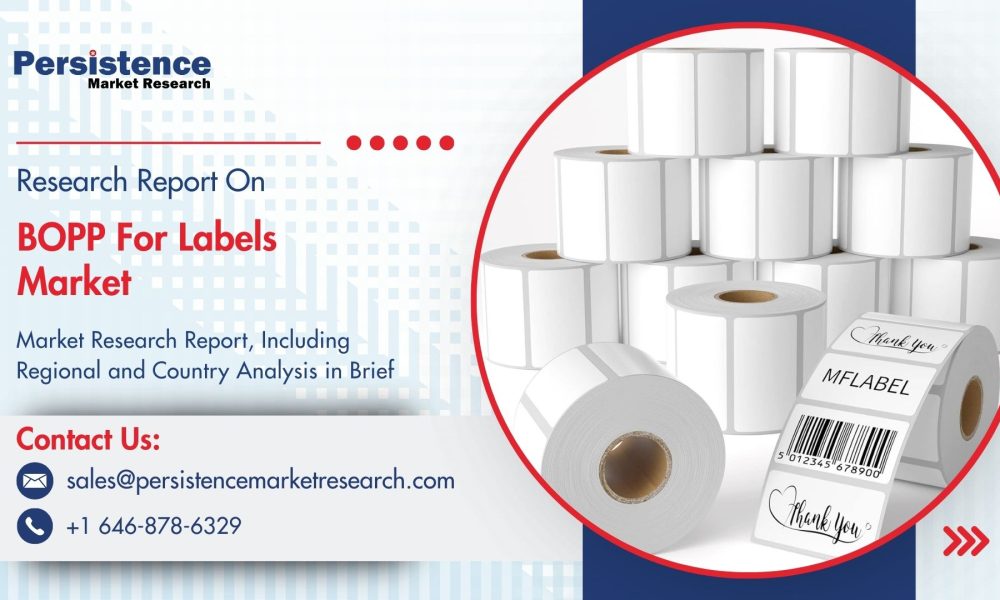
Market Overview
The global BOPP (Biaxially Oriented Polypropylene) for labels market is witnessing robust expansion as consumer goods, food and beverages, pharmaceuticals, and personal care industries increasingly adopt cost-efficient, durable, and visually appealing labeling solutions. According to the latest study by Persistence Market Research, the BOPP For Labels market generated revenue of US$ 20.6 billion in 2025 and is projected to top a valuation of US$ 31.2 billion by 2032, advancing at a CAGR of 6.1% during the forecast period. This growth highlights the rising demand for versatile labeling materials that not only enhance product aesthetics but also support long shelf life, brand visibility, and regulatory compliance.
BOPP films are widely recognized for their high clarity, lightweight nature, resistance to moisture, and print-friendliness. These properties make them one of the most preferred substrates for pressure-sensitive and wrap-around labels across industries. Their compatibility with advanced printing technologies, recyclability, and cost-effectiveness add to their appeal, strengthening their position in the global labeling sector.
Get a Sample PDF Brochure of the Report (Use Corporate Email ID for a Quick Response): https://www.persistencemarketresearch.com/samples/31507
Key Market Drivers
One of the primary drivers boosting the BOPP for labels market is the growing demand from the food and beverage industry, which accounts for the largest share of label applications. With an increasing focus on product differentiation, food and beverage manufacturers are investing in high-quality labels that ensure brand visibility and consumer trust. The superior barrier properties of BOPP labels against moisture and chemicals also make them ideal for packaging perishable and liquid-based products.
The rising pharmaceutical and healthcare industries are further fueling demand, as clear, durable, and tamper-proof labels are essential for regulatory compliance and patient safety. The personal care and cosmetics sector also contributes significantly, with BOPP labels being used to enhance product attractiveness on retail shelves. Moreover, the rapid growth of e-commerce is creating additional demand for reliable labeling materials that can withstand varying shipping and handling conditions.
Another key factor driving market expansion is the global trend toward sustainable packaging solutions. As brand owners and consumers increasingly prioritize recyclability and reduced environmental impact, BOPP films are gaining traction due to their compatibility with recycling systems and potential for downgauging without compromising performance. Advancements in film manufacturing technologies and printing processes, including digital and flexographic printing, further support innovation in label design and efficiency in production.
Market Challenges
Despite the promising outlook, the BOPP for labels market faces challenges that could impact growth. One of the main concerns is the fluctuation in raw material prices, particularly polypropylene, which directly influences the production cost of BOPP films. Price volatility can create uncertainty for manufacturers and affect profit margins.
Additionally, while BOPP is recyclable, the lack of standardized recycling infrastructure across many regions poses hurdles in achieving circular economy goals. This could potentially limit adoption in regions with stricter environmental regulations. Competition from alternative labeling materials such as PET and paper-based labels also presents a challenge, as these materials are sometimes preferred for specific sustainability or performance attributes.
Moreover, the need for consistent quality in printing and performance across various end-use industries requires continuous investment in advanced technology and quality control, which may increase operational costs for smaller manufacturers.
Market Opportunities
Amidst these challenges, several opportunities are emerging for stakeholders in the BOPP for labels market. Growing interest in premium packaging and product personalization presents scope for innovative label designs using BOPP films. Brands are increasingly leveraging labels not just for identification but also as marketing tools to engage consumers through vibrant colors, tactile finishes, and interactive elements such as QR codes.
Sustainability-driven innovation also opens new pathways for growth. The development of bio-based BOPP films and recyclable label-liner combinations could address environmental concerns and align with global sustainability initiatives. Additionally, expanding applications in non-food segments such as electronics, household care, and industrial goods are creating new market niches for BOPP labels.
Emerging economies in Asia-Pacific and Latin America provide fertile ground for growth, as rapid urbanization, rising disposable incomes, and evolving retail sectors fuel demand for packaged goods. Local manufacturers, with cost advantages, can also tap into regional demand by offering competitive solutions to global players.
Regional Insights
Geographically, Asia-Pacific dominates the global BOPP for labels market due to the presence of major packaging hubs, strong growth in food and beverage consumption, and rapid industrialization. China, India, and Southeast Asian countries are leading markets, benefiting from robust manufacturing bases and expanding consumer markets. Additionally, government support for modern packaging and labeling solutions in emerging economies further drives demand.
North America and Europe represent mature markets with high adoption of advanced labeling technologies. In these regions, strict regulations on labeling, sustainability initiatives, and consumer preference for premium packaging are shaping market trends. The U.S., Germany, the UK, and France remain key contributors.
Latin America and the Middle East & Africa are projected to see steady growth, driven by gradual industrial expansion and increasing focus on product branding. Growing investments in retail infrastructure and rising demand for packaged products in countries like Brazil, Mexico, and South Africa will contribute to regional market expansion.
For Customized Insights on Segments, Regions, or Competitors, Request Personalized Purchase Options @ https://www.persistencemarketresearch.com/request-customization/31507
Company Insights
The competitive landscape of the BOPP for labels market is moderately fragmented, with global players dominating production while regional manufacturers serve niche applications. Companies are increasingly focusing on expanding production capacity, investing in research and development, and forming strategic partnerships to strengthen their position. Sustainability and innovation in film technology remain central to their growth strategies.
✦ UPM Raflatac
✦ Avery Dennison Corporation
✦ CCL Industries Inc.
✦ Cosmo Films Limited
✦ Jindal Poly Films Limited
✦ Taghleef Industries
✦ Innovia Films
✦ Polinas Plastik Sanayi ve Ticaret A.S.
✦ Treofan Group
✦ Toray Plastics (America), Inc.
These companies are actively engaged in product innovation, offering BOPP films with enhanced printability, recyclability, and downgauging capabilities. Collaborations with brand owners and converters to develop customized labeling solutions are common strategies. Expanding into emerging markets and investing in eco-friendly film technologies are also key priorities for many leading players.
Future Outlook
The future of the BOPP for labels market looks promising, with sustained growth expected across end-use industries. Continued innovation in sustainable packaging, such as recyclable and bio-based BOPP films, will play a critical role in shaping the industry landscape. Digital printing advancements are also likely to revolutionize label customization and shorten production cycles, providing further impetus to market growth.
As brand owners increasingly view labels as a medium for storytelling and consumer engagement, the demand for versatile, durable, and aesthetically appealing label films will rise. With regulatory bodies pushing for sustainable packaging and circular economy practices, companies that invest in eco-friendly BOPP film solutions will gain a competitive edge.
Conclusion
In conclusion, the global BOPP for labels market is on a strong growth trajectory, set to expand from US$ 20.6 billion in 2025 to US$ 31.2 billion by 2032 at a CAGR of 6.1%. Driven by surging demand from the food and beverage, pharmaceutical, and personal care industries, along with the rising importance of sustainable and innovative labeling solutions, the market offers significant opportunities for manufacturers and stakeholders. While challenges such as raw material price volatility and recycling infrastructure gaps persist, proactive innovation and strategic expansion into emerging economies will ensure long-term growth. With evolving consumer preferences and rapid advancements in packaging technologies, BOPP labels are poised to remain a cornerstone of global labeling solutions in the years ahead.
Explore the Latest Trending Research Report:




