
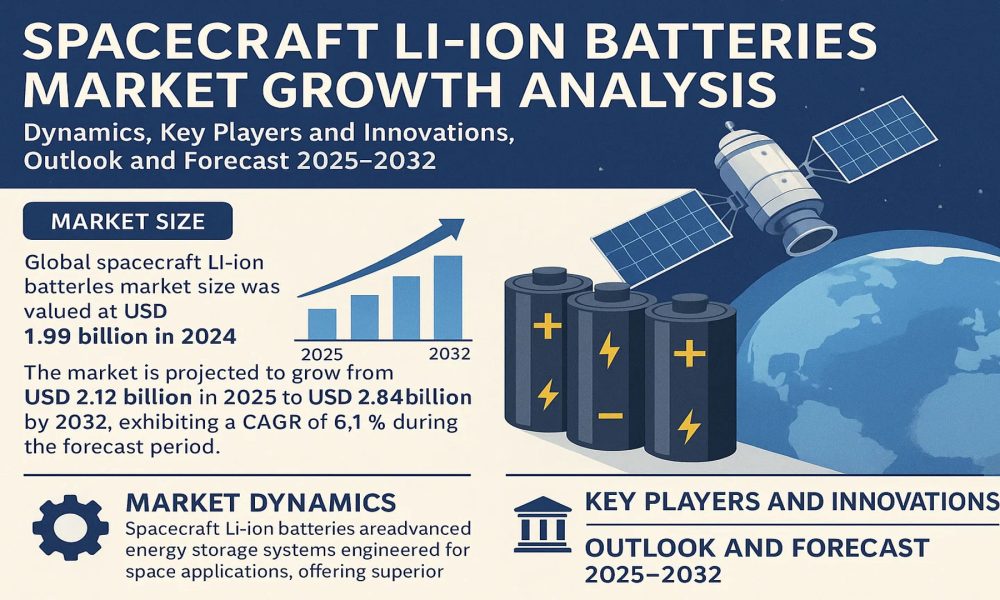
Spacecraft Li-ion Batteries Market size was valued at USD 1.99 billion in 2024. The market is projected to grow from USD 2.12 billion in 2025 to USD 2.84 billion by 2032, exhibiting a CAGR of 6.1% during the forecast period.
Spacecraft Li-ion batteries are advanced energy storage systems engineered for space applications, offering superior energy density, thermal stability, and radiation resistance compared to conventional batteries. These specialized power solutions are critical components in satellites, deep-space probes, and crewed spacecraft, where they must maintain performance in extreme vacuum conditions (-120°C to +60°C operational range) while withstanding launch vibrations up to 20G. The technology has evolved significantly since NASA’s first Li-ion battery deployment in 1999, with current systems achieving 5000+ charge cycles at 80% depth of discharge – a 300% improvement over early models.
Market growth is being propelled by increasing satellite deployments (over 2,200 active satellites as of 2024) and government investments in space programs, with NASA’s budget reaching USD 25.4 billion in 2024. However, supply chain challenges for aerospace-grade lithium and cobalt remain a constraint. Recent developments include GS Yuasa’s 2023 launch of radiation-hardened batteries for lunar missions and Saft’s collaboration with ESA on next-generation battery management systems. The competitive landscape features specialized players like EaglePicher and EnerSys controlling approximately 35% of the market collectively, while new entrants from China (Shanghai Institute of Space Power-Sources) are gaining traction with cost-competitive solutions.
Unlock Your Free Sample Report Here- https://www.intelmarketresearch.com/download-free-sample/6927/spacecraft-li-ion-batteries-market
MARKET DYNAMICS
MARKET DRIVERS
Growing Satellite Launches to Accelerate Demand for Spacecraft Li-ion Batteries
The global space industry is witnessing unprecedented growth, with satellite deployments increasing at a compound annual growth rate of over 15% since 2020. This surge is primarily driven by the expansion of communication networks and Earth observation systems. Modern satellites increasingly rely on high-performance Li-ion batteries to power their systems through eclipse periods and during peak load operations. The growing constellation deployments by private space companies are creating sustained demand for reliable energy storage solutions optimized for space environments. These batteries must maintain performance across thousands of charge-discharge cycles while withstanding extreme thermal and radiation conditions.
Advancements in Battery Technology Enhancing Space Mission Capabilities
Breakthroughs in Li-ion battery chemistry and design are enabling longer mission durations and more ambitious exploration programs. Recent innovations include silicon-anode batteries offering 30-40% higher energy density compared to conventional designs, addressing one of the most critical constraints in space systems. Novel thermal management systems have demonstrated the ability to maintain optimal operating temperatures in deep space environments where temperature variations can exceed 300°C. These technological improvements are particularly crucial for emerging deep space missions, where power systems must function reliably for decades without maintenance opportunities.
The development of radiation-hardened battery management systems represents another significant advancement, reducing the risk of single-event upsets from cosmic radiation. These systems incorporate redundant protection circuits and specialized shielding materials that mitigate space radiation effects while maintaining high power conversion efficiency.
MARKET OPPORTUNITIES
Emerging Lunar and Deep Space Exploration Programs Creating New Demand
Ambitious lunar exploration initiatives and planned Mars missions are driving demand for next-generation battery systems capable of operating in extreme environments. These programs require batteries that can withstand temperature extremes ranging from -150°C to +150°C while maintaining high reliability over mission durations extending 10-15 years. Recent developments in solid-state battery technology show promise for meeting these demanding requirements, with several space agencies funding advanced research programs in this area.
The emergence of lunar surface power systems presents another significant opportunity. Future lunar bases will require robust energy storage solutions capable of surviving the two-week lunar night while providing continuous power for critical systems. This application space is driving innovation in battery chemistries optimized for low-temperature operation and extended cycling performance.
Segment Analysis:
By Type
- Low to Medium Capacity Type
- High Capacity Batteries Type
High Capacity Batteries Type is witnessing rapid adoption due to increasing demand for extended mission durations and higher power requirements in deep-space probes and manned missions.
By Application
- Satellites
- Deep Space Probes
- Manned Spacecraft
- Others
Satellites dominate the application segment, fueled by the growing deployment of communication and earth observation satellites requiring reliable, long-lasting power solutions.
By End User
- Government Space Agencies
- Commercial Space Companies
- Defense & Military
- Research Institutions
Government Space Agencies remain the primary end users, investing heavily in space exploration programs and satellite deployment for national security and scientific research.
By Technology
- Lithium Cobalt Oxide (LCO)
- Lithium Iron Phosphate (LFP)
- Lithium Nickel Manganese Cobalt Oxide (NMC)
- Others
Lithium Nickel Manganese Cobalt Oxide (NMC) is gaining traction due to its balanced performance in energy density, thermal stability, and cycle life, making it ideal for demanding space applications.
List of Key Spacecraft Li-ion Battery Manufacturers:
- EnerSys (U.S.)
- Saft (France)
- GS Yuasa (Japan)
- EaglePicher Technologies (U.S.)
- AAC Clyde Space (UK/Sweden)
- Pumpkin Space Systems (U.S.)
- Mitsubishi Electric (Japan)
- L3Harris Technologies (U.S.)
- Hitachi Zosen Corporation (Japan)
- Space Vector Corporation (U.S.)
- Suzhou Everlight Space Technology (China)
- Shanghai Institute of Space Power-Sources (China)
Market consolidation is accelerating as traditional defense contractors acquire specialized battery technology providers. Recent examples include L3Harris’ acquisition of small satellite component manufacturers and Mitsubishi Electric’s technology partnerships with Japanese research institutions. These strategic moves aim to develop integrated power solutions that combine energy storage with next-generation power management systems.
Regional players are also gaining traction, particularly in China where companies like Suzhou Everlight Space Technology and Shanghai Institute of Space Power-Sources are developing competitive alternatives to Western products. Their growing capabilities position them strongly to support China’s ambitious space station and lunar exploration programs.
Rising Demand for High-Performance Power Solutions in Space Missions Drives Market Growth
The global spacecraft lithium-ion (Li-ion) battery market is witnessing significant growth, driven by increasing demand for reliable and high-performance power solutions in space applications. With the market valued at $1.985 billion in 2024 and projected to reach $2.838 billion by 2032, the industry is expanding at a CAGR of 6.1%. This growth is fueled by the expanding satellite industry, deep-space exploration missions, and the need for advanced energy storage solutions capable of withstanding extreme space conditions. Recent advancements in battery technologies, including higher energy densities exceeding 300 Wh/kg and improved thermal management systems, are making Li-ion batteries the preferred choice for spacecraft power systems.
Other Trends
Miniaturization of Satellites Requires Compact Power Solutions
The rise of small satellites and CubeSats has created demand for compact, lightweight Li-ion batteries with medium capacity. These smaller spacecraft require power systems that occupy minimal volume while delivering sufficient energy for communication, imaging, and scientific instruments. Manufacturers are responding with modular battery designs that offer flexible configurations to accommodate various mission requirements while complying with strict weight limitations. This trend is particularly prominent in low Earth orbit (LEO) satellite constellations, where hundreds to thousands of small satellites require reliable power systems.
Increasing Investments in Space Exploration Programs
Growing government and private sector investments in space exploration are accelerating innovation in spacecraft battery technologies. Major space agencies and commercial operators are funding research into batteries that can operate reliably in harsh space environments for extended durations. For example, next-generation Li-ion batteries are being developed with radiation-hardened components and extended cycle lives surpassing 50,000 charge-discharge cycles to meet the demands of long-duration missions. The commercial space sector, particularly companies developing satellite internet constellations, is emerging as a key driver of battery innovation and volume production.
Unlock Your Free Sample Report Here- https://www.intelmarketresearch.com/download-free-sample/6927/spacecraft-li-ion-batteries-market
Recent Developments in Spacecraft Li-ion Batteries Market
- Advancements in High-Energy Density Batteries
Leading battery manufacturers are developing next-generation lithium-ion batteries with higher energy density and longer life cycles. This includes innovations in electrode materials and solid-state electrolytes to improve efficiency and safety for long-duration space missions. - Collaboration Between Aerospace and Battery Companies
Companies like Tesla, Northrop Grumman, and Saft have been collaborating with space agencies (NASA, ESA) to supply customized Li-ion batteries for satellites, lunar rovers, and deep-space exploration vehicles. These partnerships aim to optimize power systems for extreme temperature and radiation conditions. - Miniaturization for Small Satellites (CubeSats and NanoSats)
With the rise of small satellites, there is a trend towards miniaturized, high-performance Li-ion batteries that are lightweight yet robust. This allows CubeSats to operate longer in orbit while reducing launch costs. - Integration of Battery Management Systems (BMS)
Advanced BMS are being integrated with spacecraft batteries to monitor and manage charge cycles, temperature, and voltage in real-time. This enhances safety, efficiency, and the overall lifespan of batteries used in space missions. - Sustainability and Recyclability Focus
Battery manufacturers are increasingly focusing on eco-friendly materials and recycling initiatives, aligning with global sustainability goals. Efforts include reducing the use of cobalt and improving the recyclability of Li-ion cells after mission completion. - Government and Private Sector Investments
Governments and private space companies are investing heavily in research to improve the performance and safety of Li-ion batteries for spacecraft. Funding is supporting projects for manned space missions, Mars exploration, and orbital satellite constellations.
About Intel Market Research
Intel Market Research delivers actionable insights in technology and infrastructure markets. Our data-driven analysis leverages:
- Real-time infrastructure monitoring
- Techno-economic feasibility studies
Competitive intelligence across 100+ countries
Trusted by Fortune 500 firms, we empower strategic decisions with precision.
International: +1(332) 2424 294 | Asia: +91 9169164321
Website: https://www.intelmarketresearch.com
Follow us on LinkedIn: https://www.linkedin.com/company/intel-market-research
Market Research Reports | Market Trends | SWOT Analysis | Industrial Survey – Intelmarketresearch
Intel market research provides market research reports and company research reports across worldwide industries. We also offers customized market research solutions




