
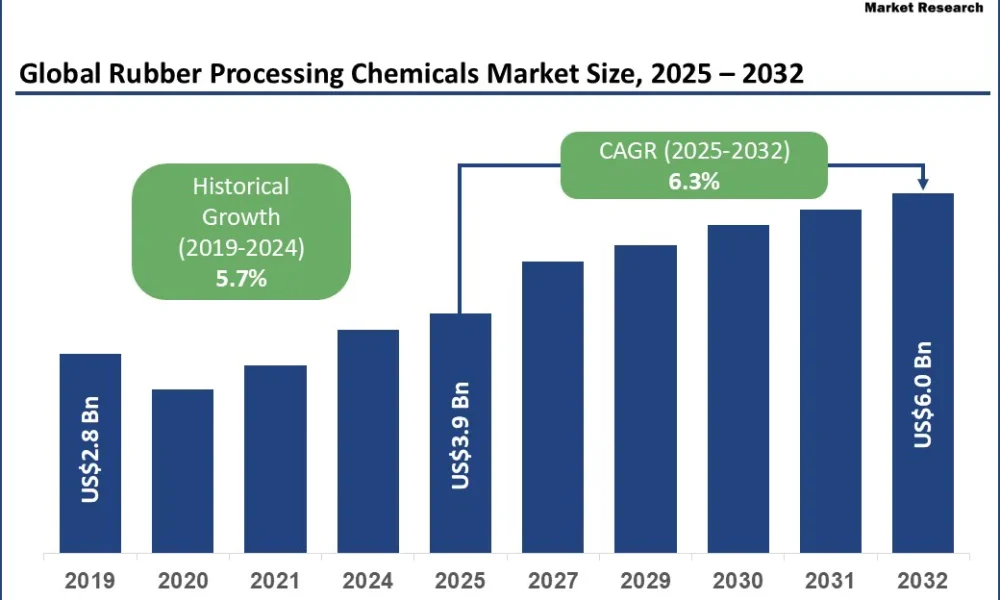
The rubber processing chemicals market plays a vital role in enhancing the performance, durability, and sustainability of rubber products. These chemicals are extensively used in tire manufacturing, automotive components, industrial products, and construction materials. They improve heat resistance, elasticity, weatherability, and aging properties, making them indispensable in modern industries. According to the latest study by Persistence Market Research, the market size is projected to grow from US$3.9 Bn in 2025 to US$6.0 Bn by 2032, expanding at a CAGR of 6.3% during the forecast period. Growth is mainly fueled by the rising demand for high-performance tires and the global transition toward electric vehicles (EVs) that require advanced rubber solutions for battery insulation and lightweight components.
Market expansion is further supported by applications in the construction sector, where rubber-based materials are used for waterproofing, flooring, and sealing. Among the product categories, antidegradants emerge as the leading segment, as they extend the life of rubber products by protecting them against ozone, heat, and oxidation. Geographically, Asia Pacific dominates the global market, attributed to its strong automotive industry, expanding EV production, and large-scale infrastructure projects. Countries like China, India, and Japan are central to this dominance due to their robust tire manufacturing base and rising industrialization.
Request a Sample: https://www.persistencemarketresearch.com/samples/21595
Key Market Insights
• The market is projected to expand from US$3.9 Bn in 2025 to US$6.0 Bn by 2032 at a CAGR of 6.3%.
• Antidegradants remain the leading product type due to their critical role in extending rubber product lifespan.
• Asia Pacific dominates the market, supported by automotive and construction industry growth.
• Rising demand for eco-friendly and non-toxic processing chemicals is shaping product innovation.
• Electric vehicles are creating new demand for heat-resistant and lightweight rubber components.
What are the main drivers of the rubber processing chemicals market?
The primary drivers of the rubber processing chemicals market include the rising demand for high-performance tires, the shift toward electric vehicles (EVs), and the expansion of construction activities worldwide. High-performance tires require chemicals that improve grip, reduce wear, and enhance fuel efficiency. The EV transition demands lightweight, durable rubber for battery components and seals. Additionally, infrastructure growth in developing economies boosts demand for rubber products in waterproofing, flooring, and adhesives. Environmental regulations are also prompting innovation in sustainable and eco-friendly rubber chemicals, further shaping market growth opportunities.
Market Dynamics
Drivers: The market is driven by surging demand for automotive tires, particularly those designed for EVs, as well as infrastructure development. The growing focus on sustainability is also pushing manufacturers to develop low-toxicity, eco-friendly chemicals.
Market Restraining Factor: Stringent environmental regulations regarding toxic chemical emissions and high production costs associated with advanced formulations are significant restraints. Volatility in raw material prices also poses challenges to market stability.
Key Market Opportunity: The development of bio-based rubber processing chemicals offers a major opportunity. Companies investing in green chemistry solutions can gain competitive advantage while meeting regulatory compliance and consumer demand for sustainable products.
Market Segmentation
The rubber processing chemicals market can be segmented by product type and application. By product type, the market includes antidegradants, accelerators, processing aids, and others. Among these, antidegradants dominate due to their essential role in improving resistance against ozone, UV light, and oxidation, which directly enhances tire performance and lifespan. Accelerators also play a critical role in speeding up the vulcanization process, thereby improving the efficiency of manufacturing operations. Processing aids are gaining attention as they reduce energy consumption and improve the dispersion of fillers in rubber compounds, adding to operational efficiency.
By application, the market is categorized into tires, non-tire automotive products, industrial products, and construction materials. Tires account for the largest market share, as they represent the most significant use of rubber globally. The growing demand for high-performance tires in passenger and commercial vehicles, coupled with EV adoption, continues to expand this segment. Non-tire automotive products such as hoses, gaskets, and seals are another key area, benefiting from increased vehicle production and technological advancements. Industrial applications, including belts, gloves, and footwear, as well as construction uses in waterproofing and flooring, are also expected to grow steadily during the forecast period.
Regional Insights
Asia Pacific remains the largest and fastest-growing region, driven by its strong automotive sector, expanding EV market, and increasing construction projects. China dominates tire manufacturing, while India’s booming infrastructure projects also contribute to market growth. North America follows, supported by demand for high-performance tires, EV production, and strict regulatory standards encouraging advanced formulations. Europe is another significant region, benefiting from innovation in eco-friendly chemicals and a focus on sustainable mobility solutions. Meanwhile, Latin America and the Middle East & Africa are emerging regions, where expanding automotive industries and urbanization are creating new growth opportunities.
Request a Customization: https://www.persistencemarketresearch.com/request-customization/21595
Competitive Landscape
The rubber processing chemicals market is competitive, with players investing in product innovation, sustainable solutions, and regional expansion to strengthen their market positions.
Company Insights
✦ Lanxess AG
✦ Eastman Chemical Company
✦ Solvay S.A.
✦ Kumho Petrochemical Co., Ltd.
✦ Arkema Group
✦ NOCIL Limited
✦ Sumitomo Chemical Co., Ltd.
✦ BASF SE
✦ Merchem Limited
✦ Shikoku Chemicals Corporation
Key Industry Developments
In recent years, several players have focused on sustainability initiatives by investing in the development of eco-friendly processing chemicals. Companies are reducing the use of harmful aromatic amines and adopting green chemistry practices to meet stringent environmental regulations. For instance, Lanxess has been actively developing solutions with reduced environmental footprints, aligning with global sustainability goals.
Collaborations and acquisitions are also shaping the competitive landscape. Leading players are forming alliances with tire manufacturers to ensure consistent demand for specialized chemicals. Expanding production facilities in Asia Pacific to cater to regional demand has become a common trend, with companies like Kumho Petrochemical and BASF strengthening their footprint in the region.
Innovation and Future Trends
The future of the rubber processing chemicals market lies in bio-based formulations and digital manufacturing integration. Manufacturers are exploring renewable sources for chemical production to reduce dependency on petrochemicals. This not only helps meet environmental regulations but also creates differentiation in a competitive market.
Additionally, the adoption of smart manufacturing technologies such as AI-driven process optimization and advanced quality monitoring is expected to revolutionize production. Future trends also include the development of next-generation accelerators and antidegradants designed for EV tires, which must balance durability, safety, and lightweight performance. This innovation-driven outlook positions the market for robust long-term growth.




