
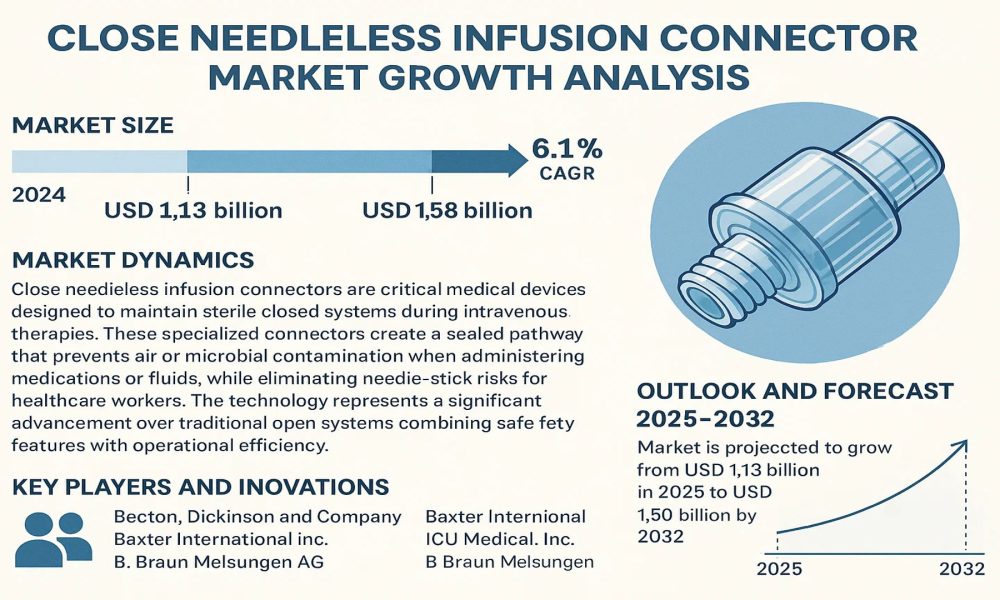
Close Needleless Infusion Connector Market size was valued at USD 1.05 billion in 2024. The market is projected to grow from USD 1.13 billion in 2025 to USD 1.58 billion by 2032, exhibiting a CAGR of 6.1% during the forecast period.
Close needleless infusion connectors are critical medical devices designed to maintain sterile closed systems during intravenous therapies. These specialized connectors create a sealed pathway that prevents air or microbial contamination when administering medications or fluids, while eliminating needle-stick risks for healthcare workers. The technology represents a significant advancement over traditional open systems by combining safety features with operational efficiency.
Market growth is driven by increasing healthcare-acquired infection concerns, rising demand for safer IV administration systems, and expanding outpatient treatment needs. The COVID-19 pandemic accelerated adoption as hospitals prioritized contamination prevention. However, higher costs compared to conventional systems and the need for staff training present adoption barriers, particularly in developing regions. Leading manufacturers are addressing these challenges through product innovations and educational initiatives.
Access Your Free Sample Report Now- https://www.intelmarketresearch.com/download-free-sample/4360/close-needleless-infusion-connector-2025-2032-314
MARKET DYNAMICS
MARKET DRIVERS
Rising Prevalence of Hospital-Acquired Infections to Fuel Market Expansion
The increasing incidence of hospital-acquired infections (HAIs) is a significant factor propelling the closed needleless infusion connector market forward. Healthcare facilities globally are witnessing approximately 7-10% of hospitalized patients acquiring infections during their stay annually. These infections not only extend hospital stays by an average of 7-10 days but also significantly increase healthcare costs. Since catheter-related bloodstream infections account for a substantial portion of HAIs, healthcare providers are actively adopting closed needleless connectors as a preventive measure. The technology’s ability to maintain sterility throughout intravenous therapy makes it a critical component in infection control protocols across hospitals worldwide.
Growing Adoption of Home Healthcare Services to Accelerate Demand
Home healthcare services are experiencing rapid growth, with projections indicating a 7-9% annual increase in adoption rates. This surge is creating substantial demand for safe and easy-to-use infusion solutions like closed needleless connectors. As more patients receive long-term therapies such as antibiotics, chemotherapy, and parenteral nutrition at home, the need for devices that minimize infection risks without requiring specialized medical training becomes paramount. Closed needleless connectors not only reduce complications but also decrease healthcare facility visits, leading to estimated cost savings of 15-20% for payers and providers. The convenience and safety advantages make these devices ideal for the expanding home healthcare sector.
Stringent Regulations Promoting Needle Safety to Drive Market Growth
Regulatory bodies worldwide are implementing increasingly strict guidelines to enhance healthcare worker safety, particularly concerning needle-stick injuries which affect an estimated 3 million healthcare professionals annually. Closed needleless infusion connectors address these concerns by completely eliminating needle exposure during IV therapy management. Recent updates to occupational safety standards have made needle-free systems mandatory in many healthcare settings, with compliance rates improving by 25-30% over the past five years. These regulatory changes are compelling healthcare facilities to upgrade their infusion systems, directly benefiting the closed needleless connector market.
MARKET OPPORTUNITIES
Technological Advancements in Connector Design to Create Growth Prospects
The closed needleless infusion connector market stands to benefit significantly from ongoing technological innovations. Recent developments include antimicrobial-coated connectors that demonstrate 70-80% reduction in microbial colonization rates, and smart connectors with integrated pressure sensors that alert clinicians to potential complications. Manufacturers investing in these advanced iterations can capture premium market segments, with projections indicating 20-25% higher margins compared to conventional products. The integration of IoT capabilities for remote monitoring represents another promising avenue, projected to grow at 15-18% annually as healthcare systems increasingly embrace digital solutions.
Expansion in Emerging Markets to Offer Substantial Growth Potential
Emerging economies present significant growth opportunities as healthcare infrastructure improves and infection prevention becomes a priority. Many developing countries are allocating 25-30% more funds annually for medical device upgrades, with closed needleless connectors identified as a key procurement item. Local manufacturers entering these markets benefit from lower production costs and regional preferences, while global players can leverage partnerships with local distributors. Market penetration rates in these regions, currently at 15-20% of developed markets, are projected to double within the next five years as awareness grows and healthcare standards evolve.
Segment Analysis:
By Type
Positive Pressure Connector Segment Holds Largest Market Share Due to Superior Infection Prevention Capabilities
The market is segmented based on type into:
- Positive Pressure Connector
- Subtypes: Mechanical valve, Luer-activated design, and others
- Negative Pressure Connector
- Balance Pressure Connector
- Others
By Application
Hospital Segment Leads Market Adoption Due to High Patient Volume and Stringent Safety Requirements
The market is segmented based on application into:
- Hospital
- Sub-segments: ICU, Oncology, Emergency departments, and others
- Clinic
- Ambulatory Surgical Centers
- Home Healthcare
By Material
Plastic Segment Dominates Owing to Cost-effectiveness and Compatibility with Infusion Systems
The market is segmented based on material into:
- Plastic
- Subtypes: Polycarbonate, Polypropylene, and others
- Stainless Steel
- Others
By End User
Adult Patients Segment Accounts for Major Revenue Share Due to Higher Incidence of Chronic Diseases
The market is segmented based on end user into:
- Adult Patients
- Pediatric Patients
- Geriatric Patients
List of Key Close Needleless Infusion Connector Companies
- BD (Becton, Dickinson and Company) (U.S.)
- B. Braun (Germany)
- ICU Medical (U.S.)
- Terumo Medical (Japan)
- Vygon (France)
- Henan Tuoren Best Medical Device (China)
- Guangdong Baihe Medical Technology (China)
- Weigao Group (China)
- JiangXi HuaLi Medical (China)
- Shenzhen Antmed (China)
CLOSE NEEDLELESS INFUSION CONNECTOR MARKET TRENDS
Growing Emphasis on Infection Prevention to Drive Demand for Closed Systems
The global healthcare sector’s increasing focus on infection control and patient safety is significantly boosting adoption of closed needleless infusion connectors. These devices reduce bloodstream infection rates by an estimated 35-50% compared to traditional needle systems, making them particularly valuable in critical care settings. Recent advances in connector designs now incorporate antimicrobial materials and enhanced sealing mechanisms, further minimizing contamination risks. Major healthcare providers are prioritizing these systems in their procurement strategies, with over 65% of US hospitals having transitioned to needle-free solutions for central line maintenance.
Other Trends
Technological Integration in Connector Designs
Manufacturers are developing smart connectors with integrated pressure monitoring and usage tracking capabilities. These innovations help healthcare teams monitor infusion patterns and detect potential complications earlier. The latest generation of connectors also features color-coded components and tactile indicators to reduce medication errors, addressing one of the most common challenges in IV therapy administration. While these advanced features currently represent about 15-20% of the market, their adoption is projected to double within the next five years as hospitals seek to optimize medication safety protocols.
Expansion in Chronic Disease Management
The rising prevalence of chronic conditions requiring long-term IV therapy, including cancer and autoimmune diseases, is creating sustained demand for reliable infusion systems. Closed needleless connectors are particularly valuable for home healthcare settings, where they reduce both infection risks and needlestick injuries for caregivers. Market data indicates that the home infusion segment now accounts for approximately 25% of total connector sales, with growth rates exceeding the overall market average. This trend aligns with broader healthcare shifts toward decentralized care models and value-based reimbursement structures emphasizing patient outcomes.
Access Your Free Sample Report Now- https://www.intelmarketresearch.com/download-free-sample/4360/close-needleless-infusion-connector-2025-2032-314
Recent Developments in the Close Needleless Infusion Connector Market
- Enhanced Design Innovations: Manufacturers are focusing on developing closed-system connectors with improved flow rates, reduced blood reflux, and effective antimicrobial barriers to minimize infection risks.
- Antimicrobial Coating Integration: Several companies are introducing connectors with antimicrobial surface technologies, such as silver ion coatings, to combat catheter-related bloodstream infections (CRBSIs).
- Regulatory Approvals & Standards: Increasing FDA approvals and adherence to ISO 80369 standards for small-bore connectors are driving safer product launches. Compliance with infection prevention protocols is a key development.
- Strategic Partnerships: Major players are entering into collaborations with healthcare providers to co-develop customized infusion solutions, enhancing compatibility with different IV therapy systems.
- Sustainability Focus: Companies are also working on BPA-free and DEHP-free materials to align with eco-friendly healthcare initiatives.
- Market Expansion: Leading firms are expanding their presence in Asia-Pacific and Latin America due to the rising demand for advanced infusion therapy devices in developing healthcare infrastructures.
About Intel Market Research
Intel Market Research delivers actionable insights in technology and infrastructure markets. Our data-driven analysis leverages:
- Real-time infrastructure monitoring
- Techno-economic feasibility studies
Competitive intelligence across 100+ countries
Trusted by Fortune 500 firms, we empower strategic decisions with precision.
International: +1(332) 2424 294 | Asia: +91 9169164321
Website: https://www.intelmarketresearch.com
Follow us on LinkedIn:https://www.linkedin.com/company/intel-market-research




