
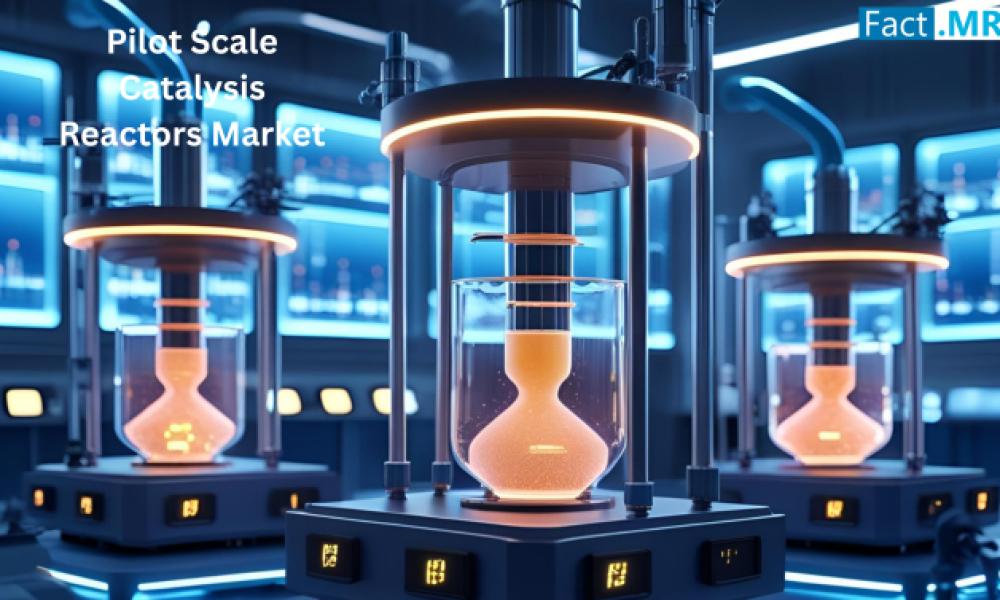
The global pilot-scale catalysis reactors market is projected to grow from USD 575 million in 2025 to USD 954.6 million by 2035, registering a CAGR of 5.2% over the forecast period. This growth is driven by the rising demand for sustainable chemical processes, the increasing production of specialty and fine chemicals, and stronger academic–industry collaborations.
Pilot-scale catalysis reactors play a pivotal role in enabling precise screening of green catalytic reactions, which supports the upscaling of processes in high-value sectors such as pharmaceuticals and agrochemicals. They are extensively used in collaborative R&D initiatives for catalyst testing and process scale-up, ensuring a seamless transition from laboratory research to industrial production.
Full Market Report available for delivery. For purchase or customization, please request here – https://www.factmr.com/connectus/sample?flag=S&rep_id=10866
What are the key drivers of the pilot-scale catalysis reactors market?
The pilot-scale catalysis reactors market is gaining momentum as the demand for sustainable chemical processing intensifies. Industries such as pharmaceuticals, petrochemicals, and specialty chemicals are facing increasing pressure to minimize their environmental footprint. In this context, pilot-scale reactors have become vital for conducting test runs of cleaner, more efficient catalytic reactions.
These reactors offer a controlled platform for experimenting with new formulations, optimizing reaction pathways, and significantly reducing waste generation. Their ability to replicate real-world production conditions on a smaller scale enables industries to refine processes before scaling up, thereby saving resources and ensuring compliance with environmental standards.
Furthermore, the push for eco-friendly and resource-efficient business practices is accelerating, driven by stricter government regulations on emissions and industrial effluents. As regulatory frameworks tighten worldwide, the need for innovative tools like pilot-scale catalysis reactors—capable of supporting green chemistry initiatives—continues to grow. This combination of environmental responsibility, cost efficiency, and process optimization is expected to remain a major growth driver for the industry in the years ahead.
What are the regional trends in the pilot-scale catalysis reactors market?
In North America, the pilot-scale catalysis reactors market is well-established, supported by a robust industrial base and a strong R&D ecosystem across sectors such as chemicals and pharmaceuticals. This mature infrastructure enables rapid adoption of advanced reactor technologies for process validation, optimization, and scale-up, fostering innovation in sustainable manufacturing.
In Europe, uptake is driven by stringent environmental and safety regulations combined with a strong commitment to sustainability. Policies promoting innovation and cross-industry collaboration have encouraged countries like Germany, France, and the UK to integrate efficient pilot reactors into chemical process development, ensuring compliance while enhancing productivity.
The Asia-Pacific region—particularly China, India, Japan, and South Korea—is experiencing rapid growth in adoption. Factors such as accelerated industrialization, rising demand for chemicals and consumer goods, and consistent investment in advanced manufacturing technologies are propelling the market forward. The region is emerging as a global hotspot for pilot-scale reactor development, with a growing focus on bridging the gap between laboratory research and commercial production.
Competitive Analysis
To stay competitive in the pilot-scale catalysis reactors market, companies need to offer platform-flexible reactor systems, integrated process simulation services, and proprietary catalyst integration platforms. Differentiation lies in providing scalable, configurable designs aligned with evolving catalyst R&D and process validation needs.
Competition among leading manufacturers centers on delivering versatile reaction environments—gas-solid, gas-liquid, and multiphase—supported by IoT-enabled flow, pressure, and heat control systems. Market leaders are investing in AI-driven kinetic profiling, digital twins, and advanced process modeling labs to accelerate development cycles and improve industrial scalability.
Key players include Büchi AG, Applied Catalysts Inc., Micromeritics, Vinci Technologies, INFRA Synthetic Fuels, and others.
Recent Developments:
- June 2025: SHARP partners with Sparc Hydrogen to advance patented PWS reactor technology, enabling global catalyst evaluation and boosting solar hydrogen commercialization.
- December 2024: BASF opens a new Catalyst Development and Solids Processing Center in Ludwigshafen, enhancing pilot-scale catalyst synthesis and speeding technology delivery to global customers.
Segmentation of Pilot-Scale Catalysis Reactors Market
- By Reactor Type :
- Batch Catalytic Reactors
- Continuous‑flow Catalytic Reactors
- Semi‑batch Catalytic Reactors
- By Application :
- Chemical Synthesis / Specialty Chemicals
- Pharmaceutical R&D / Drug Synthesis
- Biofuels & Green Energy
- Environmental Catalysis
- Others (Materials, food processing)
- By Material :
- Glass
- Stainless Steel
- Alloy materials or specialized constructions
- By Catalyst Type :
- Heterogeneous Catalysts
- Homogeneous Catalysts
- Nanostructured / Advanced Catalysts & Supports
- By Region :
- North America
- Latin America
- Western Europe
- Eastern Europe
- East Asia
- South Asia & Pacific
- Middle East & Africa
Check out More Related Studies Published by Fact.MR:
Chillers Market
https://www.factmr.com/report/554/chillers-market
Top Dresser Market
https://www.factmr.com/report/555/top-dresser-market
Contact:
11140 Rockville Pike
Suite 400
Rockville, MD 20852
United States
Tel: +1 (628) 251-1583
Email: [email protected]



