
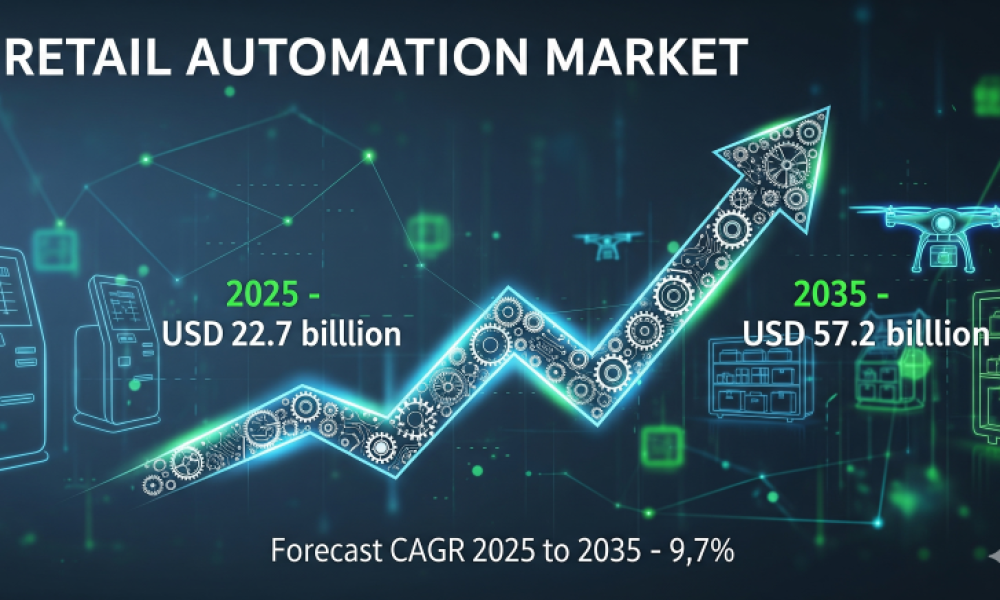
The global retail automation market, valued at USD 22.7 billion in 2025, is expected to grow significantly over the next decade. Projections indicate that it will reach USD 57.2 billion by 2035, reflecting a compound annual growth rate (CAGR) of 9.7% during the forecast period. This impressive growth can be attributed to the growing demand for operational efficiency, enhanced customer experiences, and the adoption of emerging technologies such as artificial intelligence (AI) and cloud-based solutions.
Unlock detailed analytics – Request your personalized report now! https://www.futuremarketinsights.com/reports/sample/rep-gb-5017
Market Drivers and Trends
Retailers around the world are increasingly adopting automation solutions to streamline operations, reduce costs, and offer better customer experiences. The ongoing shift toward omnichannel retailing, which blends digital and physical shopping experiences, has been a significant driver of this growth. Retail chains are deploying automated point-of-sale (POS) systems, self-checkout kiosks, and robotic systems to speed up transactions, minimize human error, and improve inventory management.
The rise in cloud-based POS systems has made it easier for retailers to manage transactions remotely, enhancing data accessibility and operational flexibility. Industry 4.0 technologies, including robotics and AI, are becoming key enablers, driving automation in logistics and inventory tracking.
Segmental Breakdown
- Manned POS Terminals Lead the Market: The manned POS terminal segment is projected to maintain its dominance in 2025, contributing 46.8% of the market’s total revenue. Despite the rise of self-checkout solutions, manned POS terminals remain the preferred option due to their reliability and ability to handle complex transactions. Retailers appreciate the balance between human assistance and technological efficiency offered by these systems.
- The Organized Market Dominates: The organized retail market, which includes supermarkets, hypermarkets, and branded stores, is set to account for 61.4% of the retail automation market in 2025. This segment’s growth is driven by the need for standardized processes, better inventory management, and cost efficiency. The widespread expansion of organized retail chains, especially in emerging markets, is accelerating the adoption of automation technologies.
- FMCG Sector to Lead Industry Adoption: The fast-moving consumer goods (FMCG) industry is projected to hold 27.6% of the market share in 2025. FMCG retailers are adopting automation systems to improve transaction speed, reduce stockouts, and optimize supply chain operations. Real-time inventory monitoring and rapid product replenishment are critical in the high-volume, low-margin FMCG sector.
Regional Outlook
North America: A Hotspot for Automation Adoption
North America, particularly the United States, is expected to be a key growth region for the retail automation market, with a CAGR of over 9.9%. Major retailers, including Amazon and Walmart, are increasingly incorporating automation into their operations. The United States’ advanced retail infrastructure makes it a prime location for market expansion.
Asia-Pacific: Rising Demand for Automation in Emerging Markets
The Asia-Pacific region, especially countries like India and Japan, is witnessing a surge in retail automation adoption. In India, the rapid growth of e-commerce and government initiatives like the implementation of the Unified Payments Interface (UPI) are fueling demand for automation systems. Meanwhile, Japan’s labor shortage is driving automation adoption in convenience stores, making it an important market for growth.
United Kingdom: Adoption Accelerated by COVID-19
The UK retail automation market is expanding due to the rising demand for contactless payment solutions, enhanced customer experiences, and operational efficiency. The pandemic has accelerated the adoption of automation technologies, with many retailers shifting towards self-checkout systems and automated inventory management to meet consumer expectations for speed and convenience.
Download Brochure for Full Insights: https://www.futuremarketinsights.com/reports/brochure/rep-gb-5017
Competitive Landscape
The retail automation market is highly competitive, with several key players leading the charge. Datalogic S.p.A, NCR Corporation, Honeywell International Inc., KUKA AG, and Zebra Technologies Corporation are among the top companies driving innovation in the sector. These companies are focusing on product development, acquisitions, and partnerships to strengthen their positions in the market.
In January 2024, NCR Corporation acquired Freshop, enhancing its retail e-commerce capabilities and enabling seamless integration with POS systems. Similarly, Toshiba Corporation launched its ELERA unified commerce platform, designed to enhance the customer shopping experience and streamline operations.
About Future Market Insights (FMI)
Future Market Insights, Inc. (ESOMAR certified, recipient of the Stevie Award, and a member of the Greater New York Chamber of Commerce) offers profound insights into the driving factors that are boosting demand in the market. FMI stands as the leading global provider of market intelligence, advisory services, consulting, and events for the Packaging, Food and Beverage, Consumer Technology, Healthcare, Industrial, and Chemicals markets. With a vast team of over 400 analysts worldwide, FMI provides global, regional, and local expertise on diverse domains and industry trends across more than 110 countries.



