
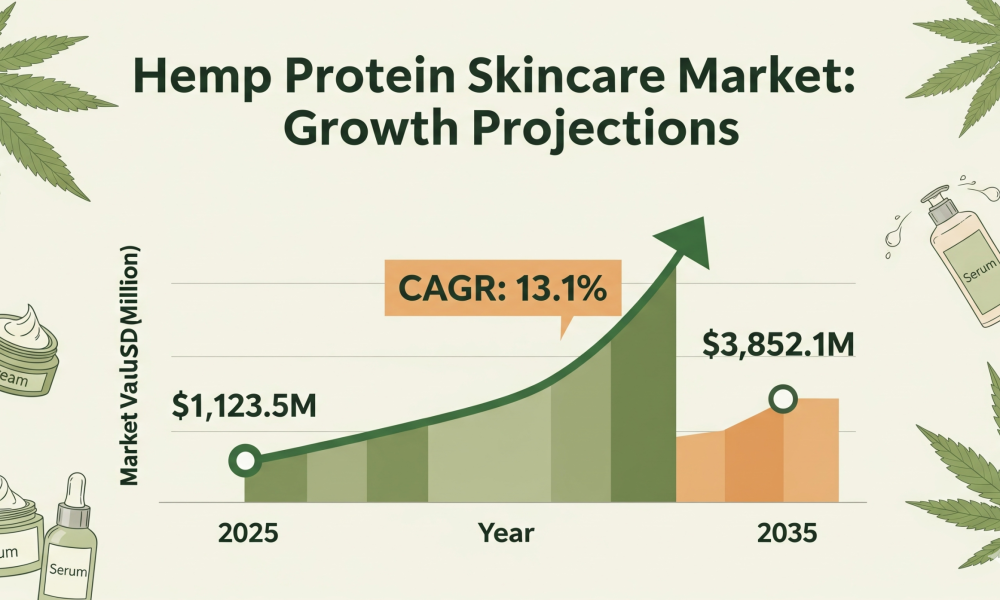
The Hemp Protein Skincare Market is poised for remarkable expansion over the next decade, reflecting an expected growth from USD 1,123.5 million in 2025 to USD 3,852.1 million by 2035. This represents an increase of USD 2,728.6 million, translating into a 243% surge and a CAGR of 13.1%. The growth underscores a global shift toward plant-based, sustainable, and ethically sourced skincare solutions, with hemp protein emerging as a core ingredient for moisturizing and anti-aging applications.
The first half of the decade, from 2025 to 2030, marks steady adoption, increasing the market by USD 956.8 million to reach USD 2,080.3 million. Creams and lotions dominate this period, accounting for over 50% of market share due to their absorbent textures ideal for delivering hemp protein’s moisturizing and barrier-repair benefits. Traditional heritage brands like The Body Shop and Hempz leveraged clean-label positioning, ethical sourcing, and affordability to build early consumer trust, while digital channels remained supportive rather than central to overall revenue.
Full Market Report available for delivery. For purchase or customization, please request here: https://www.futuremarketinsights.com/reports/sample/rep-gb-25200
From 2030 to 2035, market growth accelerates, adding USD 1,771.8 million as widespread adoption of clean-label and organic-certified hemp protein actives, AI-personalized skincare, and multi-functional anti-aging products take center stage. Serums, oils, and hybrid topical formats collectively capture nearly half of the market share by 2035. Digital innovations such as AI-powered diagnostics, AR/VR virtual trials, and subscription-based routines are reshaping consumer engagement and expanding the importance of online sales channels.
Key Market Drivers
Consumer preference for plant-based skincare that aligns with sustainability, health, and ethical sourcing is driving hemp protein adoption. Rich in amino acids and omega fatty acids, hemp protein provides anti-inflammatory and moisturizing benefits, positioning it as a safer alternative to synthetic chemicals. Millennials and Gen Z consumers are particularly drawn to clean-label, vegan, and organic-certified products due to increasing awareness of ingredient transparency and environmental sustainability.
The rise of multi-functional skincare solutions is also supporting market expansion. Hemp protein is being integrated into serums, barrier-repair oils, and anti-aging creams, offering hydration, elasticity, and barrier support in single formulations. Combined with AI-driven diagnostic tools and direct-to-consumer subscription models, hemp protein has moved from a niche additive to a core ingredient in personalized skincare routines.
Segmental Analysis
By Function: Moisturizing remains dominant, contributing 54.5% of market revenue in 2025. Its leadership is driven by the demand for hydration-focused skincare that strengthens the skin barrier and improves elasticity.
By Product Type: Creams and lotions hold a 50.5% market share in 2025 due to their ease of use, stable formulations, and compatibility across skin types. Innovation in texture, absorption speed, and incorporation of additional actives like peptides and ceramides further strengthens their position.
By Claim: Vegan-certified formulations account for 49.5% of the market in 2025, highlighting growing consumer interest in cruelty-free, ethical, and environmentally responsible skincare products.
Regional Insights
United States: Projected to grow from USD 228.87 million in 2025 to USD 755.09 million in 2035, driven by AI-personalized skincare, subscription-based models, and multi-functional formulations. Moisturizing remains the leading functional segment, with anti-aging and barrier-repair products gaining traction.
United Kingdom: Growth is fueled by consumer demand for vegan, clean-label, and ethically sourced formulations. Indie brands integrating hemp protein into minimalist, multi-functional moisturizers are driving expansion. Strong e-commerce infrastructure and AI-powered personalization tools support market growth.
India: The market is expected to grow at a CAGR of 23.1%, driven by Ayurveda-aligned plant-based skincare, rising disposable incomes, and urban millennial and Gen Z consumers. D2C startups and e-commerce platforms are rapidly scaling hemp protein skincare offerings.
China: Growth is among the fastest globally, supported by the C-beauty movement, social commerce platforms, and local innovation. Creams and lotions dominate, with oils, serums, and masks gaining traction among younger consumers.
Germany: Represents a mature market with steady growth, focusing on certified organic, eco-conscious, and dermatologically tested products distributed primarily through pharmacies and drugstores.
Japan: High growth at 16.6% CAGR driven by clinical skincare innovations and anti-aging formulations utilizing hemp protein.
Competitive Landscape
The market is moderately fragmented, combining global heritage brands, indie innovators, and niche specialists. The Body Shop leverages strong brand equity, ethical sourcing credentials, and retail networks to drive early adoption. Indie brands like Hempz, Herbivore Botanicals, The Inkey List, and Cannuka are innovating through vegan-certified, minimalist routines and influencer-led marketing. Specialist entrants such as Apothecanna, CBDfx, and Lord Jones focus on therapeutic applications, leveraging hemp protein’s anti-inflammatory properties and community-driven engagement.
The market is increasingly defined by ecosystem strength rather than brand legacy or ingredient lists alone. AI-powered personalization, sustainability storytelling, and subscription-based models are emerging as decisive factors in retaining consumer loyalty and driving recurring revenue.
Request Market Research Draft Report: https://www.futuremarketinsights.com/reports/brochure/rep-gb-25200
Market Trends
- Clean-Label & Plant-Based Formulations: Consumers demand transparency, ethical sourcing, and natural ingredients, driving both legacy and emerging brands to innovate in moisturizing, anti-aging, and barrier repair applications.
- E-Commerce & D2C Personalization: Digital platforms enable tailored routines through AI diagnostics and virtual consultations, particularly in North America and Asia-Pacific.
- Regulatory Ambiguity: Varying hemp-related regulations pose challenges for cross-border scalability, particularly affecting smaller players.
- Multi-Functional Skincare: Hemp protein is being incorporated into hybrid products that deliver hydration, anti-aging, and barrier repair in single formulations.
- Sustainability: Hemp’s low water requirements, CO₂ sequestration, and biodegradable properties enhance eco-conscious branding and consumer appeal.
About Future Market Insights (FMI)
Future Market Insights, Inc. (ESOMAR certified, recipient of the Stevie Award, and a member of the Greater New York Chamber of Commerce) offers profound insights into the driving factors that are boosting demand in the market. FMI stands as the leading global provider of market intelligence, advisory services, consulting, and events for the Packaging, Food and Beverage, Consumer Technology, Healthcare, Industrial, and Chemicals markets. With a vast team of over 400 analysts worldwide, FMI provides global, regional, and local expertise on diverse domains and industry trends across more than 110 countries.
Contact Us:
Future Market Insights Inc.
Christiana Corporate, 200 Continental Drive,
Suite 401, Newark, Delaware – 19713, USA
T: +1-347-918-3531
For Sales Enquiries: [email protected]



