
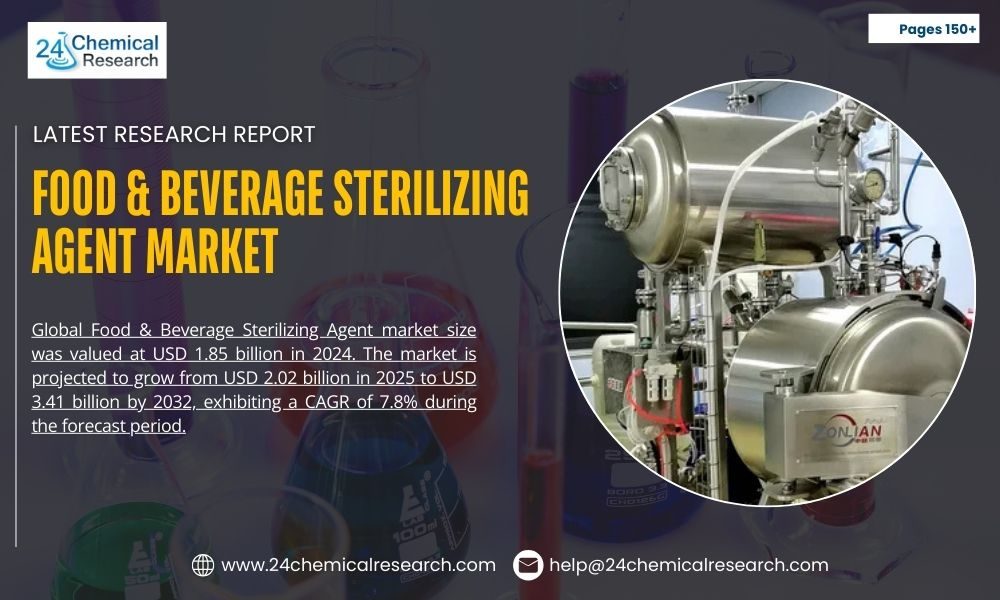
Global Market Analysis of Sterilizing Agents in the Food and Beverage Industry 2025
Global Food & Beverage Sterilizing Agent Market continues to gain momentum in response to heightened food safety regulations and increasing consumer awareness about microbial contamination. Valued at $1.2 billion in 2023, the market is projected to expand at a CAGR of 5.8% through 2030, reaching approximately $1.8 billion. This growth is driven by stringent hygiene standards in food processing and packaging, particularly in meat, dairy, and beverage sectors where sterilization prevents spoilage and extends shelf life.
Sterilizing agents like hydrogen peroxide and peracetic acid are becoming indispensable for manufacturers aiming to meet international safety benchmarks such as FDA and EFSA guidelines. The shift toward chemical sterilization over thermal methods owing to superior efficacy and minimal product alteration is further accelerating adoption. Emerging bio-based sterilants also show promise, aligning with the industry’s sustainability goals.
Download FREE Sample Report: https://www.24chemicalresearch.com/download-sample/226273/global-food-beverage-sterilizing-agent-forecast-market-2023-2029-167
Market Overview & Regional Analysis
North America leads with 35% market share, fueled by robust FDA oversight and high processed food consumption. Europe follows closely, where the EU’s biocidal products regulation (BPR) mandates rigorous sterilization protocols. However, Asia-Pacific is emerging as the fastest-growing region, with China and India scaling food export operations to comply with global safety standards. Latin America and Africa show nascent but steady growth, driven by urbanization and expanding food processing capacities.
Key Market Drivers and Opportunities
Demand is propelled by the rising incidence of foodborne illnesses, which cost the global economy $110 billion annually. Sterilizing agents effectively mitigate pathogens like Salmonella and E. coli, making them critical for brands safeguarding their reputations. The beverage sector, especially juices and dairy alternatives, represents a key opportunity, as thermal pasteurization can degrade nutritional content. Innovations like encapsulated hydrogen peroxide for controlled release in packaging are gaining traction.
Plant-based sterilants derived from thyme oil or citrus extracts are carving a niche in organic food production. Meanwhile, mergers among chemical manufacturers aim to consolidate expertise—Evonik’s acquisition of PeroxyChem in 2020 exemplifies strategic moves to capture this space.
Challenges & Restraints
Residual toxicity concerns and varying international regulations pose hurdles. For instance, China’s GB 2760 standards impose strict limits on peracetic acid residues—a challenge for exporters. Supply chain volatility, particularly for hydrogen peroxide feedstocks, also disrupts pricing. Smaller producers struggle with the high R&D costs of developing EPA/FDA-compliant formulations, leaving the market concentrated among top players.
Recent Developments
Peracetic Acid Market Growth & Innovation
- The peracetic acid market size was about USD 1.04 billion in 2024, and is forecast to reach ~USD 1.90 billion by 2033.
- Key drivers: its use in food safety, wastewater treatment, healthcare, and its more eco‑friendly profile compared to many chlorine‑based biocides.
- Innovation around formulation: there is increasing interest in buffered blends, stabilized aqueous solutions, lower concentration but safe forms (to ease transport/regulation), and better worker safety.
Regulatory Pressure & Replacement of Chlorine
- Because of concerns over chlorinated by‑products and environmental / health issues, there is a shift toward non‑chlorine sterilants (peracetic acid, hydrogen peroxide, ozone).
- Regulatory bodies (e.g. in EU, U.S.) are tightening rules on residues, disinfection by‑products, environmental safety, and approval processes.
Increased Demand from Emerging Markets & Asia‑Pacific
- Asia‑Pacific is among the fastest growing regions due to rising food processing volumes, growing middle classes, urbanization, improvements in cold chains, more packaged foods.
- Manufacturers are expanding production capacity in these regions and establishing local supply chains to reduce cost and comply with regional regulatory / trade barriers.
“Clean Label” / Consumer Preference & Natural Alternatives
- Consumers increasingly prefer foods with fewer synthetic preservatives. This is pushing adoption of “clean‑label” sterilizing agents or those with minimal residue, or natural / plant‑derived antimicrobial agents.
- Non‑thermal and non‑chemical sterilization techniques (UV, ozone, cold plasma, etc.) are gaining attention because they preserve organoleptic (taste, texture, smell) and nutritional qualities better.
Technological Advances
- More adoption of advanced sterilization processes: UV, ozone, high pressure processing (HPP), aseptic packaging.
- Research into cold plasma, low‑temperature plasmas, nanobubble ozone water (for example, generation of ozone water with nanobubbles that increase virucidal activity and half‑life) to improve effectiveness without damaging food items.
- Smart / active packaging that can release active antimicrobial compounds on demand or detect pathogens / spoilage and respond. Example: packaging with sensors + controlled release of antibacterial compounds, which can extend shelf life.
Market Segmentation by Type
- Hydrogen Peroxide
- Peracetic Acid
- Others (Chlorine Dioxide, Ozone)
Market Segmentation by Application
- Cereals & Pulses
- Meat & Poultry
- Beverages
- Dried Fruits & Vegetables
- Dairy Ingredients
- Others (Seafood, Prepared Foods)
Market Segmentation and Key Players
- Steris plc
- Solvay S.A.
- Evonik Industries
- Arkema S.A.
- AkzoNobel N.V.
- Jubilant Life Sciences
- Mitsubishi Gas Chemical
- Enviro Tech Chemical Services
Report Scope
This report provides a thorough analysis of the Food & Beverage Sterilizing Agent Market from 2023 to 2030, covering:
- Market size projections and historical data
- Type- and application-level demand trends
- Regulatory landscape across 20+ countries
- Impact of bio-based alternatives on conventional chemistries
Detailed company profiles include:
- Financial performance
- Product portfolios
- Geographical reach
- Recent developments (e.g., Arkema’s 2022 launch of high-purity peracetic acid)
Primary interviews with industry experts validated:
- Emerging sterilization technologies
- Barriers to entry in regulated markets
- Post-COVID demand shifts toward packaged foods
Get Full Report Here: https://www.24chemicalresearch.com/reports/226273/global-food-beverage-sterilizing-agent-forecast-market-2023-2029-167
Founded in 2015, 24chemicalresearch has rapidly established itself as a leader in chemical market intelligence, serving clients including over 30 Fortune 500 companies. We provide data-driven insights through rigorous research methodologies, addressing key industry factors such as government policy, emerging technologies, and competitive landscapes.
- Plant-level capacity tracking
- Real-time price monitoring
- Techno-economic feasibility studies
With a dedicated team of researchers possessing over a decade of experience, we focus on delivering actionable, timely, and high-quality reports to help clients achieve their strategic goals. Our mission is to be the most trusted resource for market insights in the chemical and materials industries.
International: +1(332) 2424 294 | Asia: +91 9169162030
Website: https://www.24chemicalresearch.com/




