
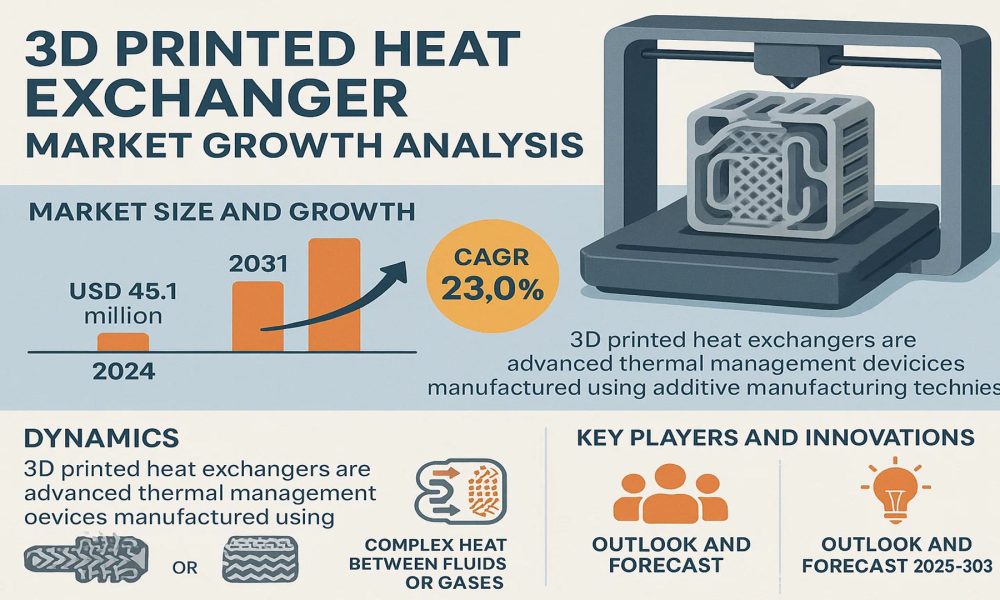
The Global 3D Printed Heat Exchanger Market was valued at USD 45.1 million in 2024 and is projected to reach USD 183 million by 2031, exhibiting a CAGR of 23.0% during the forecast period.
3D printed heat exchangers are advanced thermal management devices manufactured using additive manufacturing techniques. These components transfer heat between fluids or gases, optimizing energy efficiency in applications ranging from aerospace to automotive systems. Unlike traditional methods, 3D printing enables complex geometries such as microchannels and integrated structures that enhance thermal performance while reducing weight and material waste.
The market growth is driven by increasing demand for lightweight, high-efficiency heat exchangers in industries like aerospace, where fuel efficiency improvements are critical. Furthermore, advancements in additive manufacturing materials including high-performance polymers and metal alloys are expanding design possibilities and reducing production costs. Key players such as Conflux Technology and Sintavia are pioneering innovative solutions, while collaborations between material scientists and manufacturers continue to push the boundaries of thermal management technology.
Download Your Free Copy of the Sample Report- https://www.intelmarketresearch.com/download-free-sample/9668/d-printed-heat-exchanger-market
MARKET DYNAMICS
MARKET DRIVERS
Material Innovation Expands Applications of 3D Printed Heat Exchangers
Material innovation is revolutionizing the 3D printed heat exchanger industry, enabling the use of high-performance alternatives beyond traditional metals. While metals like aluminum and titanium alloys continue to dominate due to their superior thermal conductivity, advanced polymers and composite materials are gaining traction in applications where weight and corrosion resistance are priorities. Polymers enhanced with thermally conductive fillers like graphene can achieve up to 80% of metal performance while reducing weight by approximately 60%, making them ideal for aerospace and automotive applications. These innovative materials, combined with 3D printing’s geometric freedom, allow manufacturers to create heat exchangers with enhanced surface area and optimized fluid dynamics, significantly improving thermal efficiency.
Growing Demand for Compact Thermal Solutions in Aerospace and Defense
The aerospace and defense sector’s relentless pursuit of lightweight components has become a key driver for 3D printed heat exchanger adoption. Traditional heat exchangers often require complex assemblies of multiple parts, while 3D printing enables consolidated designs that reduce weight by 30-40% while improving thermal performance. In jet engines, for instance, 3D printed heat exchangers can be directly integrated into structural components, eliminating junctions and potential failure points. The defense sector particularly values the ability to create customized cooling solutions for sensitive electronics in constrained spaces, with some applications showing 25% better thermal performance compared to conventional designs.
Electric Vehicle Revolution Accelerates Market Growth
The global shift toward electric vehicles is creating significant opportunities for 3D printed heat exchangers in battery thermal management systems. EV manufacturers face unique thermal challenges, as battery packs require precise temperature control within tight space constraints. 3D printing enables the creation of compact, integrated cooling solutions that can reduce thermal resistance by up to 35% compared to conventional designs. With the EV market projected to grow at over 22% annually, the demand for advanced thermal management solutions is expected to fuel substantial growth in the 3D printed heat exchanger segment. Several major automotive OEMs have already begun integrating these solutions into their next-generation vehicle platforms.
MARKET OPPORTUNITIES
Industrial Energy Efficiency Mandates Create New Applications
Global initiatives to improve industrial energy efficiency are driving demand for advanced heat exchange solutions. 3D printed designs can achieve 15-20% better thermal performance than conventional units in some applications, translating to substantial energy savings in process industries. Regulatory pressures, combined with corporate sustainability goals, are prompting manufacturers to explore these advanced solutions despite higher upfront costs. Several pilot projects in chemical processing and power generation have demonstrated payback periods of under three years through energy savings alone, suggesting strong growth potential in industrial applications.
Emerging Markets Present Untapped Potential
Developing economies with growing manufacturing bases represent significant growth opportunities for 3D printed heat exchangers. These regions often lack established supply chains for conventional heat exchangers and can leapfrog directly to additive manufacturing solutions. The ability to produce complex designs locally reduces import dependence while meeting stringent environmental regulations that are increasingly adopted in these markets. Several Southeast Asian countries have already seen 30-40% annual growth in industrial 3D printing adoption, with heat exchangers representing a growing segment.
Aftermarket and Retrofit Solutions Offer Growth Potential
The installed base of conventional heat exchangers presents a substantial retrofit opportunity. Many industrial facilities operate with aging thermal systems where space constraints prevent like-for-like replacements. 3D printing enables the creation of compact, efficient replacements that fit existing footprints while improving performance. Some industry estimates suggest the global retrofit market for heat exchangers exceeds $8 billion annually, with additive manufacturing poised to capture a growing share as the technology matures and costs decline.
Segment Analysis:
By Type
- Plate Heat Exchanger
- Tube Heat Exchanger
Plate Heat Exchangers dominate due to their superior thermal efficiency and compact design, making them ideal for space-constrained applications.
By Material
- Metal
- Polymer
- Ceramic
- Graphene Composites
Metal-based heat exchangers remain prevalent due to their high thermal conductivity, though advanced materials like graphene composites are gaining traction for lightweight applications.
By Application
- Aerospace and Defense
- Automotive
- Energy
- Electronics
- Others
Aerospace and Defense leads the market, driven by demand for lightweight, high-performance thermal management solutions in critical applications.
- By Manufacturing Technology
- Powder Bed Fusion
- Binder Jetting
- Direct Energy Deposition
- Material Extrusion
Powder Bed Fusion is the most widely adopted technology owing to its ability to produce high-resolution, complex geometries with excellent material properties.
List of Key 3D Printed Heat Exchanger Companies Profiled
- Sintavia (U.S.)
- Conflux Technology (Australia)
- Unison Industries (GE Aerospace) (U.S.)
- Prima Additive (Italy)
- Mott Corporation (IDEX) (U.S.)
- Exergetica (Germany)
- PrintSky (AddUp) (France)
- Infinity Turbine LLC (U.S.)
- Renishaw (UK)
3D PRINTED HEAT EXCHANGER MARKET TRENDS
Material Innovation and Lightweight Design Transforming Market Dynamics
Material innovation is reshaping the 3D printed heat exchanger industry, unlocking new possibilities beyond traditional metal-based solutions. While metals like aluminum and titanium continue to dominate due to their superior thermal conductivity, there’s growing momentum behind polymer-based composites, ceramics, and graphene-enhanced materials. These alternatives offer compelling advantages, such as corrosion resistance and reduced weight critical for industries like aerospace and automotive. Recent developments show polymer heat exchangers with graphene additives achieving 30-40% higher thermal conductivity than conventional plastics while weighing 50-60% less than metal counterparts. The flexibility of 3D printing allows for geometric optimizations that maximize surface area, compensating for any limitations in base material properties. This trend is particularly evident in applications where weight savings outweigh extreme temperature demands, such as satellite thermal management systems and electric vehicle battery cooling.
Other Trends
Aerospace-Driven Demand for Complex Geometries
The aerospace sector accounts for over 35% of the 3D printed heat exchanger market by value, driven by the need for components that combine lightweight properties with intricate internal channel designs. Traditional manufacturing struggles to produce the lattice structures and microchannels that 3D printing delivers effortlessly features that improve heat transfer efficiency by up to 70% while reducing pressure drops. Leading engine manufacturers have reported 15-20% weight reductions in thermal management systems through 3D printed solutions, directly contributing to fuel efficiency. The technology’s ability to consolidate multiple parts into single assemblies eliminates leakage-prone joints, a crucial factor for aviation safety standards. As more aerospace OEMs adopt additive manufacturing for certified components, this segment is projected to maintain double-digit annual growth through 2030.
Electrification and Miniaturization Across Industries
Rapid electrification in automotive and industrial equipment is accelerating the need for compact, high-performance heat exchangers tailored to space-constrained environments. In electric vehicles, 3D printed solutions enable direct integration of cooling systems within battery packs and power electronics a design approach that improves thermal regulation by up to 25% compared to traditional bolt-on heat sinks. The medical device sector shows similar momentum, where printers now produce micro-scale heat exchangers for portable oxygen concentrators and MRI cooling systems with channel resolutions under 100 microns. This trend aligns with broader industry shifts toward modular designs; one automotive supplier recently demonstrated a 3D printed heat exchanger that combines cooling functions for batteries, motors, and cabin climate control into a single 25% smaller unit.
Download Your Free Copy of the Sample Report- https://www.intelmarketresearch.com/download-free-sample/9668/d-printed-heat-exchanger-market
Recent Developments in the 3D Printed Heat Exchanger Market:
- Adoption in Aerospace & Defense – Aerospace companies are increasingly using 3D printed heat exchangers for lightweight, high-performance thermal management solutions in satellites, aircraft engines, and defense systems. This shift reduces weight while enhancing fuel efficiency.
- Advancements in Metal 3D Printing – Developments in additive manufacturing techniques like laser powder bed fusion (LPBF) and electron beam melting (EBM) are enabling the production of complex heat exchanger geometries that were not possible with conventional methods.
- Partnerships & Collaborations – Major aerospace and automotive OEMs are partnering with additive manufacturing firms to co-develop customized 3D printed heat exchangers. For example, collaborations between GE Additive, EOS, and other companies are driving innovation in thermal management solutions.
- Energy & Industrial Applications – Oil & gas and renewable energy sectors are adopting 3D printed heat exchangers for improved efficiency in harsh environments, including offshore platforms and geothermal plants.
- Miniaturization & Micro Heat Exchangers – Recent developments include micro-sized 3D printed heat exchangers for electronics cooling, electric vehicles, and semiconductor applications, where compact and efficient thermal solutions are critical.
- Sustainability Focus – Companies are focusing on lightweight, recyclable metal alloys (like aluminum, titanium, and nickel-based superalloys) to make heat exchangers more sustainable, energy-efficient, and cost-effective.
About Intel Market Research
Intel Market Research delivers actionable insights in technology and infrastructure markets. Our data-driven analysis leverages:
- Real-time infrastructure monitoring
- Techno-economic feasibility studies
Competitive intelligence across 100+ countries
Trusted by Fortune 500 firms, we empower strategic decisions with precision.
International: +1(332) 2424 294 | Asia: +91 9169164321
Website: https://www.intelmarketresearch.com
Follow us on LinkedIn: https://www.linkedin.com/company/intel-market-research
Market Research Reports | Market Trends | SWOT Analysis | Industrial Survey – Intelmarketresearch
Intel market research provides market research reports and company research reports across worldwide industries. We also offers customized market research solutions




