
Introduction
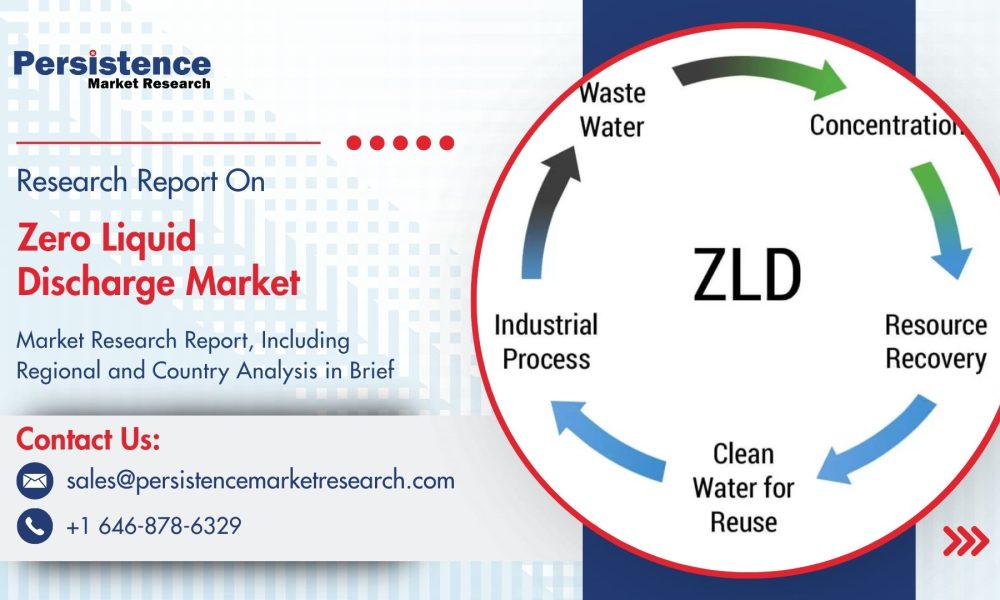
The zero liquid discharge (ZLD) market has gained significant attention over the past decade as industries face increasing regulatory pressure to minimize environmental impact and ensure sustainable water management. ZLD is an advanced wastewater treatment process that ensures nearly all wastewater is purified and recycled, leaving behind only solid waste. This process not only reduces freshwater dependency but also helps industries comply with stringent environmental regulations on effluent discharge.
With growing industrialization, urbanization, and water scarcity concerns, ZLD has become an essential solution for industries such as power generation, oil & gas, pharmaceuticals, textiles, and chemicals. This report provides a comprehensive analysis of the global ZLD market, covering growth drivers, challenges, emerging trends, regional insights, and future outlook.
Market Projections and Forecast
According to Persistence Market Research’s projections, the global zero liquid discharge market is poised for strong growth over the forecast period. The market size is estimated to be valued at US$ 7.5 billion in 2025 and is expected to reach US$ 12.9 billion by 2032, expanding at a robust CAGR of 8.1% from 2025 to 2032.
The rising adoption of sustainable water management practices, combined with government-enforced environmental regulations, is fueling market expansion. North America, with its strict environmental policies and heavy industrial base, is anticipated to dominate the market, while Asia-Pacific is expected to showcase the fastest growth due to rapid industrialization and water scarcity challenges.
Get a Sample PDF Brochure of the Report (Use Corporate Email ID for a Quick Response): https://www.persistencemarketresearch.com/samples/12307
Market Dynamics
Drivers of Market Growth
- Stringent Environmental Regulations:
Governments and environmental bodies worldwide are imposing strict regulations on wastewater discharge, compelling industries to adopt advanced treatment systems like ZLD. This is especially critical in regions with scarce water resources or high pollution levels. - Rising Water Scarcity Concerns:
With increasing global demand for clean water, industries are turning to ZLD systems to recycle and reuse wastewater, thereby reducing dependence on freshwater sources and improving sustainability. - Growing Industrialization:
Expanding industries, particularly in emerging economies, are generating large volumes of wastewater. ZLD technologies are being implemented to manage wastewater effectively, especially in power plants, chemical manufacturing, and textile processing units. - Advancements in Technology:
Continuous innovations in membrane filtration, thermal desalination, and crystallization technologies are making ZLD systems more energy-efficient and cost-effective, boosting adoption across multiple industries.
Challenges in the Market
Despite its growth potential, the ZLD market faces several challenges:
- High Capital and Operating Costs:
The installation of ZLD systems requires significant investment, and their energy-intensive operations result in high running costs. This remains a major barrier for small and medium-sized enterprises (SMEs). - Complexity of Implementation:
ZLD systems are technically complex and require proper integration with existing industrial processes. Industries with limited technical expertise may find implementation challenging. - Energy Consumption:
Conventional ZLD processes are energy-intensive, especially thermal methods. This creates a demand for innovations in low-energy alternatives.
Market Trends and Technological Innovations
- Integration of Hybrid ZLD Systems:
Hybrid systems combining membrane-based technologies with thermal processes are gaining popularity for improving energy efficiency and reducing costs. - Rising Adoption in Emerging Economies:
Countries like India and China are witnessing large-scale deployment of ZLD systems due to water scarcity and government mandates for zero wastewater discharge in key industries. - Focus on Energy-Efficient Solutions:
Manufacturers are investing in R&D to develop energy-efficient ZLD technologies, such as advanced reverse osmosis membranes, vapor compression systems, and solar-assisted evaporation. - Digitalization and Smart Monitoring:
The integration of IoT and AI into ZLD systems is enabling real-time monitoring, predictive maintenance, and performance optimization, helping industries lower costs and improve system reliability.
Zero Liquid Discharge Industry Segmentation
By Technology:
- Thermal ZLD Systems
- Membrane-Based ZLD Systems
- Hybrid ZLD Systems
By End-Use Industry:
- Power Generation
- Oil & Gas
- Pharmaceuticals
- Chemicals & Petrochemicals
- Textiles
- Food & Beverages
- Others
By Component:
- Systems (Evaporators, Crystallizers, Reverse Osmosis Units, Brine Concentrators)
- Services (Installation, Maintenance, Monitoring)
By Region:
- North America
- Europe
- Asia-Pacific
- Latin America
- Middle East & Africa
Regional Analysis
North America
North America is expected to lead the global ZLD market, driven by stringent environmental laws such as the Clean Water Act in the U.S. and Canada’s wastewater management regulations. The presence of a large number of power plants and oil & gas facilities further supports market expansion in the region.
Europe
Europe is witnessing significant adoption of ZLD technologies, especially in the chemicals, pharmaceuticals, and food & beverage sectors. The region’s strong regulatory framework and commitment to sustainability goals are fueling market growth.
Asia-Pacific
The Asia-Pacific region is projected to experience the fastest growth during the forecast period. Rapid industrialization in China, India, and Southeast Asian countries, coupled with acute water scarcity, is creating a strong demand for ZLD solutions. Government mandates in India requiring ZLD in textile dyeing and tanneries highlight the region’s proactive approach.
Middle East & Africa
Water scarcity and growing industrialization are driving ZLD adoption in the Middle East. Industries like oil & gas and desalination plants are increasingly integrating ZLD to maximize water recovery.
Latin America
Latin America shows moderate growth potential, particularly in Brazil and Mexico, where expanding industries and growing environmental concerns are increasing interest in sustainable water treatment solutions.
Key Companies Profiled in the Report
- Veolia Water Technologies
- SUEZ Water Technologies & Solutions
- Aquatech International LLC
- GEA Group AG
- Praj Industries Ltd.
- H2O GmbH
- Thermax Global
- Doosan Heavy Industries & Construction Co. Ltd.
- IDE Technologies
- Oasys Water, Inc.
- SafBon Water Service (Holding) Inc.
- Saltworks Technologies Inc.
Future Outlook
The future of the zero liquid discharge market looks promising, with significant opportunities in both developed and emerging economies. Technological innovations will play a key role in overcoming current barriers, particularly high costs and energy consumption. Hybrid systems and energy-efficient technologies will drive market adoption across industries.
Furthermore, the growing integration of digital solutions such as AI and IoT for monitoring and predictive maintenance will enhance operational efficiency. Governments worldwide are expected to tighten environmental laws further, compelling industries to adopt ZLD systems to ensure compliance and sustainability.
As industries continue to prioritize water conservation and sustainable operations, ZLD will emerge as a critical component of industrial water management strategies.
Conclusion
The zero liquid discharge market is set for strong growth, supported by rising regulatory pressures, water scarcity challenges, and advancements in water treatment technologies. While high costs and energy requirements remain hurdles, ongoing innovation is addressing these challenges, making ZLD more accessible to industries worldwide.
With its ability to minimize environmental impact and ensure water reuse, ZLD is becoming an indispensable solution for sustainable industrial practices. As adoption grows across sectors like power, oil & gas, textiles, and pharmaceuticals, the market is well-positioned to expand steadily, reaching US$ 12.9 billion by 2032.
Explore the Latest Trending Research Reports:




