
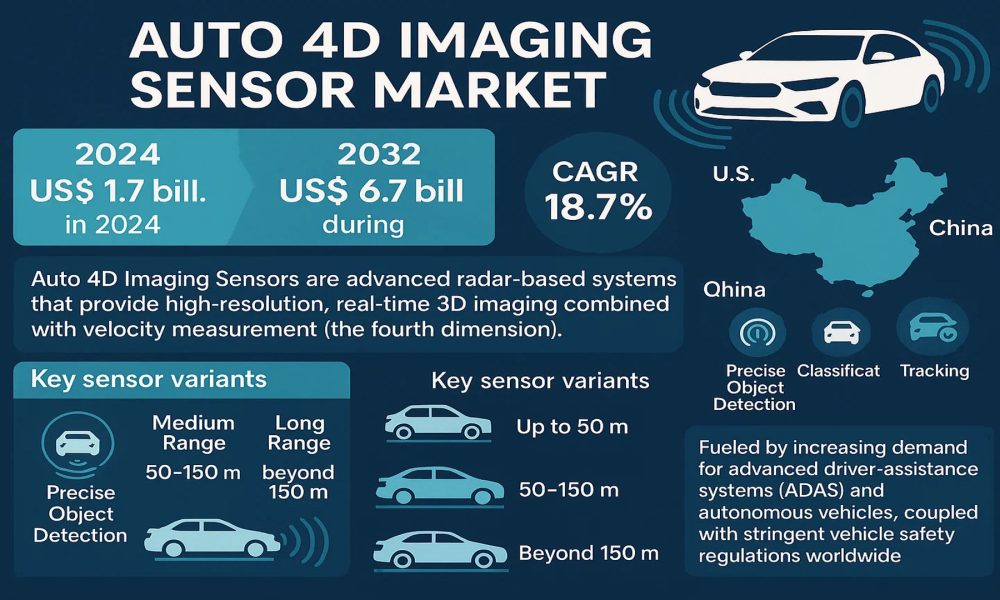
Auto 4D Imaging Sensor Market size was valued at US$ 1.7 billion in 2024 and is projected to reach US$ 6.7 billion by 2032, at a CAGR of 18.7% during the forecast period 2025-2032. The U.S. market accounted for USD 310 million in 2024, while China is expected to reach USD 650 million by 2032, driven by rapid automotive industry advancements.
Auto 4D Imaging Sensors are advanced radar-based systems that provide high-resolution, real-time 3D imaging combined with velocity measurement (the fourth dimension). These sensors enable precise object detection, classification, and tracking for autonomous driving applications. Key variants include Short Range (up to 50 meters), Medium Range (50-150 meters), and Long Range (beyond 150 meters) sensors, each serving distinct automotive safety functions.
The market growth is fueled by increasing demand for advanced driver-assistance systems (ADAS) and autonomous vehicles, coupled with stringent vehicle safety regulations worldwide. Major players like Arbe, Aptiv, and Continental AG are expanding their portfolios through technological innovations, such as ultra-high-resolution 4D imaging radar solutions. For instance, in March 2024, Arbe launched its next-generation 4D imaging radar chipset, offering 30% greater range accuracy for Level 4 autonomous vehicles.
Download Your Free Copy of the Sample Report-https://semiconductorinsight.com/download-sample-report/?product_id=107290
MARKET DRIVERS
Rising Demand for Advanced Driver Assistance Systems (ADAS) to Accelerate Market Growth
The global automotive industry is witnessing a surge in demand for advanced safety features, especially in passenger and commercial vehicles. Auto 4D imaging sensors play a pivotal role in enhancing ADAS capabilities by providing high-resolution 360-degree monitoring, object detection, and real-time environmental mapping. With the increasing integration of autonomous driving technologies, automakers are prioritizing these sensors to improve collision avoidance, pedestrian detection, and adaptive cruise control systems. The global ADAS market is projected to grow significantly, with Europe and North America leading adoption rates due to stringent safety regulations. For instance, recent mandates in several countries require automatic emergency braking systems, which rely heavily on 4D imaging radar technology.
Technological Advancements in Radar Imaging to Fuel Market Expansion
Recent breakthroughs in 4D imaging radar technology are revolutionizing the automotive sensor landscape. Conventional radar systems are being replaced by high-resolution 4D sensors capable of detecting objects with millimeter precision while maintaining performance in adverse weather conditions. These next-generation sensors provide not just distance and velocity data (like traditional 3D radar) but also elevation measurements critical for object classification. Leading manufacturers are investing heavily in R&D to miniaturize components while improving angular resolution up to 1-degree accuracy. The development of chip-scale radar solutions has enabled integration into compact vehicle designs without compromising performance, creating new opportunities across vehicle segments.
Furthermore, increasing collaboration between semiconductor companies and automotive OEMs is accelerating technology adoption. Strategic partnerships are focusing on developing cost-effective solutions suitable for mass-market vehicles, which will drive penetration rates beyond premium segments in coming years.
Recent Developments:
- Automotive OEMs are increasingly integrating 4D imaging radar sensors in ADAS and autonomous vehicles for enhanced safety and real-time object detection.
- In 2024, Arbe Robotics partnered with Tier-1 suppliers to scale mass production of 4D imaging radar for next-gen vehicles.
- Texas Instruments introduced high-resolution radar sensors enabling precise detection of vehicle surroundings in low visibility conditions.
- Continental AG expanded its radar sensor portfolio by launching advanced 4D imaging radar designed for Level 4 autonomous driving.
- Rising collaborations between automakers and semiconductor companies are driving innovations in AI-powered 4D radar systems.
MARKET OPPORTUNITIES
Growing Integration with V2X Communication Systems to Create New Revenue Streams
The convergence of 4D imaging sensors with vehicle-to-everything (V2X) communication presents significant growth opportunities. By combining high-resolution environmental sensing with real-time data sharing between vehicles and infrastructure, automakers can develop enhanced safety systems that anticipate hazards beyond line-of-sight limitations. This integration is particularly valuable for commercial fleet operators seeking to optimize logistics operations through networked sensor data. Pilot programs in smart cities have demonstrated accident reduction rates exceeding 40% when combining 4D radar with V2X technologies.
Furthermore, the development of standardized interfaces between sensor systems and automotive networks enables seamless data fusion with other vehicle systems. This interoperability is critical for next-generation mobility solutions and creates opportunities for sensor manufacturers to develop value-added software services alongside hardware offerings.
The emergence of software-defined vehicle architectures also allows for over-the-air updates to enhance sensor capabilities post-deployment, creating recurring revenue models for sensor manufacturers through feature upgrades and performance optimizations throughout the vehicle lifecycle.
Download Your Free Copy of the Sample Report-https://semiconductorinsight.com/download-sample-report/?product_id=107290
List of Key Auto 4D Imaging Sensor Companies
- Continental AG (Germany)
- BOSCH (Germany)
- Arbe Robotics (Israel)
- Aptiv PLC (Ireland)
- Vayyar Imaging (Israel)
- Zadar Labs (U.S.)
- Smartmicro (Germany)
- HUAWEI (China)
- Steradian (India)
- Oculii (U.S.)
- Uhnder (U.S.)
- RadSee (Israel)
Segment Analysis:
By Type
Short Range Segment Leads Due to Increasing Demand for Urban Mobility Solutions
The market is segmented based on type into:
- Short Range
- Medium Range
- Long Range
By Application
Passenger Vehicle Segment Dominates with Rising Adoption of ADAS Technologies
The market is segmented based on application into:
- Passenger Vehicle
- Commercial Vehicle
By Technology
Radar-Based Sensors Hold the Largest Share Owing to Superior Object Detection Capabilities
The market is segmented based on technology into:
- Radar-based
- LiDAR-based
- Ultrasonic
By Vehicle Autonomy Level
Level 2 Autonomy Segment Leads with Increasing Semi-Autonomous Vehicle Deployment
The market is segmented based on vehicle autonomy level into:
- Level 1
- Level 2
- Level 3
- Level 4 & 5
Other Topic-Photoelectric Level Sensor Market
CONTACT US:
City vista, 203A, Fountain Road, Ashoka Nagar, Kharadi, Pune, Maharashtra 411014
[+91 8087992013]




