
Definition
Scientific lasers are high-precision optical devices engineered to deliver exceptional beam quality, wavelength stability, and output control for advanced research applications. Unlike industrial lasers that emphasize large-scale manufacturing processes, scientific lasers are tailored for laboratory and academic research in physics, chemistry, biology, engineering, and material sciences.
They play a pivotal role in experiments requiring ultra-stable and ultra-fast light sources, such as quantum computing, spectroscopy, photonics research, biomedical imaging, and material analysis. Scientific lasers are typically categorized into solid-state, gas, and liquid-based systems, with solid-state lasers leading the market due to their energy efficiency, versatility, and compact design.
With precision-driven research accelerating globally, these lasers have become indispensable in advancing fields such as quantum technologies, optical communications, and nanotechnology.
Recent Developments
The scientific lasers market is experiencing a significant boom, driven by breakthroughs in ultrafast and quantum cascade laser technologies. These advancements are pushing the boundaries of speed, tunability, and wavelength, enabling new research in fields like biomedical imaging, micromachining, and environmental sensing. Another key trend is the miniaturization and increased portability of laser modules, making them more accessible for use in mobile and aerial platforms. Manufacturers are also integrating smart control software and AI into their systems, which allows for real-time optimization, predictive maintenance, and more precise beam shaping. This shift toward compact, intelligent, and highly efficient systems is expanding the applications of scientific lasers beyond traditional laboratory settings.
Major Distribution Channels
The distribution of scientific lasers is primarily a specialized business-to-business (B2B) process. A major channel is direct sales from manufacturers to large research institutions, universities, and major corporations in the life sciences, aerospace, and defense sectors. These sales often involve complex contracts and a high level of technical support. A significant portion of the market is also served by specialized scientific and electronic component distributors, such as Thorlabs and Edmund Optics, who provide a wide range of laser systems, components, and accessories to a broader audience, including smaller research labs and individual engineers. The growth of e-commerce platforms has also become a crucial distribution channel, offering a more convenient way for customers to research product specifications and purchase components online, making the market more globally accessible.
Market Size
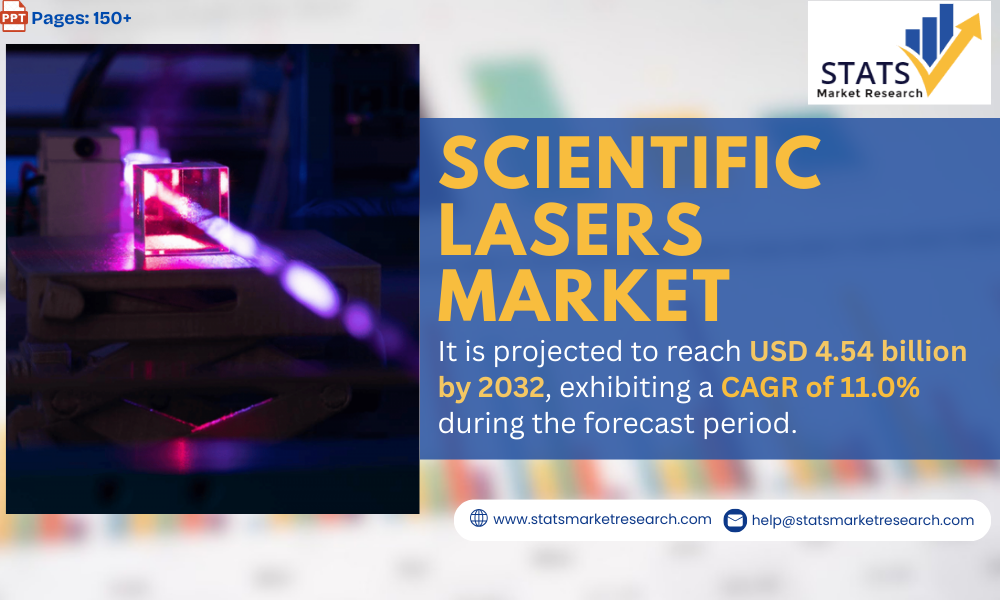
Global Scientific Lasers Market was valued at USD 2.22 billion in 2024 and is projected to grow to USD 4.54 billion by 2032, registering a CAGR of 11.0% during the forecast period.
- In 2025, the market is estimated at USD 2.47 billion, highlighting strong year-over-year growth.
- Solid-state lasers hold a 58% market share in 2024, dominating due to their efficiency and wide adoption in photonics and quantum research.
- The quantum computing sector alone is driving unprecedented demand, with quantum-related laser applications projected to grow at over 25% CAGR through 2030.
Government funding also underpins growth. For instance, the U.S. National Science Foundation (NSF) allocated USD 9.87 billion in 2024, a significant portion directed toward infrastructure such as advanced laser systems.
Overall, the expansion of R&D budgets in academic, industrial, and healthcare research is creating a high-growth trajectory for the scientific lasers market.
Download FREE Sample of this Report @ https://www.statsmarketresearch.com/download-free-sample/8058695/global-scientific-lasers-forecast-market
Market Dynamics (Drivers, Restraints, Opportunities, and Challenges)
Drivers
- Advancements in Photonics Research
- Photonics, expected to grow at a 7% CAGR through 2030, is a major driver.
- Scientific lasers are essential in nonlinear optics, microscopy, and ultrafast spectroscopy.
- Leading labs use femtosecond lasers for studying molecular dynamics at nanosecond timescales.
- Expanding Biomedical Applications
- Applications in OCT (Optical Coherence Tomography), flow cytometry, and precision surgery are accelerating demand.
- The biomedical laser segment is projected to surpass USD 15 billion by 2027.
- OCT alone is growing at 9% CAGR through 2030.
Restraints
- High Initial Costs
- Advanced scientific lasers cost $50,000 – $500,000+, with annual maintenance at 15–20% of system cost.
- Institutions with limited budgets face adoption challenges.
- Strict Safety Regulations
- IEC 60825 standards and Class 4 safety protocols increase compliance costs.
- Institutions delay adoption until safety data validates cutting-edge systems.
Opportunities
- Quantum Technology Expansion
- Quantum computing and communication require narrow-linewidth, stable lasers.
- Quantum sensing is expected to surpass USD 1 billion by 2028, directly boosting demand.
- Materials Processing Applications
- Growing usage in semiconductors, additive manufacturing, and nanomaterial synthesis.
- The laser materials processing market is projected to hit USD 12 billion by 2026.
Challenges
- Skills Shortage
- Over 100,000 skilled photonics professionals are needed globally.
- Lack of expertise in laser system integration delays deployments.
- Competition from Alternatives
- Electron microscopy competes in nanoscale imaging.
- High-power LEDs are emerging substitutes for some applications.
Regional Analysis
- North America
- Dominates due to strong government funding and advanced research ecosystems.
- The U.S. NSF’s $9.87B investment directly supports scientific lasers adoption.
- Europe
- Stronghold in quantum photonics, with Germany, France, and the U.K. leading.
- EU Horizon programs invest heavily in quantum optics and photonics R&D.
- Asia-Pacific
- Fastest-growing region with over 30% projected share by 2032.
- China and Japan lead through semiconductor research, quantum computing, and biotech applications.
- Local manufacturers such as Shanghai Precilasers are scaling globally.
- Latin America & Middle East
- Emerging adoption in materials processing, medical imaging, and defense R&D.
Competitor Analysis (in brief)
The competitive landscape is driven by innovation, strategic mergers, and portfolio expansion.
- Coherent, Inc. and IPG Photonics dominate with 30%+ combined market share, leveraging strong patent positions and broad wavelength coverage.
- TRUMPF and MKS Instruments (Spectra-Physics) follow, excelling in precision machining and spectroscopy.
- TOPTICA Photonics & NKT Photonics are key innovators in quantum laser systems.
- Asian players like Hamamatsu Photonics and Shanghai Precilasers are expanding globally with cost-efficient, mid-range products.
Get the Complete Report & TOC @ https://www.statsmarketresearch.com/global-scientific-lasers-forecast-market-8058695
Global Scientific Lasers: Market Segmentation Analysis
This report provides a deep insight into the global Scientific Lasers market, covering all its essential aspects. This ranges from a macro overview of the market to micro details of the market size, competitive landscape, development trend, niche market, key market drivers and challenges, SWOT analysis, value chain analysis, etc.
The analysis helps the reader to shape the competition within the industries and strategies for the competitive environment to enhance the potential profit. Furthermore, it provides a simple framework for evaluating and assessing the position of the business organization. The report structure also focuses on the competitive landscape of the Global Scientific Lasers. This report introduces in detail the market share, market performance, product situation, operation situation, etc., of the main players, which helps the readers in the industry to identify the main competitors and deeply understand the competition pattern of the market.
In a word, this report is a must-read for industry players, investors, researchers, consultants, business strategists, and all those who have any kind of stake or are planning to foray into the Scientific Lasers market in any manner.
Market Segmentation (by Application)
- Quantum Information
- Optical Research
- Materials Processing
- Medical and Biomedical Sciences
- Environmental Monitoring
- Others
Market Segmentation (by Type)
- Solid-state Lasers
- Diode-pumped
- Fiber
- Others
- Gas Lasers
- CO2
- HeNe
- Argon-Ion
- Others
- Liquid Lasers
- Dye Lasers
- Others
- Others
Key Company
- Coherent, Inc. (U.S.)
- IPG Photonics (U.S.)
- TRUMPF GmbH + Co. KG (Germany)
- MKS Instruments (Spectra-Physics) (U.S.)
- Hamamatsu Photonics K.K. (Japan)
- Lumentum Operations LLC (U.S.)
- TOPTICA Photonics AG (Germany)
- NKT Photonics A/S (Denmark)
- Thorlabs, Inc. (U.S.)
- EKSPLA (Lithuania)
- Amplitude Laser Group (France)
- InnoLas Laser GmbH (Germany)
- Shanghai Precilasers Co., Ltd. (China)
- Changchun New Industries Optoelectronics (China)
- Beijing Grace Laser Technology Co., Ltd. (China)
Geographic Segmentation
- North America
- Europe
- Asia-Pacific
- Latin America
- Middle East & Africa
FAQ
- What is the current market size of the Scientific Lasers Market?
The global scientific lasers market was valued at USD 2.22 billion in 2024 and is projected to reach USD 4.54 billion by 2032, growing at a CAGR of 11.0%. - Which are the key companies operating in the Scientific Lasers Market?
Key players include Coherent, IPG Photonics, TRUMPF, MKS Instruments (Spectra-Physics), Hamamatsu Photonics, TOPTICA Photonics, and NKT Photonics. - What are the key growth drivers in the Scientific Lasers Market?
Major drivers include advancements in photonics research, growing biomedical applications, and expanding demand from quantum technologies. - Which regions dominate the Scientific Lasers Market?
North America leads the market, followed by Europe. The Asia-Pacific region is the fastest-growing, driven by R&D investments in China, Japan, and South Korea. - What are the emerging trends in the Scientific Lasers Market?
Emerging trends include quantum technology applications, AI integration in biomedical lasers, miniaturized ultrafast systems, and smart photonic solutions for next-gen research.
About Us
☎️ International: +1 (332) 2424 294
📄 Website: www.statsmarketresearch.com
Join us on LinkedIn:- https://www.linkedin.com/company/statsmarketresearch




