
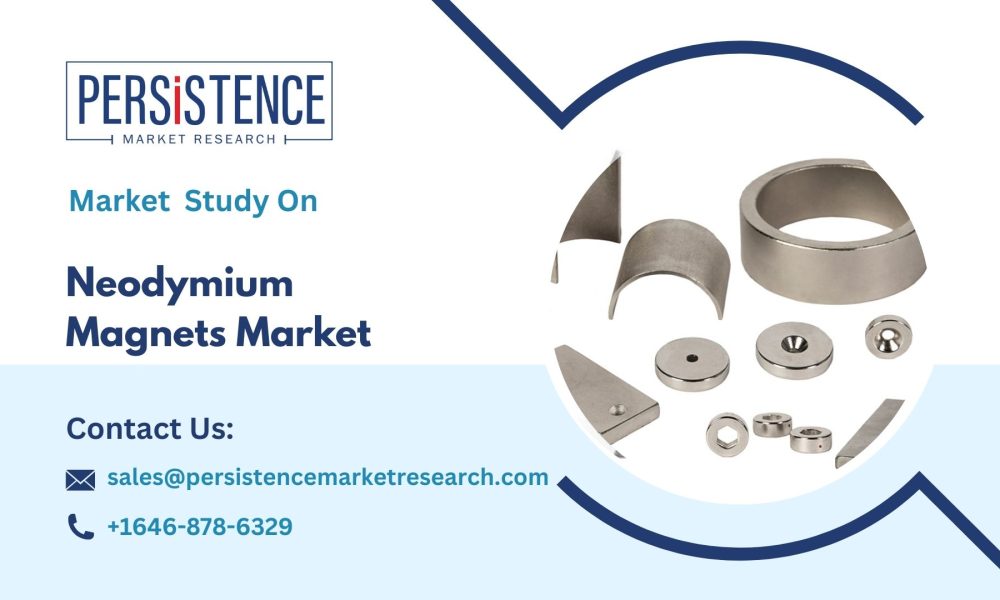
The global neodymium magnets market is projected to be valued at US$ 3.9 billion in 2025 and is expected to reach US$ 9.9 billion by 2032, growing at a robust CAGR of 14% during the forecast period (2025–2032). The market expansion is fueled by the growing emphasis on renewable energy, clean mobility, and advanced electronics. Neodymium magnets, particularly NdFeB (neodymium-iron-boron) types, are widely used in electric motors, wind turbines, medical devices, and consumer electronics, thanks to their exceptional magnetic strength, high torque-to-weight ratio, and ability to operate efficiently across a wide temperature range.
Among product categories, sintered NdFeB magnets dominate with nearly 86% share, due to their superior strength, coercivity, and thermal stability, making them indispensable in demanding applications such as electric vehicles and wind power generation. Regionally, Asia Pacific leads the market, accounting for the majority of global production and consumption, backed by China’s dominance in rare-earth processing and Japan’s advanced manufacturing ecosystem. This regional advantage, coupled with aggressive EV adoption and renewable energy deployment, reinforces Asia Pacific’s role as the hub of neodymium magnet demand and supply.
Key Highlights from the Report
- • The global neodymium magnets market is projected to reach US$ 9.9 billion by 2032, at a CAGR of 14%.
- • Sintered NdFeB magnets dominate with 86% market share, owing to their strength and thermal stability.
- • Arc and disc magnets are widely used in motors, turbines, and compact electronic devices.
- • Electric vehicles and wind turbines are the fastest-growing end-use sectors for NdFeB magnets.
- • Asia Pacific remains the global leader in both production and consumption.
- • North America is investing in domestic NdFeB magnet production to strengthen supply chain resilience.
𝐆𝐞𝐭 𝐚 𝐒𝐚𝐦𝐩𝐥𝐞 𝐏𝐃𝐅 𝐁𝐫𝐨𝐜𝐡𝐮𝐫𝐞 𝐨𝐟 𝐭𝐡𝐞 𝐑𝐞𝐩𝐨𝐫𝐭 (𝐔𝐬𝐞 𝐂𝐨𝐫𝐩𝐨𝐫𝐚𝐭𝐞 𝐄𝐦𝐚𝐢𝐥 𝐈𝐃 𝐟𝐨𝐫 𝐚 𝐐𝐮𝐢𝐜𝐤 𝐑𝐞𝐬𝐩𝐨𝐧𝐬𝐞): https://www.persistencemarketresearch.com/samples/35508
Market Segmentation
The neodymium magnets market is segmented based on product type, shape, and end-use applications.
By product type, sintered NdFeB magnets hold the largest share, accounting for over 85% of global consumption. Their superior performance characteristics make them essential for high-power applications in EV drive motors, wind turbines, and industrial automation. Bonded NdFeB magnets, though smaller in share, find applications in consumer electronics, sensors, and toys due to their flexibility and design versatility. Hot-pressed magnets contribute marginally but serve niche applications requiring unique shapes and durability.
In terms of shape, arc and disc magnets are the most widely used, particularly in motors and generators. Arc magnets are critical for radial flux motor designs in EVs and robotics, while disc magnets are integral to speakers, hard drives, and compact electronics. Coated variants, including nickel and epoxy-coated magnets, are gaining demand for durability in harsh environments.
By end-use industry, automotive and renewable energy lead adoption. EV drive motors typically consume 1–2 kilograms of NdFeB magnets per vehicle, while wind turbines may require up to 600 kg of magnets per MW of capacity. Consumer electronics such as smartphones, laptops, and audio devices also account for significant consumption. Healthcare and robotics are emerging end-use industries, with applications in MRI machines, surgical tools, and precision robotics.
Regional Insights
Asia Pacific dominates the neodymium magnets market, with China accounting for over 60% of rare earth mining and nearly 90% of global magnet production. Strong EV sales, government incentives, and an established rare-earth ecosystem make the region the undisputed leader. Japan contributes significantly through advanced magnet technologies and high-performance applications, while India is increasing demand with EV incentives and renewable energy projects.
North America is witnessing steady growth, driven by demand from medical devices, EVs, and defense applications. The U.S. is actively investing in local manufacturing facilities to reduce reliance on Chinese imports. Companies like MP Materials and HyProMag USA are leading efforts to localize production and recycling. Robotics adoption in logistics and advanced manufacturing also supports regional demand.
Europe presents strong opportunities, especially in electric bikes, wind energy, and premium electronics. With e-bike sales crossing 2 million units annually in Germany and strict EU decarbonization goals, NdFeB magnet demand is climbing. Consumer electronics in Western Europe also rely heavily on neodymium magnets for miniaturization and performance. Furthermore, European governments are pushing to diversify supply chains by encouraging local production and recycling.
Market Drivers
The strongest driver of the neodymium magnets market is the global transition to renewable energy and electric mobility. Offshore wind turbines and EVs are particularly reliant on NdFeB magnets. According to IRENA, offshore wind capacity is expected to grow nearly sixfold by 2030, with each direct-drive turbine requiring hundreds of kilograms of NdFeB magnets. Likewise, global EV sales surpassed 14 million units in 2023 and are expected to exceed 30 million by 2030, fueling massive demand.
Another driver is the growth in consumer electronics. Smartphones, laptops, speakers, and hard drives all incorporate neodymium magnets for compact yet powerful performance. With rising disposable incomes and rapid adoption of smart devices, magnet consumption in this sector continues to climb.
Market Restraints
The biggest restraint is the concentrated supply chain. China’s dominance in rare-earth mining and magnet production creates risks of price volatility and export restrictions. Recent export control measures in 2023 and 2025 have highlighted vulnerabilities for global manufacturers.
Another restraint is technological and intellectual property barriers. Production of high-grade magnets like N52 requires sophisticated sintering and processing technologies, much of which are protected by patents held in Japan and China. This limits new entrants and regional expansion in Western markets.
Market Opportunities
The expanding electric vehicle market represents the most lucrative opportunity for neodymium magnets. With each EV consuming magnets for both drive and auxiliary motors, demand per vehicle continues to increase. Auxiliary uses include HVAC systems, fuel pumps, and electronic braking systems.
Another opportunity lies in robotics and industrial automation. With more than 4 million industrial robots operating globally by 2023, demand for compact and precise motors is accelerating. Robotics in manufacturing, logistics, and defense increasingly rely on NdFeB magnets for efficiency and reliability.
Additionally, magnet recycling presents a long-term opportunity. Companies are now developing methods to recover rare earths from end-of-life electronics, EV motors, and industrial waste, reducing dependence on fresh mining and supporting sustainability goals.
Reasons to Buy the Report
- Gain comprehensive insights into global neodymium magnets market size, growth rate, and key trends.
- Understand detailed segmentation across product types, shapes, and end-use industries.
- Analyze regional growth opportunities and investment trends across Asia Pacific, North America, and Europe.
- Identify key drivers, restraints, and opportunities shaping the industry.
- Access competitive landscape insights, recent developments, and strategies of major players.
Frequently Asked Questions (FAQs)
#1 How Big is the Neodymium Magnets Market?
#2 Who are the Key Players in the Global Market for Neodymium Magnets?
#3 What is the Projected Growth Rate of the Neodymium Magnets Market?
#4 What is the Market Forecast for 2032?
#5 Which Region is Estimated to Dominate the Industry through the Forecast Period?
Company Insights
• Ningbo Tongchuang Magnetic Materials Co., Ltd.
• Hitachi Metals Ltd.
• Shin-Etsu Chemical Co. Ltd.
• Arnold Magnetic Technologies
• TDK Corporation
• Armstrong Magnetics
• MP Materials
• Chengdu Galaxy Magnets
• Magna Co., Ltd.
• Electron Energy Corporation
• Goudsmith Magnetics
• Dexter Magnetic Technologies
• Ningbo Yunsheng Co., Ltd.
• HGT Advanced Magnets Co., Ltd.
• Eclipse Magnetics
• Adams Magnetic Products
Recent Developments:
- In February 2025, MP Materials began trial production of NdFeB magnets in Texas, targeting 1,000–3,000 tonnes annually to supply General Motors and strengthen U.S. supply security.
- In December 2024, HyProMag USA announced the establishment of the first U.S. rare-earth magnet recycling facility in Dallas-Fort Worth, with capacity of 750 tonnes per year by 2027.
Conclusion
The neodymium magnets market is on a strong growth trajectory, driven by rising demand from electric vehicles, renewable energy, consumer electronics, and industrial automation. While challenges such as China’s supply chain dominance and high production costs persist, opportunities in EV expansion, robotics, and recycling offer strong growth potential. With Asia Pacific leading the market, and North America and Europe making strategic investments in local production, the industry is entering a phase of transformation. Companies that invest in innovation, supply resilience, and sustainable practices will be well-positioned to capitalize on the market’s future growth.
𝐑𝐞𝐥𝐚𝐭𝐞𝐝 𝐑𝐞𝐩𝐨𝐫𝐭𝐬:




