
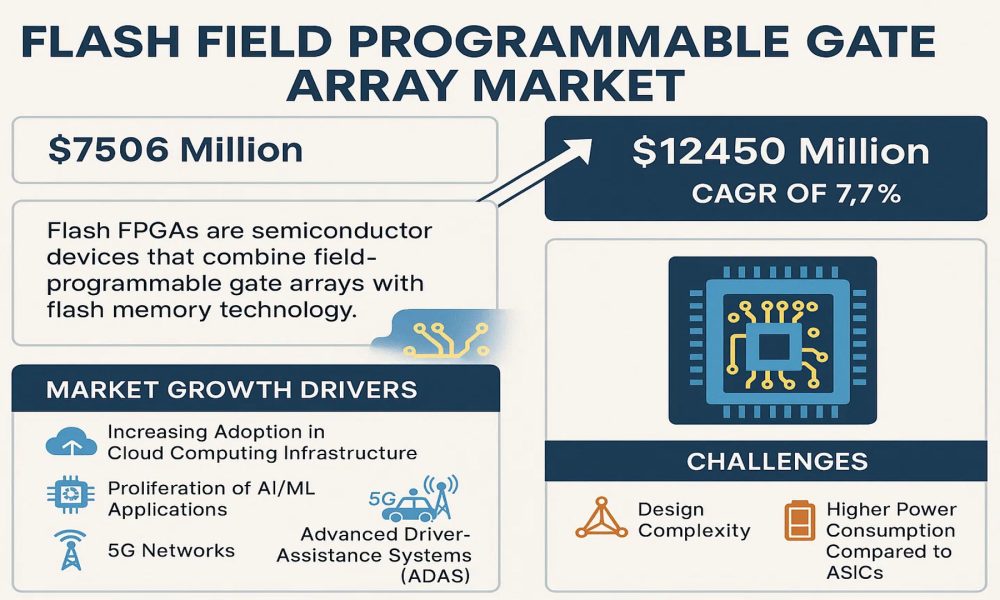
Flash Field Programmable Gate Array Market was valued at 7506 million in 2024 and is projected to reach US$ 12450 million by 2032, at a CAGR of 7.7% during the forecast period.
Flash FPGAs are semiconductor devices that combine field-programmable gate arrays with flash memory technology. These integrated circuits are built around a matrix of configurable logic blocks (CLBs) connected via programmable interconnects, allowing post-manufacturing reprogramming for specific applications. The architecture enables high flexibility in digital circuit design while retaining non-volatile configuration storage.
The market growth is driven by increasing adoption in cloud computing infrastructure, where FPGAs accelerate service-oriented tasks like AI inference, network encryption, and real-time data processing. For instance, Amazon Web Services utilizes FPGA coprocessors in its EC2 F1 instances for hardware acceleration. Additionally, the proliferation of AI/ML applications, 5G networks, and advanced driver-assistance systems (ADAS) continues to expand demand. However, design complexity and higher power consumption compared to ASICs remain key challenges for widespread adoption across all application segments.
Click to Access Your Free Sample Report-Flash Field Programmable Gate Array Market
MARKET DYNAMICS
MARKET DRIVERS
Accelerated Cloud Computing Adoption Fuels FPGA Market Expansion
The rapid adoption of cloud computing services is significantly driving the flash field-programmable gate array (FPGA) market. Cloud service providers are increasingly leveraging FPGA technology to accelerate computationally intensive workloads like AI model training, financial analytics, and video processing. The global cloud computing market is projected to grow at over 15% annually, creating substantial demand for FPGA-based hardware acceleration. Major providers like AWS (with their EC2 F1 instances) and Microsoft Azure (with Project Brainwave) have already integrated FPGAs into their infrastructure, demonstrating the technology’s crucial role in modern cloud architectures.
AI and IoT Proliferation Creates FPGA Adoption Wave
The explosive growth of artificial intelligence applications and Internet of Things deployments represents another key market driver. FPGAs offer unique advantages for AI inference tasks, particularly in edge computing scenarios where low latency and power efficiency are critical. The global AI chip market is expected to surpass $80 billion by 2027, with FPGAs capturing a significant portion due to their reprogrammable nature and parallel processing capabilities. Similarly, in IoT applications, flash FPGAs provide the flexibility needed to support diverse sensor interfaces and edge processing requirements across industrial automation, smart cities, and consumer electronics sectors.
Automotive Sector Transformation Drives FPGA Demand
The automotive industry’s shift toward autonomous driving and advanced driver assistance systems (ADAS) is creating substantial opportunities for flash FPGA vendors. Modern vehicles require sophisticated processing capabilities for sensor fusion, computer vision, and real-time decision making – all areas where FPGAs excel. The automotive FPGA market segment is growing at approximately 12% annually, driven by increasing semiconductor content in vehicles and the transition to electric/autonomous platforms. Flash-based FPGAs are particularly well-suited for automotive applications due to their reliability, radiation tolerance, and ability to be reprogrammed for future feature upgrades.
Recent Developments – Flash Field Programmable Gate Array Market
- Growing Adoption in Automotive Electronics – Flash-based FPGAs are increasingly used in advanced driver-assistance systems (ADAS), electric vehicle powertrains, and infotainment due to their low power consumption and instant-on capability.
- Expansion in Aerospace & Defense – Defense organizations are deploying flash FPGAs for secure, radiation-tolerant applications, with recent innovations focusing on enhanced reliability in harsh environments.
- Integration with AI and Edge Computing – New flash FPGAs are being designed to accelerate AI inference at the edge, supporting real-time processing for IoT, industrial automation, and robotics.
- Partnerships and Product Launches – Leading players like Microchip Technology and Lattice Semiconductor have launched advanced flash FPGA families with higher density, improved security features, and better energy efficiency.
- Focus on Security Features – With growing cyber threats, flash FPGAs are being enhanced with built-in hardware security for encryption, secure boot, and protection against IP theft.
- Shift Toward 5G and Telecom Infrastructure – Recent developments highlight increasing demand for flash FPGAs in 5G base stations and networking equipment due to their adaptability and low-latency performance.
MARKET OPPORTUNITIES
Edge AI Revolution Creates New FPGA Application Frontiers
The burgeoning edge AI market presents significant growth opportunities for flash FPGA vendors. Unlike cloud-based AI that relies on powerful GPUs, edge applications demand solutions that balance performance with power efficiency and compact form factors. Flash FPGAs are uniquely positioned to address these requirements, offering the ability to implement custom neural network accelerators while consuming minimal power. The edge AI processor market is forecast to exceed $15 billion by 2026, with FPGA-based solutions expected to capture a growing share as developers recognize their advantages for real-time inferencing in smart cameras, industrial equipment, and wearable devices.
5G Infrastructure Rollout Drives FPGA Demand
The global deployment of 5G networks represents another major opportunity for flash FPGA adoption. Modern 5G base stations require flexible processing platforms that can support evolving radio standards and protocols. FPGAs provide this flexibility while delivering the high throughput needed for massive MIMO processing and beamforming algorithms. With 5G infrastructure investments projected to surpass $30 billion annually in coming years, telecom equipment manufacturers are increasingly turning to flash FPGAs for their baseband processing and fronthaul/backhaul solutions. The technology’s ability to be reprogrammed remotely also makes it ideal for future-proofing 5G installations against evolving technical requirements.
Emerging Space Applications Create Niche Growth Segments
The commercialization of space technologies is creating new specialized markets for radiation-hardened flash FPGAs. With the global space economy expected to exceed $1 trillion by 2040, demand is growing for reliable computing platforms that can withstand the harsh conditions of orbital and deep space environments. Flash FPGAs offer significant advantages in these applications due to their immunity to configuration upsets from cosmic radiation. The technology is finding increasing use in small satellites, scientific payloads, and even interplanetary missions, creating a high-value niche segment with strong growth potential despite relatively low unit volumes compared to terrestrial applications.
List of Key Flash FPGA Companies Profiled
- Intel Corporation (U.S.)
- Xilinx (U.S.)
- Lattice Semiconductor (U.S.)
- Achronix Semiconductor (U.S.)
- Efinix Inc (U.S.)
- Quick Logic Corporation (U.S.)
- GOWIN Semiconductor Corp (China)
- Microsemi Corporation (U.S.)
- Cobham Limited (U.K.)
- Flex Logix Technologies (U.S.)
- EnSilica (U.K.)
- Mistral Solutions (India)
- Nuvation (U.S.)
Claim Your Free Sample Report-Flash Field Programmable Gate Array Market
Segment Analysis:
By Type
Switched DC-DC Regulator Segment Dominates Due to High Efficiency in Power Management Applications
The market is segmented based on type into:
- LDO
- Switched DC-DC Regulator
- Switched Power Module
By Application
Consumer Electronics Drives Market Growth Due to Increasing Demand for Smart Devices
The market is segmented based on application into:
- Internet
- Signal Communication
- Consumer Electronics
- Other
By Configuration
Mid-Range FPGAs Hold Significant Share for Balanced Performance and Cost Efficiency
The market is segmented based on configuration into:
- Low-End FPGAs
- Mid-Range FPGAs
- High-End FPGAs
By Technology Node
28nm Technology Remains Prevalent Offering Optimal Performance-Power Tradeoff
The market is segmented based on technology node into:
- Above 28nm
- 28nm
- 22nm
- Below 22nm
Other Topic-Ziner Diode Array Market
CONTACT US:
City vista, 203A, Fountain Road, Ashoka Nagar, Kharadi, Pune, Maharashtra 411014
[+91 8087992013]




