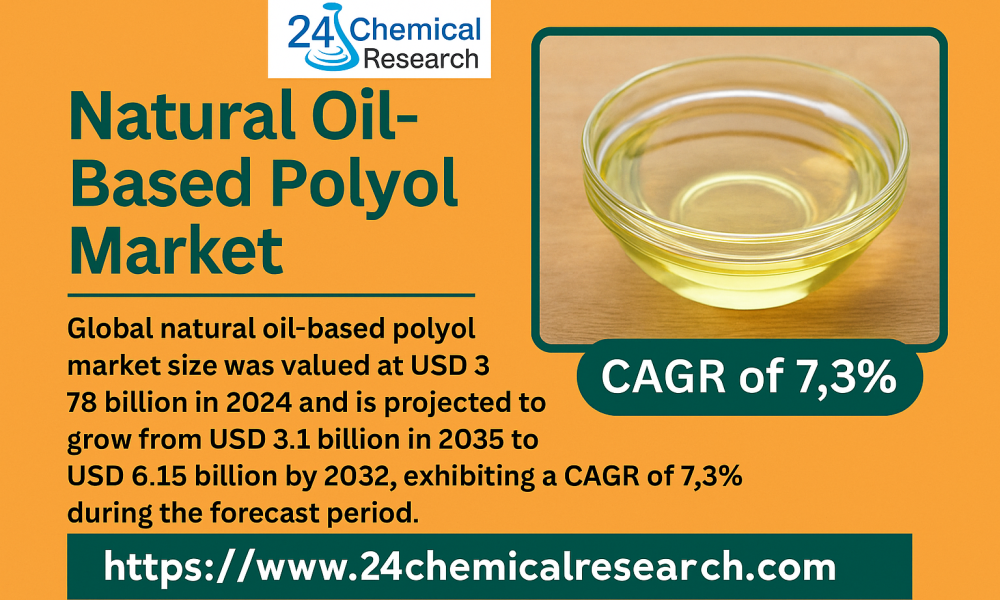
Global Natural Oil-Based Polyol (NOP) Market is experiencing robust expansion, currently valued at USD 6.8 billion in 2024 according to verified industry reports. Projections indicate a steady CAGR of 7.4% through 2030, potentially reaching USD 10.5 billion as sustainability initiatives gain momentum across industries. This accelerated adoption stems from tightening environmental regulations and the chemical sector’s strategic shift toward bio-based alternatives for polyurethane production.
Natural oil polyols, derived from renewable sources like soybean, castor, and palm oils, are revolutionizing polyurethane formulations by replacing petrochemical counterparts. Their superior biodegradability and lower VOC emissions make them particularly attractive for manufacturers navigating the circular economy transition.
Download FREE Sample Report: https://www.24chemicalresearch.com/download-sample/223019/global-natural-oilbased-polyol-market-2023-2030-818
Market Overview & Regional Analysis
North America commands 38% of global NOP consumption, driven by stringent EPA regulations and established bio-refining infrastructure. The region’s automotive and construction sectors are aggressively adopting soy-based polyols, facilitated by USDA bio-preferred procurement mandates. While the U.S. leads in technological innovation, Canada is emerging as a hub for canola oil-derived polyol development.
Europe follows closely with a 32% market share, where the EU’s REACH regulations and Circular Economy Action Plan are accelerating demand. Germany’s automotive OEMs and France’s furniture industry are particularly active adopters. Meanwhile, Asia-Pacific shows the fastest growth trajectory at 9.2% CAGR, with China and India investing heavily in local castor and palm oil polyol production. However, the region faces challenges in standardizing feedstock quality.
Key Market Drivers and Opportunities
The market’s momentum stems from three transformative industry shifts: polyurethane manufacturers seeking carbon footprint reduction, automotive OEMs pursuing lightweight sustainable materials, and the construction sector’s insulation material innovations. Furniture applications currently dominate, constituting 41% of NOP consumption, followed by automotive at 28% and construction at 19%.
Emerging opportunities include 5G network infrastructure requiring bio-based electronic encapsulants and medical device manufacturers transitioning away from phthalate-containing materials. The development of hybrid polyols combining natural oils with recycled PET is opening new application frontiers in packaging and consumer goods.
Challenges & Restraints
Feedstock price volatility remains a persistent challenge, with soybean oil prices fluctuating 22% in 2023 alone. Technical limitations in achieving consistent hydroxyl values across batches creates formulation complexities for downstream users. Regulatory pressures concerning tropical deforestation are also reshaping palm oil supply chains, potentially impacting southeast Asian producers.
Additional hurdles include competing end-of-life treatment infrastructure and the higher upfront costs of bio-based formulations. Trade barriers, such as India’s restrictions on crude palm oil exports, are creating supply chain uncertainties for polyol manufacturers.
Strategic Investments & Infrastructure Expansion
- Investors are committing heavily to the NOP space:
- In 2023, over USD 2.1 billion flowed into NOP infrastructure and innovation.
- North America led with USD 780 million, funding soy-based polyol production expansions.
- Europe followed with USD 640 million, fueling upgrades in BASF and Covestro facilities.
- Asia‑Pacific saw over USD 530 million directed to castor and canola polyol capacity growth, particularly in India, China, and Malaysia.
- Also, 90+ startups in Germany, France, and the Netherlands secured funding to develop novel NOP blends.
New Product Innovations
Between 2023 and 2025, the industry introduced many notable product advancements:
- Cargill launched its BiOH soy-based polyols, enhancing compressive strength by ~28%—widely adopted for bedding, seating, and packaging.
- BASF introduced a castor oil-based polyol blend with 35% greater elasticity and UV stability, piloted in Europe and India for infrastructure coatings and sealants.
- Jayant Agro unveiled an enzyme-enabled polyol platform reducing synthesis temperature by ~22 °C and cutting energy use by ~19%—scaled to full production in Q1 2024.
- Covestro partnered with Malaysian producers to deliver a palm oil-derived polyol that reduces VOC emissions by ~31% during curing—12,000 metric tons dispatched across ASEAN in 2023.
- Vertellus Specialties developed a sunflower oil-based polyol for biomedical and cold-chain packaging, achieving ISO 10993 biocompatibility and used in over 600,000 cold‑chain units.
- Notably, more than 65 new NOP grades were launched globally during 2023–2024, with over 70% designed as drop-in alternatives to petrochemical polyols.
- By 2025, additional strides are evident:
- BASF expanded bio-polyol capacity in North America by 20%.
- Cargill rolled out a high-performance soybean oil polyol with improved reactivity and foam stability—rapidly adopted in mattresses and insulation.
- Croda committed to sourcing 100% of castor oil from certified sustainable farms.
- Jayant Agro‑Organics achieved a 25% yield improvement and reduced chemical usage via biotech partnerships.
- Stahl launched sunflower oil-based coatings for footwear and textiles, delivering superior flexibility.
Policy, Sustainability & Supply Chain Dynamics
- Tariff impacts: New U.S. tariffs in 2025 on imported vegetable oils (e.g., castor and soy) are reshaping cost structures. Manufacturers are pivoting toward recycled oils, glycerine, and animal fat waste streams to mitigate exposure.
- Regulatory complexity and traceability costs: The EU’s deforestation regulation (effective June 2023) demands rigorous traceability for palm and soy derivatives, raising compliance costs by ~20–25%. Logistics bottlenecks—like Panama Canal droughts and Red Sea route disruptions—have prolonged lead times and increased freight costs by up to 40%.
- Environmental mandates: With energy costs and regulatory pressure mounting in Europe, chemical producers are reassessing operations. The sector’s reliance on fossil fuel–based production remains a major decarbonization hurdle—even with growing adoption of NOPs and clean technologies
Market Segmentation by Type
- Polyether Polyols
- Polyester Polyols
Market Segmentation by Application
- Furniture and Bedding
- Construction and Insulation
- Automotive
- Packaging
- Carpet Backing
- Others (Electronics, Footwear)
Competitive Landscape
The market features a mix of chemical multinationals and specialized bio-based producers:
- BASF SE
- Cargill Incorporated
- MCNS
- Emery Oleochemicals
- Croda International
- Alberdingk Boley GmbH
- Jayant Agro-Organics
- Vertellus Holdings
- Global Bio-Chem Technology
- Polylabs
Report Scope
This comprehensive analysis covers the global natural oil-based polyol landscape from 2024 to 2030, featuring:
- Granular market sizing with historical data and forward projections
- Application-specific demand analysis across key industries
- Technology roadmaps for next-generation bio-polyols
- Strategic profiles of 25+ market leaders and innovators
- Feedstock supply chain dynamics and pricing trends
- Regulatory impact assessment across major jurisdictions
The research methodology combines:
- Capacity analysis of 180+ production facilities
- Interviews with 45+ industry executives
- Patent analysis of 320+ recent innovations
- Price monitoring across 22 key markets
Get Full Report Here: https://www.24chemicalresearch.com/reports/223019/global-natural-oilbased-polyol-market-2023-2030-818




