
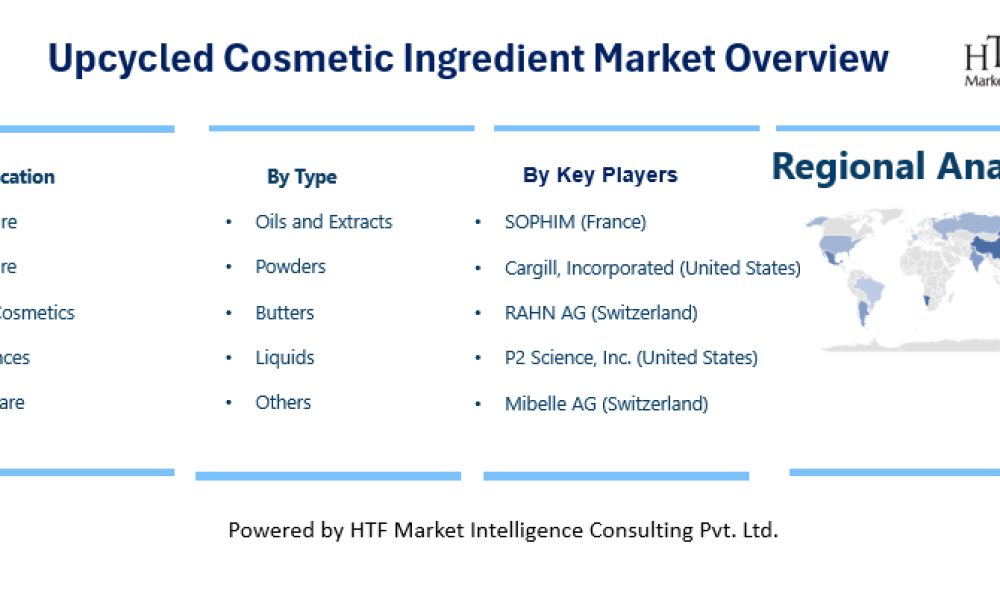
HTF MI just released the Global Upcycled Cosmetic Ingredient Market Study, a comprehensive analysis of the market that spans more than 143+ pages and describes the product and industry scope as well as the market prognosis and status for 2025–2031. The marketization process is being accelerated by the market study’s segmentation by important regions. The market is currently expanding its reach.
𝐌𝐚𝐣𝐨𝐫 𝐜𝐨𝐦𝐩𝐚𝐧𝐢𝐞𝐬 in Upcycled Cosmetic Ingredient Market are: SOPHIM (France), Cargill, Incorporated (United States), RAHN AG (Switzerland), P2 Science, Inc. (United States), Mibelle AG (Switzerland), Hair O’right International Corporation (Taiwan), OLVEA Group (France), Givaudan SA (Switzerland), Lignopure GmbH (Germany), Symrise (Germany), Innomost (France), BioVeritas (United States), Naturex (France), BASF SE (Germany), Croda International (UK), DSM (Netherlands), Amyris, Inc. (United States), Evonik Industries (Germany), Ashland Global Holdings (United States), Nouryon (Netherlands), Kerry Group (Ireland), Azelis (Belgium), Clariant (Switzerland).
𝐆𝐞𝐭 𝐂𝐮𝐬𝐭𝐨𝐦𝐢𝐳𝐞𝐝 𝐒𝐚𝐦𝐩𝐥𝐞 𝐍𝐨𝐰 👉 https://www.htfmarketintelligence.com/sample-report/global-upcycled-cosmetic-ingredient-market?utm_source=Krati_NewsTrail&utm_id=Krati
According to HTF Market Intelligence, the global Upcycled Cosmetic Ingredient Market size was valued at USD 252 Million in 2024 and estimated to reach revenue of USD 405.1Million by 2031, with a CAGR of 7.02% from 2025 to 2031.
The Upcycled Cosmetic Ingredient Market is Segmented by Application (Skin Care, Hair Care, Color Cosmetics, Fragrances, Body Care) by Type (Oils and Extracts, Powders, Butters, Liquids, Others)
Definition:
Upcycled cosmetic ingredients are functional materials derived from industrial or agricultural by-products that would otherwise be discarded, transformed into safe, consistent inputs for skincare, haircare, and personal care formulations. Common sources include fruit pomace, coffee chaff, nut shells, and spent botanicals from beverage or fragrance production. Through mechanical pressing, green chemistry extraction, enzymatic treatments, or microbial bioconversion, suppliers recover oils, antioxidants, fibers, exfoliants, and bioactive fractions. Quality programs address traceability, contaminant screening, allergen management, and reproducibility through blending and specs. Documentation packages cover regulatory status, safety, stability, and performance data so formulators can integrate these ingredients with confidence. Upcycling ties sustainability storytelling to measurable waste reduction and often local supply partnerships, enabling brands to differentiate on circularity while meeting efficacy and sensory expectations.
Market Trends:
Suppliers develop solvent-free extraction, enzymatic hydrolysis, and fermentation to unlock peptides, polyphenols, and fibers from side streams. Certifications (vegan, COSMOS) and LCA-backed claims gain prominence. Storytelling extends to farmer partnerships and local origin. Formats span cold-pressed oils, micro-exfoliants, and concentrated actives for serums. Data rooms with stability, allergen, and performance dossiers accelerate brand R&D and regulatory submissions across global markets.
Market Drivers
Beauty brands seek authentic sustainability stories and novel actives; upcycling valorizes agricultural and food by-products (fruit seeds, coffee grounds, spent grains) into oils, exfoliants, and bioactives. Tightening waste regulations and retailer clean-label standards drive adoption. Consumers reward traceable sourcing and circularity claims, while indie brands experiment rapidly, creating demand for standardized, tested ingredients with consistent sensory and efficacy profiles.
Market Opportunities:
Build long-term contracts with food and ag processors for predictable side streams. Invest in standardized extraction and blending to smooth variability. Co-develop hero actives with brands, sharing IP and exclusivity windows. Offer turnkey documentation (SDS, TDS, LCAs, safety assessments) to reduce buyer friction. Expand into haircare and scalp health where exfoliants and antioxidants can command premium positioning tied to credible performance narratives.
Market Challenges:
Feedstock variability threatens batch consistency and scale. Ensuring safety, allergen control, and contaminant limits is costly. Regulatory navigation for cosmetic ingredient approvals varies by region. Price competition from conventional inputs remains strong. Proving efficacy beyond “green” claims requires robust in vitro/in vivo testing, raising development timelines for smaller suppliers and constraining the pipeline of commercially viable, hero ingredients.
Dominating Region:
Europe
Fastest-Growing Region:
North America
Have a query? Market an enquiry before purchase 👉 https://www.htfmarketintelligence.com/enquiry-before-buy/global-upcycled-cosmetic-ingredient-market?utm_source=Krati_NewsTrail&utm_id=Krati
The titled segments and sub-section of the market are illuminated below:
In-depth analysis of Upcycled Cosmetic Ingredient market segments by Types: Oils and Extracts, Powders, Butters, Liquids, Others
Detailed analysis of Upcycled Cosmetic Ingredient market segments by Applications: Skin Care, Hair Care, Color Cosmetics, Fragrances, Body Care
Global Upcycled Cosmetic Ingredient Market –𝐑𝐞𝐠𝐢𝐨𝐧𝐚𝐥 𝐀𝐧𝐚𝐥𝐲𝐬𝐢𝐬
- North America: United States of America (US), Canada, and Mexico.
• South & Central America: Argentina, Chile, Colombia, and Brazil.
• Middle East & Africa: Kingdom of Saudi Arabia, United Arab Emirates, Turkey, Israel, Egypt, and South Africa.
• Europe: the UK, France, Italy, Germany, Spain, Nordics, BALTIC Countries, Russia, Austria, and the Rest of Europe.
• Asia: India, China, Japan, South Korea, Taiwan, Southeast Asia (Singapore, Thailand, Malaysia, Indonesia, Philippines & Vietnam, etc) & Rest
• Oceania: Australia & New Zealand
Upcycled Cosmetic Ingredient Market Research Objectives:
– Focuses on the key manufacturers, to define, pronounce and examine the value, sales volume, market share, market competition landscape, SWOT analysis, and development plans in the next few years.
– To share comprehensive information about the key factors influencing the growth of the market (opportunities, drivers, growth potential, industry-specific challenges and risks).
– To analyze the with respect to individual future prospects, growth trends and their involvement to the total market.
– To analyze reasonable developments such as agreements, expansions new product launches, and acquisitions in the market.
– To deliberately profile the key players and systematically examine their growth strategies.
FIVE FORCES & PESTLE ANALYSIS:
In order to better understand market conditions five forces analysis is conducted that includes the Bargaining power of buyers, Bargaining power of suppliers, Threat of new entrants, Threat of substitutes, and Threat of rivalry.
• Political (Political policy and stability as well as trade, fiscal, and taxation policies)
• Economical (Interest rates, employment or unemployment rates, raw material costs, and foreign exchange rates)
• Social (Changing family demographics, education levels, cultural trends, attitude changes, and changes in lifestyles)
• Technological (Changes in digital or mobile technology, automation, research, and development)
• Legal (Employment legislation, consumer law, health, and safety, international as well as trade regulation and restrictions)
• Environmental (Climate, recycling procedures, carbon footprint, waste disposal, and sustainability)
Buy Now Latest Edition of Global Upcycled Cosmetic Ingredient Market Report 👉 https://www.htfmarketintelligence.com/buy-now?format=1&report=16392?utm_source=Krati_NewsTrail&utm_id=Krati
Points Covered in Table of Content of Global Upcycled Cosmetic Ingredient Market:
Chapter 01 – Upcycled Cosmetic Ingredient Executive Summary
Chapter 02 – Market Overview
Chapter 03 – Key Success Factors
Chapter 04 – Global Upcycled Cosmetic Ingredient Market – Pricing Analysis
Chapter 05 – Global Upcycled Cosmetic Ingredient Market Background or History
Chapter 06 — Global Upcycled Cosmetic Ingredient Market Segmentation (e.g. Type, Application)
Chapter 07 – Key and Emerging Countries Analysis Worldwide Upcycled Cosmetic Ingredient Market
Chapter 08 – Global Upcycled Cosmetic Ingredient Market Structure & worth Analysis
Chapter 09 – Global Upcycled Cosmetic Ingredient Market Competitive Analysis & Challenges
Chapter 10 – Assumptions and Acronyms
Chapter 11 – Upcycled Cosmetic Ingredient Market Research Method
Thanks for reading this article; you can also get individual chapter-wise sections or region-wise report versions like North America, LATAM, Europe, Japan, Australia or Southeast Asia.
About Author:
HTF Market Intelligence Consulting is uniquely positioned to empower and inspire with research and consulting services to empower businesses with growth strategies, by offering services with extraordinary depth and breadth of thought leadership, research, tools, events, and experience that assist in decision-making.
Contact Us:
Krati Bhawsar (PR & Marketing Manager)
HTF Market Intelligence Consulting Private Limited
[email protected]
Phone: +15075562445