
Overview
AI in Remote Patient Monitoring (RPM) refers to the integration of artificial intelligence technologies—such as machine learning, natural language processing, and predictive analytics—into systems designed to track and manage patient health remotely. These tools analyze data gathered from wearable devices, mobile applications, and connected health sensors to monitor parameters like heart rate, blood pressure, glucose levels, and oxygen saturation. The use of AI enhances RPM by offering accurate insights and timely alerts for early intervention.
The global AI in Remote Patient Monitoring market is witnessing significant growth due to the increasing burden of chronic diseases and the need for continuous health monitoring. Patients with conditions such as diabetes, cardiovascular diseases, and respiratory disorders benefit from these systems through real-time supervision and data-driven care delivery. Hospitals and care providers are increasingly relying on AI-powered RPM to reduce unnecessary hospital visits and improve clinical outcomes.
This market is further supported by the aging global population, as elderly individuals require round-the-clock health monitoring. AI-enabled RPM allows healthcare teams to deliver personalized, at-home care while minimizing costs and reducing dependency on hospital infrastructure. The growing adoption of wearable technologies is another critical factor that complements the utility of AI in RPM.
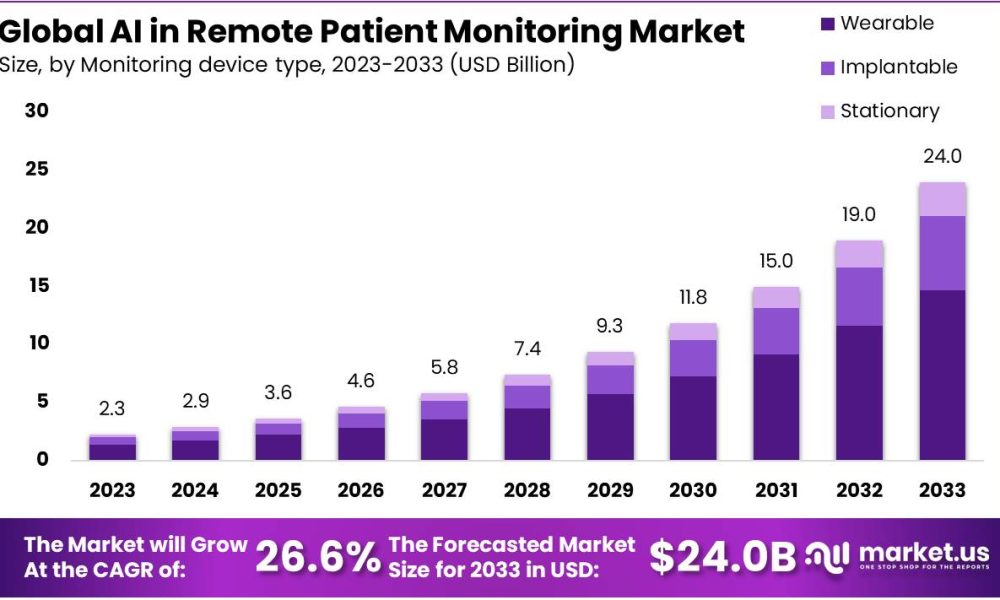
The AI in Remote Patient Monitoring market was valued at USD 2.3 Billion in 2023 and is projected to reach USD 24 Billion by 2033. It is expected to grow at a robust CAGR of 26.6% during the forecast period from 2024 to 2033. This growth is driven by the demand for value-based care and advancements in cloud-based analytics.
Regulatory initiatives and reimbursement policies by public health authorities and insurance providers are also influencing the market. These measures promote the adoption of AI-powered RPM tools and encourage innovation in remote care delivery. Furthermore, the integration of RPM solutions with electronic health records (EHRs) ensures seamless access to patient data and enables more informed clinical decisions.
The market is experiencing strong momentum from technology vendors, healthcare providers, and investors alike. Strategic collaborations, R&D initiatives, and digital transformation efforts continue to shape the competitive landscape of AI in RPM. This rising demand for automated, efficient, and patient-centric care models is expected to drive sustained market expansion.
Growth Factors: AI in Remote Patient Monitoring
The global rise in chronic diseases—including diabetes, cardiovascular disorders, and respiratory conditions—has intensified the need for continuous patient monitoring. AI-integrated RPM tools provide real-time insights, allowing early detection and prompt response to health deteriorations. This improves patient care quality while lowering the need for hospital readmissions, positioning AI in RPM as a critical component in chronic disease management strategies.
Post-pandemic, telehealth services have expanded rapidly, creating a fertile ground for AI integration in remote care models. As healthcare providers shift to digital and decentralized systems, AI-enhanced RPM platforms help manage patient data remotely with greater accuracy and efficiency. The growing reliance on virtual care has cemented the role of AI in streamlining diagnostics and automating alert systems.
The increasing geriatric population is a key growth driver. Older adults are more likely to suffer from chronic illnesses and functional limitations. AI-powered RPM systems offer proactive health management for the elderly by ensuring consistent monitoring and timely interventions without requiring frequent hospital visits. This has made RPM essential for aged care providers.
Advancements in artificial intelligence and machine learning have significantly improved the predictive capabilities of RPM platforms. These systems now identify subtle health changes, forecast complications, and support clinical decision-making. This enhances the precision and responsiveness of remote patient monitoring and expands its use across different medical conditions and age groups.
Wearable devices have become increasingly sophisticated and accessible. Smartwatches, biosensors, and fitness trackers generate vast health datasets. When integrated with AI, these tools allow real-time health tracking and dynamic patient profiling. The continuous data stream improves monitoring accuracy and supports personalized treatment approaches based on individual health patterns.
Healthcare systems worldwide are under pressure to reduce operational costs while improving service delivery. AI-based RPM systems help address this challenge by minimizing emergency visits and optimizing resource use. Cost-effectiveness and operational efficiency are pushing both private and public healthcare sectors to adopt AI-enabled monitoring solutions at scale.
Support from government bodies and insurance payers has further accelerated the market. Incentives for remote monitoring adoption, favorable regulatory frameworks, and reimbursement policies encourage both providers and patients to integrate AI-based RPM solutions. These policy initiatives reduce barriers and enhance accessibility for wider populations.
The growing availability of cloud infrastructure and big data analytics platforms is also a major enabler. AI-powered RPM systems rely on these technologies to process and analyze vast amounts of health data in real-time. Moreover, the integration with EHRs ensures that clinicians receive comprehensive, up-to-date insights, improving care coordination and patient outcomes.
Key Takeaways
- In 2023, the wearable segment dominated the AI in remote patient monitoring market, driven by rising adoption of smart health-tracking devices among patients.
- The software segment captured an impressive 75.3% market share due to its increasing role in accurate diagnosis and personalized treatment planning.
- Among technologies, machine learning emerged as the leading segment in 2023, valued for its ability to analyze complex health data efficiently.
- Chronic disease management accounted for the largest application share, highlighting the growing use of AI solutions in long-term health condition monitoring.
- The rising burden of chronic diseases and cost benefits of AI-powered RPM tools have significantly accelerated market growth in recent years.
- However, limited awareness of AI-based RPM and underdeveloped healthcare infrastructure continue to hinder broader market adoption, especially in low-resource regions.
Segmentation Analysis
In 2023, the wearable segment led the global AI in remote patient monitoring (RPM) market by capturing a dominant revenue share of 61.2%. This segment plays a crucial role in enhancing remote monitoring technology. Wearable devices enable continuous tracking of vital signs like heart rate, blood pressure, and oxygen saturation. These features help healthcare professionals detect early health changes. Devices such as Fitbit’s Sense 2, Inspire 2, and Versa 2 highlight technological advancements, offering real-time health data monitoring through sensors and smart tracking functions.
On the basis of component, the software segment exhibited dominance in the AI in RPM market with an impressive 75.3% market share in 2023. The surge in demand for AI-based software tools is attributed to the rising use of remote monitoring systems. These tools support healthcare professionals in managing patient data efficiently, regardless of the patient’s location. During the COVID-19 pandemic, remote patient care became vital. For instance, Philips’ IntelliSpace Corsium platform enables real-time monitoring of chronic conditions, assisting clinicians in making timely and informed decisions.
From a technological perspective, machine learning emerged as the leading segment, securing a significant market share of 53.9% in 2023. This dominance is due to its ability to process vast datasets and offer precise predictions. Machine learning algorithms analyze patient data from wearables, sensors, and monitors. By identifying anomalies and deviations from normal health patterns, it helps clinicians recognize risks and intervene early. This predictive ability plays a crucial role in enhancing diagnostic accuracy and supporting real-time clinical decisions.
In terms of application, chronic disease management remained the most prominent use case, accounting for a 55.2% market share in 2023. This segment is growing due to the increasing prevalence of chronic illnesses like diabetes, hypertension, and cardiovascular disease. AI-powered RPM tools provide ongoing tracking of patient symptoms, vital signs, and medication adherence. These systems offer healthcare providers actionable insights to improve patient care. According to the International Diabetes Federation, the global diabetic population may reach 6,487 million by 2030, further boosting the need for AI-driven chronic disease management solutions.
By Monitoring Device Type
- Wearable
- Implantable
- Stationary
By Component
- Hardware
- Software
- Services
By Technology
- Machine Learning
- Natural Language Processing
- Computer Vision
- Others
By Application
- Chronic Disease Management
- Geriatric Care Management
- Sleep Apnea Monitoring
- Fitness Monitoring
- Other
Regional Analysis
In 2023, North America dominated the global AI in remote patient monitoring (RPM) market, securing a commendable market share of 29.9%. This performance highlights the region’s robust healthcare infrastructure and the strong presence of established technology firms. The market growth in this region can be attributed to its proactive approach toward integrating AI technologies in healthcare. Additionally, the increasing demand for real-time patient monitoring solutions across various clinical settings supports regional market expansion.
The prevalence of chronic diseases such as diabetes, cardiovascular disorders, and respiratory illnesses has risen significantly in North America. This growing burden of chronic conditions has created an urgent need for continuous health tracking and personalized care. As a result, AI-based RPM tools are increasingly being adopted to ensure better patient outcomes. These tools enable early diagnosis and timely medical intervention, thereby reducing hospital readmission rates and supporting efficient resource management.
North America also maintains strict regulatory standards for healthcare technologies, including AI-driven medical devices and platforms. These regulations ensure safety, quality, and accuracy, thereby increasing end-user trust and accelerating technology adoption. Compliance with frameworks set by bodies such as the U.S. Food and Drug Administration (FDA) is seen as a key driver enhancing credibility and fostering market growth in the region.
Furthermore, the region’s advanced digital infrastructure contributes to the expansion of AI in RPM solutions. High smartphone penetration, widespread internet access, and growing use of social media have significantly improved communication and data transmission. These technological advantages, combined with improvements in network capabilities, enable seamless integration of AI in remote care delivery, solidifying North America’s leadership position in this market.
Get Sample: https://market.us/report/ai-in-remote-patient-monitoring-market/request-sample/
Get in Touch with Us:
Market.us (Powered By Prudour Pvt. Ltd.)
Address: 420 Lexington Avenue, Suite 300, New York City, NY 10170, United States.
Contact No: +1 718 874 1545 (International), +91 78878 22626 (Asia).
Email: [email protected]
View More



