
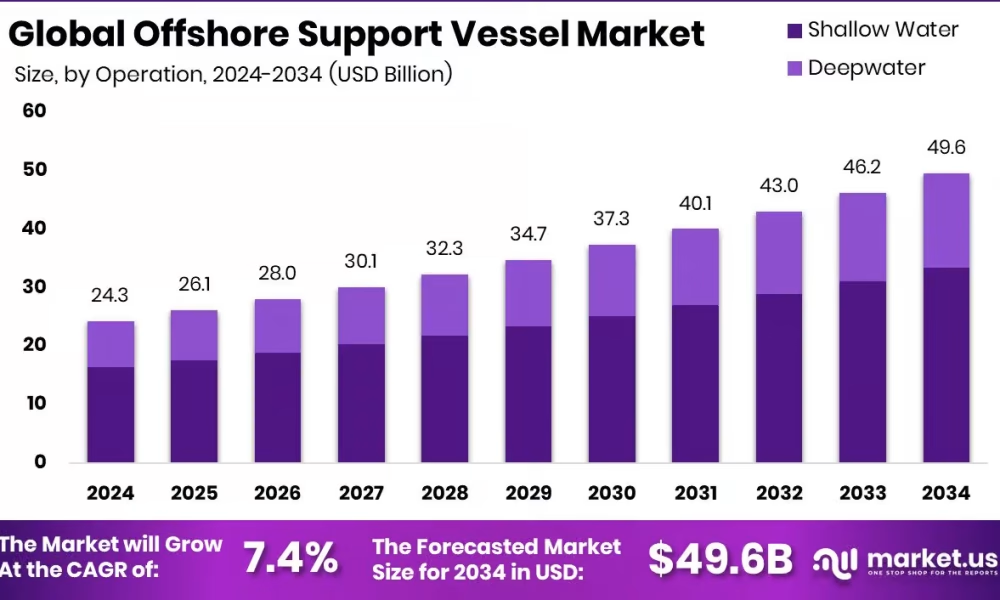
According to market.us, the global Offshore Support Vessel (OSV) market is projected to reach USD 49.6 billion by 2034, rising from USD 24.3 billion in 2024, growing at a CAGR of 7.4% between 2025 and 2034. This growth is primarily driven by increasing offshore drilling and energy exploration activities. North America accounts for a significant 43.3% of the demand, supported by ongoing fleet expansions.
OSVs play a critical role in servicing offshore oil and gas platforms, wind farms, and subsea infrastructure by transporting personnel, equipment, and supplies. The market’s expansion is closely linked to deepwater and complex field developments as shallow reserves decline. Governments are also issuing new offshore leases, creating greater demand for advanced, multi-functional vessels.
In this context, Shuaa Capital has secured USD 300 million to expand what is now the fourth-largest OSV fleet globally. The sector is also benefiting from growth in offshore wind energy. OSVs are increasingly vital for construction, maintenance, and logistics in offshore wind farms.
Alphard Maritime is set to launch a USD 500 million investment fund dedicated to offshore shipping. According to the U.S. Department of Energy’s NREL, the global offshore wind pipeline reached 453.6 GW by end-2023, including 104.4 GW from floating wind, requiring highly specialized vessel operations.
Key Takeaways
- Global Offshore Support Vessel Market is expected to be worth around USD 49.6 billion by 2034, up from USD 24.3 billion in 2024, and grow at a CAGR of 7.4% from 2025 to 2034.
- In 2024, Anchor Handling Tug Supply vessels led the Offshore Support Vessel Market with 29.3% share dominance.
- Shallow Water operations captured a commanding 67.3% share in the Offshore Support Vessel Market in 2024.
- Diesel-powered vessels accounted for 83.5%, making them the most widely used in the Offshore Support Vessel Market.
- The Oil and Gas sector dominated end-use, securing a 73.4% share in the Offshore Support Vessel Market.
- The North American market reached a total value of USD 10.5 billion in 2024.
Access a Complimentary Sample of This Premium Report: https://market.us/report/offshore-support-vessel-market/request-sample/
Factors Affecting the Growth of the Offshore Support Vessel Market
Expansion of Offshore Oil and Gas Exploration: As easily accessible onshore and shallow-water reserves continue to decline, energy companies are increasingly shifting towards deepwater and ultra-deepwater fields. These environments demand specialized vessels for logistics, anchor handling, and subsea support, thereby driving OSV demand.
Surge in Offshore Wind Energy Projects: The rapid growth of offshore wind farms, particularly in regions like Europe, Asia, and North America, is generating a consistent need for support vessels. OSVs play an essential role in transporting equipment, conducting maintenance operations, and supporting the construction of wind turbines at sea.
Technological Advancements in Vessel Capabilities: The evolution of vessel technologies, such as dynamic positioning systems, hybrid propulsion, and autonomous operations, is improving the operational efficiency and safety of OSVs. These innovations are expanding the application range of OSVs and encouraging fleet modernization.
Government Policies and Offshore Lease Allocations: National policies that support offshore energy development, including leasing new offshore blocks, significantly influence OSV market activity. Regulatory approvals and long-term energy transition plans boost operator confidence and lead to higher vessel deployment.
Global Energy Demand and Infrastructure Investment: Rising global energy consumption is encouraging offshore infrastructure investments across hydrocarbons and renewables. This is leading to increased activity in offshore fields and sustained utilization of support vessels for supply, maintenance, and construction services.
Key Market Segmentation
By Type Analysis
In 2024, Anchor Handling Tug Supply (AHTS) vessels led the Offshore Support Vessel Market by type, holding a dominant 29.3% market share. This position is attributed to the growing demand from offshore oil and gas drilling operations that require vessels capable of anchor handling, rig towing, and supporting deepwater activities.
AHTS vessels are preferred for their robust design and multipurpose functionality, making them suitable for harsh and remote marine environments. Their combined roles in logistics and anchor operations offer a clear advantage over more specialized vessels. They are especially vital in regions with deepwater drilling and floating production systems, where managing heavy subsea infrastructure is critical.
Even in mature offshore fields, the demand for AHTS vessels remains strong due to their ongoing role in equipment maintenance and repositioning. As exploration expands into deeper, more complex waters, the high bollard pull capacity and operational versatility of AHTS vessels are expected to ensure continued market dominance.
By Operation Analysis
In 2024, shallow water operations dominated the Offshore Support Vessel Market by operation type, capturing a 67.3% share. This strong position is primarily due to the ongoing reliance on mature shallow water oil fields and the cost advantages they offer.
Shallow water projects require lower capital investment and are more accessible than deepwater operations, making them attractive for companies aiming to sustain production while minimizing costs. Vessels used in these zones are smaller, more economical, and suited for shorter transport distances and lighter loads.
Their lower maintenance and fuel requirements further enhance their appeal. Many national oil companies and regional operators continue to prioritize shallow water due to existing infrastructure and quicker project timelines. These combined factors reinforced the segment’s leading role in offshore vessel deployment throughout 2024.
By Fuel Type Analysis
In 2024, diesel-powered vessels led the Offshore Support Vessel Market by fuel type, commanding an 83.5% market share. This dominance reflects the continued preference for diesel engines due to their reliability, cost-efficiency, and ability to perform under harsh offshore conditions. Diesel-powered vessels are favored for towing, anchor handling, and cargo transport, especially in remote areas where alternative fuel infrastructure is lacking.
Their ease of maintenance and the availability of global servicing networks further support operational efficiency. Despite emerging interest in cleaner propulsion technologies, diesel remained the most practical and widely used option across both shallow and deepwater operations, solidifying its leading position in the market.
By End-Use Analysis
In 2024, the oil and gas sector held a dominant 73.4% share in the Offshore Support Vessel Market by end-use. This strong position reflects the continued global dependence on offshore hydrocarbon production. OSVs are essential in this sector for transporting equipment, personnel, and supplies, as well as handling anchors, maintenance, and emergency tasks.
The large share highlights the intensity of offshore oil field operations, especially in regions with existing infrastructure and long-term investments. As projects move into deeper waters and servicing demands grow, the need for reliable, cost-effective vessel support remains high. This sustained reliance secured oil and gas as the leading end-use segment in 2024.
Key Market Segments
By Type
- Anchor Handling Tug Supply (AHTS) Vessels
- Platform Supply Vessels (PSVs)
- Multi-Purpose Support Vessels (MPSVs)
- Emergency Response and Rescue Vessels (ERRVs)
- Seismic Vessels
- Well Intervention Vessels
- Construction Support Vessels
- Crew Transfer Vessels (CTVs)
- Others
By Operation
- Shallow Water
- Deepwater
By Fuel Type
- Diesel-Powered
- Gas-Powered
By End-Use
- Oil and Gas
- Offshore Wind
- Others
Regional Analysis
In 2024, North America dominated the global Offshore Support Vessel Market with a 43.3% share, valued at USD 10.5 billion. This leadership is driven by robust offshore oil and gas activities in the Gulf of Mexico, supported by strong maritime infrastructure and a favorable regulatory environment. Europe followed with continued demand for maintenance services in mature platforms, particularly in the North Sea.
Asia Pacific showed steady growth due to coastal energy development, while the Middle East & Africa relied on fleets for large-scale offshore projects. Latin America held a smaller share, mainly due to deepwater exploration. North America’s scale, investment, and resource access firmly positioned it as the leading region in both revenue and vessel deployment.
Top Key Players in the Market
- Tidewater Inc.
- Maersk Supply Service A/S
- Bourbon
- Seacor Marine Holdings Inc.
- Solstad Offshore ASA
- Deltamarin Ltd
- Edison Chouest Offshore LLC
- Swire Pacific Limited
- Harvey Gulf International Marine LLC
- Hornbeck Offshore Services Inc.
- POSH (Singapore) Limited
- DOF Group
- Grupo CBO
- Havila Shipping ASA
- Nam Cheong Limited
- Vroon Group
- Other Key Players
Get in Touch with Us:
Market.us (Powered By Prudour Pvt. Ltd.)
Address: 420 Lexington Avenue, Suite 300 New York City, NY 10170, United States
Send Email: [email protected]
Refer to More Related Reports:



