
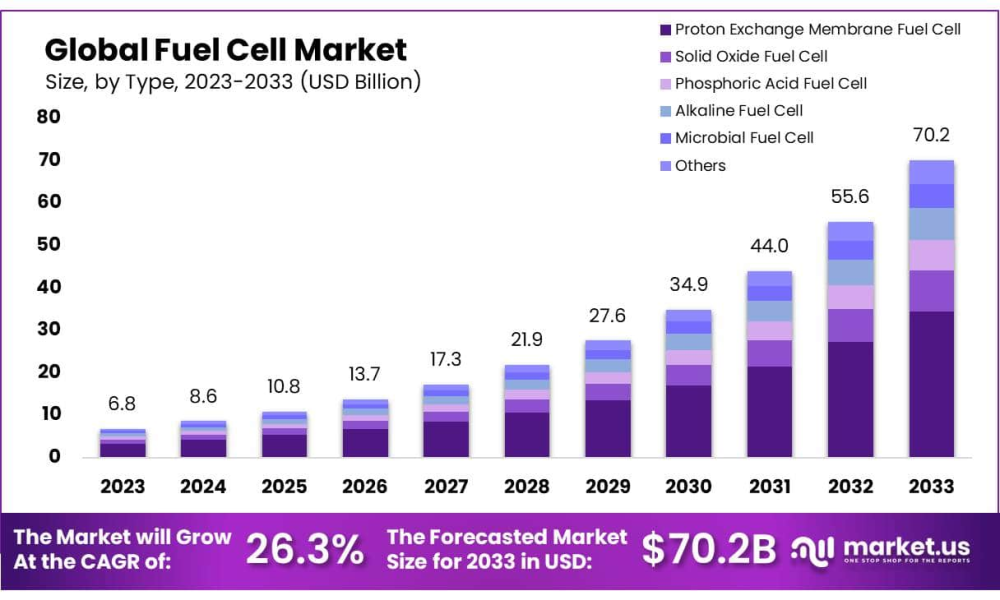
New York, NY – July 14, 2025 – The Global Fuel Cell Market is experiencing rapid growth, driven by increasing demand for clean energy solutions and the shift toward sustainable power generation. In 2023, the market was valued at USD 6.8 billion, but it is projected to surge to USD 70.2 billion by 2033, expanding at an impressive compound annual growth rate (CAGR) of 26.3% from 2024 to 2033.
The fuel cell market is experiencing robust growth in sectors like transportation, stationary power generation, and industrial applications. Hydrogen-powered vehicles, particularly fuel cell electric vehicles (FCEVs), are projected to reach global sales of 5.4 million units by 2030, fueled by rising demand for zero-emission transport solutions.
In 2022, global sales of fuel cell vehicles surpassed 10,000 units, with the International Energy Agency (IEA) forecasting a compound annual growth rate (CAGR) of approximately 40% through 2032 (IEA, 2023). Governments are accelerating fuel cell adoption through policies and funding. The European Union aims to produce 10 million tons of renewable hydrogen by 2030 under its hydrogen strategy.
The EU’s Hydrogen Backbone project, with a €43 billion investment, plans to develop a 23,700 km hydrogen infrastructure network by 2040 (European Commission, 2020). In the U.S., the Biden administration has allocated USD 8 billion to establish regional hydrogen hubs to support fuel cell vehicle deployment and stationary power systems. Global investments in hydrogen projects exceeded USD 1 billion in 2022, with significant funds directed toward fuel cell research and infrastructure.
Notable partnerships include Shell and Toyota’s collaboration to deploy 1,000 hydrogen-powered trucks by 2030 (Toyota, 2021) and Hyundai and SK Group’s USD 5 billion investment in a green hydrogen value chain in South Korea by 2030. The global hydrogen trade is expanding, with Australia and the Middle East emerging as key exporters. Australia projects hydrogen export revenues of USD 1.7 billion annually by 2040.
Meanwhile, the EU and Japan are set to become major importers, with Japan targeting 3 million tons of hydrogen imports annually by 2030. Innovations in fuel cell technology are driving efficiency and cost reductions. In 2022, Ballard Power Systems achieved a 30% reduction in fuel cell production costs through advancements in membrane technology.
Important Revelation
- Fuel Cell Market size is expected to be worth around USD 70.2 Bn by 2033, from USD 6.8 Bn in 2023, growing at a CAGR of 26.3%.
- Proton Exchange Membrane Fuel Cell (PEMFC) held a dominant market position, capturing more than 49.4%.
- Stack held a dominant market position, capturing more than a 59.5% share of the fuel cell market.
- Hydrogen held a dominant market position, capturing more than a 75.4% share of the fuel cell market.
- Small Scale held a dominant market position, capturing more than a 67.5% share of the fuel cell market.
- <100KW held a dominant market position, capturing more than a 47.8% share of the fuel cell market.
- Stationary held a dominant market position, capturing more than a 58.5% share of the fuel cell market.
- Commercial & Industrial held a dominant market position, capturing more than a 39.2% share.
- North America dominated the fuel cell market, holding a significant share of 39.7%, valued at approximately USD 2.5 billion.
➤ Download Exclusive Sample Of This Premium Report (Including Full TOC, Table & Figures): https://market.us/report/fuel-cell-market/request-sample/
Report Segmentation
By Type
- In 2023, the Proton Exchange Membrane Fuel Cells Market led the fuel cell market, accounting for over 49.4% of the global share. Their dominance was attributed to widespread use in automotive, portable electronics, and stationary power generation due to advantages such as high efficiency and low operating temperatures. Increasing adoption of eco-friendly transportation further propelled demand for PEMFCs.
- Solid Oxide Fuel Cell Market followed with notable market presence, driven by their high efficiency and application in stationary and industrial power systems. Phosphoric Acid Fuel Cells (PAFCs), commonly used in commercial and industrial sectors, secured a moderate share owing to their operational reliability and long service life.
- Alkaline Fuel Cell Market maintained a niche position, particularly in aerospace and military applications, valued for their simple design and low cost. Microbial Fuel Cells (MFCs), although still an emerging category, exhibited steady progress due to their sustainability potential in waste-to-energy and off-grid solutions.
By Components
- The stack segment was the largest contributor in 2023, securing more than a 59.5% share. As the central unit responsible for electrochemical energy conversion, stacks are essential for overall fuel cell performance. Rising deployment in automotive and stationary applications supported this segment’s growth.
- The Balance of Plant (BOP) segment, which includes supporting systems such as fuel processors, compressors, and thermal control units, played a vital role in ensuring operational stability. Although smaller in share, this segment is gaining importance with increasing system integration in complex industrial settings.
By Fuel
- Hydrogen remained the most widely used fuel in 2023, holding over 75.4% of the market. Its zero-emission output, high energy density, and expanding production and storage infrastructure contributed to widespread acceptance, particularly in transport and industrial applications. Ammonia showed promise due to its storage advantages and high energy potential, though its use remained limited by infrastructure constraints.
- Methanol emerged as a viable alternative for portable and backup power due to its ease of handling. Ethanol, while similar to methanol, saw lower market penetration due to efficiency concerns. Hydrocarbons like natural gas retained niche usage in stationary applications where cost-efficiency and availability take precedence, although the trend favored cleaner fuels.
By Size
- Small-scale fuel cells dominated in 2023 with a 67.5% market share. They are widely used in portable and backup power systems, electric forklifts, and residential units, benefiting from compact size, flexibility, and low emissions. Their appeal was further boosted by increasing demand for clean off-grid power.
- Large-scale systems, though smaller in share, are gaining adoption in industrial sectors and energy-intensive installations like data centers and power plants due to their capability to provide stable, long-duration power.
By Power Output
- Fuel cells rated under 100 kW led the market in 2023 with a 47.8% share, largely used in residential setups and small businesses seeking off-grid or emergency power solutions. The 100–200 kW segment gained traction in mid-sized industrial and commercial environments due to its cost-efficiency and reliable output.
- Fuel cells above 200 kW, although representing a smaller portion, are critical for powering large-scale infrastructure, with demand growing as industries and cities explore sustainable alternatives to traditional fossil-based systems.
By Application
- Stationary fuel cell market dominated the application landscape in 2023, capturing over 58.5% of the market. These systems provide consistent and dependable power in off-grid, commercial, and residential installations. Increasing focus on grid independence and energy security contributed to their adoption.
- Portable fuel cell market, while holding a smaller share, gained popularity in electronics, military devices, and outdoor equipment for their long run times and environmental benefits. Fuel Cell Vehicles (FCVs), though in early deployment stages, witnessed accelerating growth due to the push for low-emission transportation and government-supported hydrogen initiatives.
By End-Use
- The commercial and industrial segment led in 2023, holding a 39.2% share. Businesses and manufacturing units increasingly adopted the fuel cell market for reliable power and lower emissions, particularly in critical operations. Residential applications followed, with rising interest from homeowners seeking cleaner backup energy and independence from conventional grids.
- The transportation sector also progressed, driven by growth in fuel cell electric vehicles (FCEVs) and heavy-duty fleet trials. Data centers emerged as a high-potential end-use sector, requiring uninterrupted, clean power. Military and defense usage grew steadily, supported by demand for portable, silent, and high-density energy. Government and utility applications also gained attention, particularly in grid support and carbon-reduction strategies.
Market Key Segmentation
By Type
- Proton Exchange Membrane Fuel Cell
- Solid Oxide Fuel Cell
- Phosphoric Acid Fuel Cell
- Alkaline Fuel Cell
- Microbial Fuel Cell
- Others
By Components
- Stack
- Balance of plant (BOP)
By Fuel
- Hydrogen
- Ammonia
- Methanol
- Ethanol
- Hydrocarbon
By Size
- Small Scale
- Large Scale
By Power Outage
- <100KW
- 100-200K
- >200KW
By Application
- Portable
- Stationary
- Fuel Cell Vehicles
- Others
By End-use
- Residential
- Commercial & Industrial
- Transportation
- Data Centers
- Military & Defense
- Utilities & Government/Municipal Institutes
- Others
Regional Analysis
In 2023, North America emerged as the leading region in the global fuel cell market, accounting for approximately 39.7% of the total share, with a market valuation of around USD 2.5 billion. This dominance is largely driven by strong policy support, advanced infrastructure, and a rising demand for clean energy technologies, particularly within the transportation and industrial sectors.
Europe followed closely, capturing a significant share of the global market, supported by ambitious climate targets and substantial funding for hydrogen-based technologies. The European Union’s Hydrogen Strategy, which outlines a projected investment of approximately €430 billion (USD 470 billion) by 2050, has laid a strong foundation for market growth.
Asia Pacific is rapidly positioning itself as a vital growth hub for fuel cell market technology, with countries like Japan, South Korea, and China making considerable advancements. Japan’s national hydrogen roadmap targets widespread deployment of hydrogen-powered vehicles and supporting infrastructure by 2030, while South Korea has committed over USD 1.4 billion to accelerate fuel cell market development.
While the markets in the Middle East & Africa and Latin America currently represent smaller shares, they are beginning to gain traction. Government-backed initiatives aimed at lowering carbon emissions and expanding access to sustainable energy solutions are fostering interest in fuel cell market technologies across these regions, indicating potential for steady future growth.
Competitive Landscape
- Air France-KLM
- Air India Ltd
- AirAsia
- AISIN
- Alaska Airlines Inc
- AVL
- Ballard Power Systems
- Batik Air
- Bloom Energy
- Blue World Technologies
- Bosch
- Ceres Power
- China Eastern Airlines
- Convion
- EasyJet PLC
- Elcogen
- ElringKlinger
- Emirates
- Etihad
- FuelCell Energy
- Horizon Fuel Cell Technologies
- Hydrogenics
- IndiGo
- ITM Power
- Jetstar Asia Airways
- Korean Air
- Mitsubishi Hitachi Power Systems
- Nedstack Fuel Cell Technology
- Nexceris LLC
- Nuvera Fuel Cells, LLC
- Plug Power
- Pragma Industries
- Proton Motor Fuel Cell GmbH
- Roland Gumpert
- SFS Energy AG
- Singapore Airlines
- SOLIDpower Italia
- W.L. Gore & Associates
Get in Touch with Us:
Market.us (Powered By Prudour Pvt. Ltd.)
Address: 420 Lexington Avenue, Suite 300, New York City, NY 10170, United States
Send Email: [email protected]
Refer To More Related Reports:
Energy Trading Platform Market
Adaptogenic Beverages Market
Cannabis Beverages Market



