
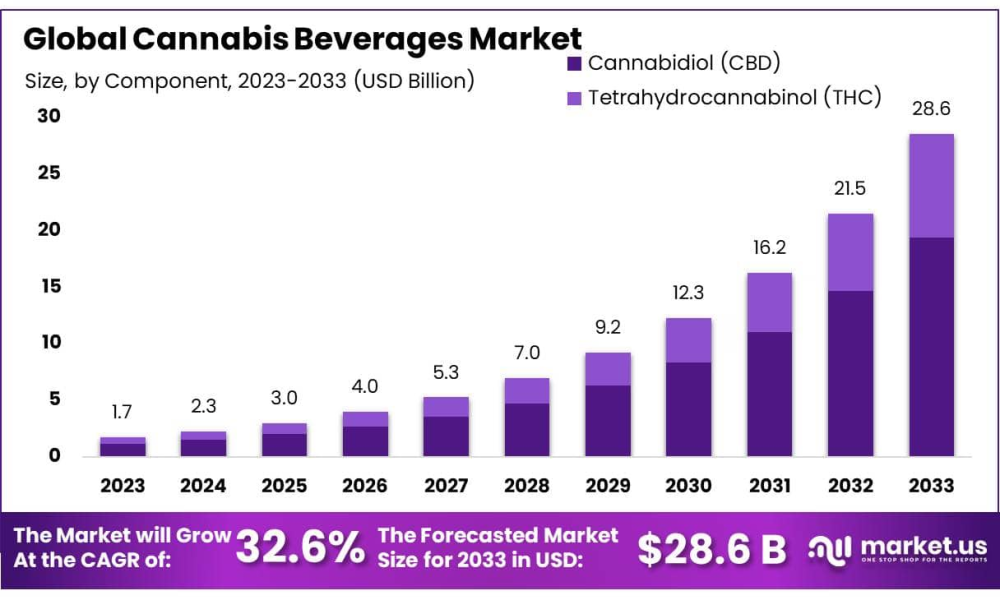
New York, NY – July 03, 2025 – The Global Cannabis Beverages Market is positioned for remarkable expansion, with its size anticipated to increase from USD 1.7 billion in 2023 to approximately USD 28.6 billion by 2033, representing a robust compound annual growth rate (CAGR) of 32.6 % from 2024 through 2033.
The regulatory environment plays a crucial role in shaping the cannabis beverages market. By the end of 2023, more than 40 countries had legalized some form of cannabis, each with its own set of restrictions concerning recreational and medical use. North America remains the dominant region, accounting for over 60% of global sales, largely supported by favorable regulations in the United States and Canada. Canada’s fully legalized cannabis industry provides a stable and structured platform for the growth of infused beverages.
In Europe, the sector is still in its early stages, with nations like Germany, Switzerland, and the Netherlands adopting medical cannabis frameworks and exploring recreational use legislation. Meanwhile, the Asia-Pacific region, though nascent, is expected to see promising expansion. By 2024, the region is projected to contribute around 12% to global market growth, with countries like Thailand and Australia driving adoption through progressive medical cannabis policies.
The global cannabis beverages market was valued at approximately USD 2.1 billion in 2023, fueled by rising consumer interest in wellness-oriented and socially acceptable cannabis formats. Non-alcoholic cannabis beverages held nearly 55% of the market share, reflecting a strong consumer shift toward alcohol alternatives. Millennials and Gen Z are the primary consumer base, responsible for over 65% of total purchases, signaling sustained demand among younger, health-conscious demographics.
Important Revelation
- The cannabis beverages market size is expected to be worth around USD 28.6 billion by 2033, from USD 1.7 billion in 2023, growing at a CAGR of 32.6%.
- Non-Alcoholic segment held a dominant position in the cannabis beverages market, capturing more than a 67.4% share.
- Cannabidiol (CBD) held a dominant market position in the cannabis beverages sector, capturing more than a 68.1% share.
- Household segment held a dominant position in the cannabis beverages market, capturing more than a 58.1% share.
- Mass Merchandisers held a dominant market position in the cannabis beverages market, capturing a share of more than 38.1%.
- North America dominated the cannabis beverages market, holding a significant 56.9% share and valuing approximately USD 0.9 billion.
➤ Download Exclusive Sample Of This Premium Report (Including Full TOC, Table & Figures): https://market.us/report/cannabis-beverages-market/request-sample/
Report Segmentation
By Type
- In 2023, the non-alcoholic segment led the cannabis beverages market with over 67.4% share, driven by demand for wellness-focused products like cannabis-infused coffee, tea, and juice. These beverages appeal to health-conscious consumers seeking stress relief and better sleep without THC’s psychoactive effects. In contrast, alcoholic cannabis drinks—such as beers and wines—grew at a slower pace due to regulatory limits and niche demand. Within non-alcoholic offerings, coffee and tea gained traction due to easy integration into daily routines, while cannabis-infused juices expanded rapidly, marketed for their health benefits.
By Component
- Cannabidiol (CBD) dominated the market in 2023, accounting for over 68.1% share. Its non-intoxicating nature and perceived health benefits, such as anxiety relief and wellness support, have driven widespread acceptance. CBD-infused waters, teas, and energy drinks gained popularity, boosted by expanding legalization. THC-infused beverages also grew, offering psychoactive effects through sodas and cocktails, particularly in legalized regions despite regulatory challenges.
By End-Use
- The household segment led in 2023 with over 58.1% share, as consumers increasingly opted for cannabis beverages at home for relaxation, wellness, or recreational use. Products like CBD teas and THC sodas gained popularity as alternatives to alcohol. The HoReCa sector is emerging, especially in progressive markets, where cannabis-friendly cafes and bars are offering infused beverages as unique social experiences.
Market Key Segmentation
By Type
- Alcoholic
- Wine
- Beer
- Others
- Non-Alcoholic
- Coffee
- Tea
- Juice
- Others
By Component
- Cannabidiol (CBD)
- Tetrahydrocannabinol (THC)
By End-Use
- Household
- HoReCa
By Distribution Channel
- Mass Merchandisers
- Specialty Stores
- Online Retail
- Others
Regional Analysis
North America led the global cannabis beverages market in 2023, capturing a dominant 56.9% share with an estimated value of USD 0.9 billion. This strong position is supported by widespread legalization across several U.S. states and Canada, a mature cannabis culture, and a well-developed production and retail ecosystem. Consumers in the region have shown growing interest in innovative cannabis-infused beverages, encouraged by advanced marketing and distribution strategies.
In Europe, the market is gaining momentum as regulatory frameworks evolve and social acceptance of cannabis continues to rise. Countries such as Germany, the Netherlands, and Switzerland are at the forefront, with progressive medical and recreational cannabis laws that support steady market development and improved access to cannabis beverages.
Factors Affecting the Growth of the Cannabis Beverages Market
1. Technological Innovation: Advances in nanoemulsion and extraction techniques have improved cannabinoid solubility and dosage consistency. These innovations have accelerated the onset time and enhanced the user experience, making cannabis beverages more reliable and appealing to both recreational and wellness consumers.
2. Regulatory Environment: Expanding legalization—especially hemp-derived products—has allowed market access in new jurisdictions. However, inconsistent rules on THC limits, labeling, and distribution create barriers. Companies must closely monitor evolving compliance standards to ensure safe, lawful market entry.
3. Consumer Health Trends: Growing interest in wellness and functional drinks is driving demand for cannabis-infused beverages. Many consumers choose these products for stress relief, relaxation, or sleep support. Lower sugar and alcohol-free formulations further align with broader shifts toward healthy lifestyles.
4. Market Distribution Channels: Products are increasingly available through diverse channels—dispensaries, cafés, online retailers, and sometimes convenience stores. HoReCa venues offering cannabis-infused menus provide experiential engagement. Strategic partnerships with beverage and alcohol distributors help widen reach.
5. Cost and Shelf-Life Challenges: Efficient production remains costly due to complex infusion processes and specialized packaging. In addition, limited shelf stability necessitates careful preservation strategies. These factors increase product prices and supply chain risks, influencing profitability and market competitiveness.
Competitive Landscape
- Aphria Inc
- ARTET, LLC
- Aurora Cannabis Inc.
- BellRock Brands (Dixie Brands)
- CANN SOCIAL TONICS
- CannTrust Holdings Inc.
- Canopy Growth Corporation
- Cronos Group Inc.
- FABLE
- GW Pharmaceuticals, plc.
- Keef Brands
- Mary Jones
- MedReleaf Corp.
- OrganiGram Holdings
- Teapot
- Tilray
- VCC BRANDS (CQ Drinks)
- VIVO Cannabis Inc.
Get in Touch with Us:
Market.us (Powered By Prudour Pvt. Ltd.)
Address: 420 Lexington Avenue, Suite 300, New York City, NY 10170, United States
Send Email: [email protected]
Refer More Related Reports:
Controlled Environment Agriculture Market
Self-Cleaning Coatings Market
Stationary Battery Storage Market



