
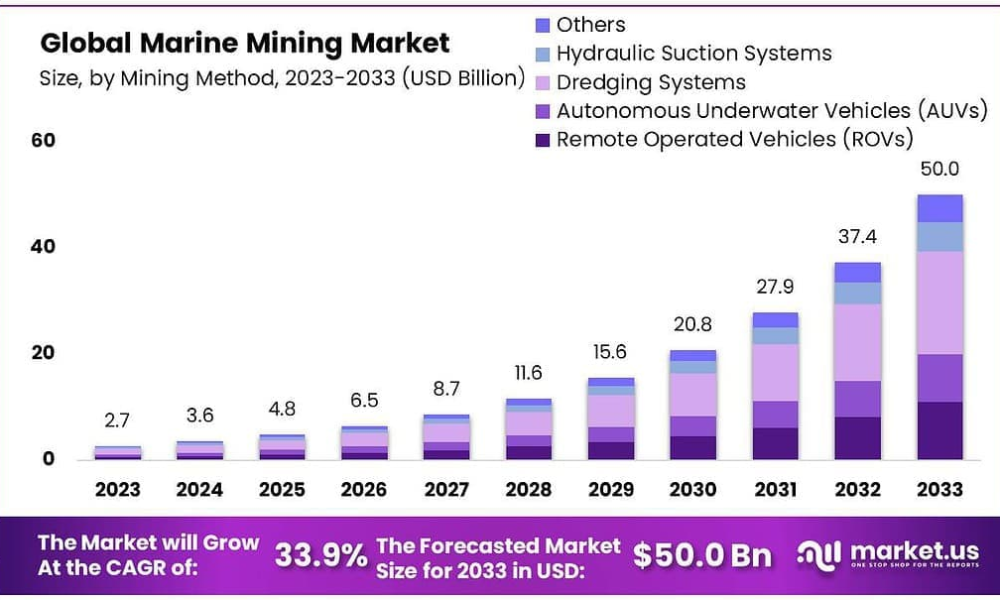
New York, NY – July 09, 2025 – The Global Marine Mining Market is experiencing unprecedented demand and rapid expansion, with its size projected to escalate from USD 2.7 billion in 2023 to approximately USD 50.0 billion by 2033, representing a robust compound annual growth rate (CAGR) of 33.9% during the 2024–2033 forecast period.
This growth can be attributed to escalating demand for rare earth elements, nickel, cobalt, and other critical minerals that are crucial for clean energy technologies, electric vehicles, and high-tech manufacturing. As terrestrial deposits are depleted, attention has shifted toward vast seabed reserves of polymetallic nodules, sulfides, and cobalt-rich crusts, providing significant market opportunities.
The rising popularity of remotely operated vehicles (ROVs) and autonomous exploration systems, facilitated by technological advances, has significantly enhanced operational efficiency and resource identification. Growth factors include increased urbanization, supportive government policies, and sustained corporate investment in the marine mining market infrastructure. Emerging markets are expanding, particularly within the Asia-Pacific region, which is benefiting from industrialization and increased resource demand.
Marine Mining Market opportunities are substantial, centered on sustainable deep-sea extraction, development of improved technologies such as precision ROVs and environmental monitoring systems, and clear regulatory frameworks. Overall, the marine mining market exhibits strong momentum driven by demand, innovation, regional expansion, and potential for high-return investment.
Important Revelation
- Marine Mining Market to reach USD 50.0 billion by 2033, growing at a CAGR of 33.9%.
- Dominant methods: Dredging Systems, ROVs, and AUVs.
- Polymetallic nodules and sulfides are lead resource types.
- Deep-Sea Mining captured a 76.8% market share in 2023.
- Environmental challenges constrain market growth but spur sustainable practices.
- Asia Pacific commands a 74.6% market share, and North America and Europe show growth potential.
- As of 2023, the average depth of current marine mining market exploration activities ranges from 800 meters to 6,500 meters below sea level.
- According to the International Energy Agency (IEA), the global demand for critical minerals like lithium, nickel, cobalt, and rare earth elements is projected to increase by at least 30% by 2040 to meet the growing demand for clean energy technologies.
- A single polymetallic nodule, commonly found in the Clarion-Clipperton Zone, can contain up to 28% manganese, 1.3% nickel, 1.1% copper, and 0.2% cobalt.
➤ Download Exclusive Sample Of This Premium Report (Including Full TOC, Table & Figures): https://market.us/report/marine-mining-market/request-sample/
Report Segmentation
By Mining Method
- Dredging Systems led the marine mining market, securing over 38.8% of the market share. Renowned for efficiently collecting loose sediments and gravel from the seabed, this method excels in shallow-water operations and is widely used for extracting construction materials and specific gemstones due to its proven effectiveness.
- Remote Operated Vehicles (ROVs) also held a substantial market share. Valued for their precision and ability to function in deep, challenging environments, ROVs are critical for extracting high-value deep-sea minerals like polymetallic nodules and hydrothermal vent deposits, with minimal environmental impact.
- Autonomous Underwater Vehicles (AUVs), while holding a smaller share, are increasingly important for their autonomous seabed mapping capabilities. AUVs provide detailed bathymetric data, essential for identifying potential mining sites during the initial stages of marine mining operations.
By Resource Type
- Polymetallic Nodules dominated the market in 2023, capturing over 32.6% of the market share. Found on deep ocean floors, these nodules are rich in nickel, copper, cobalt, and manganese, offering a relatively low environmental impact and abundant supply, making them a prime target for critical metal extraction.
- Polymetallic Sulphides, located near hydrothermal vents, held a significant share due to their high concentrations of copper, zinc, lead, gold, and silver. Despite extraction challenges, these deposits are vital for industries like electronics and renewable energy.
- Cobalt-rich Ferromanganese Crusts, found on underwater mountains, are prized for their cobalt content, critical for battery production and high-tech applications. Though extraction is technically demanding, cobalt’s strategic importance drives investment in this segment.
- Phosphorite Deposits, rich in phosphorus, are key for fertilizer production, supporting global agricultural needs. Seabed extraction of these deposits addresses the rising demand for phosphorus, a finite resource on land.
By Depth
- Deep-Sea Mining commanded a dominant 76.8% market share in 2023, focusing on mineral extraction from ocean floors deeper than 200 meters. Targeting resources like polymetallic nodules, cobalt-rich crusts, and sulfides, this segment is driven by the vast potential of untapped resources critical for technology and renewable energy. Despite environmental and technical challenges, significant investments continue to fuel advancements.
- Shallow-water mining, though smaller in scope, remains essential for extracting materials like sand, gravel, phosphorites, and gemstones from depths up to 200 meters. With lower operational costs and fewer regulatory barriers, this segment meets immediate demands in the construction, agriculture, and jewelry industries.
Market Key Segmentation
By Mining Method
- Remote Operated Vehicles (ROVs)
- Autonomous Underwater Vehicles (AUVs)
- Dredging Systems
- Hydraulic Suction Systems
- Others
By Resource Type
- Polymetallic Nodules
- Polymetallic Sulphides
- Cobalt-Rich Ferromanganese Crusts
- Phosphorite Deposits
- Rare Earth Elements (REEs)
- Others
By Depth
- Shallow Water Mining
- Deep-Sea Mining
Regional Analysis
The Asia Pacific region dominates the global marine mining market, holding a commanding 74.6% share. This prominence is driven by soaring demand for minerals and rare earth elements critical to industries like electronics, renewable energy, and automotive. Robust mineral production and intensified exploration efforts in countries such as China, India, and Southeast Asian nations, including South Korea, Thailand, Malaysia, and Vietnam, are key drivers of market growth in the region, a trend expected to continue throughout the forecast period.
North America is poised for significant growth in marine mining, fueled by economic expansion and the rising needs of its automotive and electronics sectors. Increased marine mining activities reflect the region’s industrial momentum and growing demand for marine-mined resources. In Europe, the marine mining market is set to experience notable growth, driven by the increasing demand for minerals in high-tech and renewable energy industries. Strategic initiatives and investments aimed at securing future mineral supplies are further boosting market expansion in the region.
Competitive Landscape
- Nautilus Minerals Inc.
- De Beers Marine Namibia
- Odyssey Marine Exploration, Inc.
- Diamond Fields International Ltd.
- Neptune Minerals PLC
- Ocean Minerals LLC
- DeepGreen Metals Inc.
- The Metals Company
- Blue Ocean Minerals
- UK Seabed Resources Ltd.
- Marine Mining Corp.
- Seabed Resources Development Limited
- China Minmetals Corporation
- ION Engineering Group
- Marine Diamond Corporation Ltd.
Get in Touch with Us:
Market.us (Powered By Prudour Pvt. Ltd.)
Address: 420 Lexington Avenue, Suite 300, New York City, NY 10170, United States
Send Email: [email protected]
Refer To More Related Reports:
Marine Composites Market
Agricultural Robot Market
Dimethyl Ether Market



