

Overview
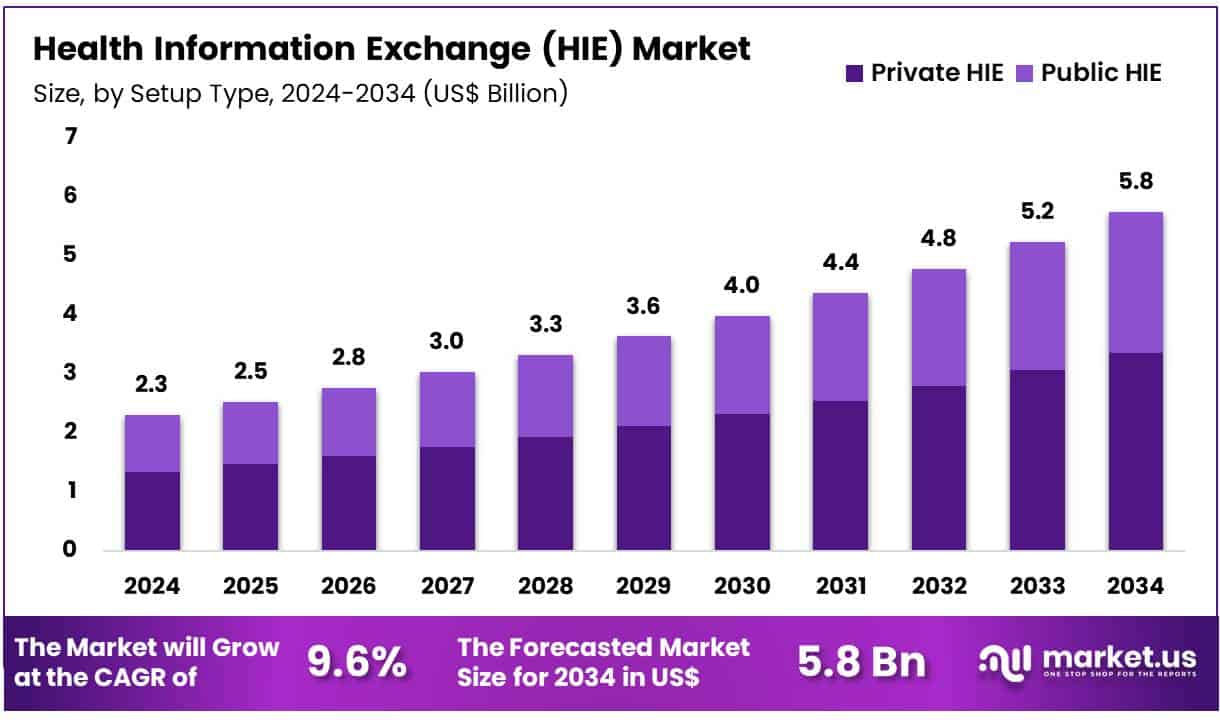
Global Health Information Exchange (HIE) Market size is expected to be worth around US$ 5.8 Billion by 2034 from US$ 2.3 Billion in 2024, growing at a CAGR of 9.6% during the forecast period 2025 to 2034. In 2024, North America led the market, achieving over 37.9% share with a revenue of US$ 0.9 Billion.
The Health Information Exchange (HIE) market is experiencing sustained growth, driven by the increasing need for secure and efficient sharing of clinical data among healthcare providers, laboratories, and public health agencies. The market is gaining traction as healthcare systems worldwide shift towards integrated, value-based care models that prioritize real-time data exchange and patient-centric decision-making.
HIE solutions enable the electronic transfer of health-related information across different care settings, improving care coordination, reducing duplicative testing, and enhancing clinical outcomes. Among the exchange models, directed exchange remains the most widely adopted due to its ability to support secure and structured communication between providers.
Private HIE setups continue to hold a dominant position in the market, offering greater control over data governance and enabling customized integrations with provider networks. These systems are widely used for applications such as internal interfacing, workflow optimization, secure messaging, and patient safety monitoring.
The market is witnessing notable adoption across North America, supported by advanced digital infrastructure, government-backed interoperability mandates, and widespread electronic health record (EHR) usage. Other regions are also demonstrating strong potential due to growing healthcare digitization efforts and public health initiatives.
As digital transformation accelerates within the healthcare sector, the HIE market is expected to expand steadily, facilitating seamless data exchange and improving the overall quality and efficiency of care delivery.
Click here to get a Sample report copy @ https://market.us/report/health-information-exchange-hie-market/free-sample/
Key Takeaways
- Market Size: In 2024, the global Health Information Exchange (HIE) market was valued at US$ 2.3 billion and is projected to expand at a compound annual growth rate (CAGR) of 9.6%, reaching approximately US$ 5.8 billion by 2034.
- By Type: The market is segmented into directed exchange, consumer-mediated exchange, and query-based exchange. Among these, directed exchange dominated in 2023, accounting for 47.6% of the total market share.
- By Setup Type: The market is categorized into private HIE and public HIE. The private HIE segment emerged as the leading category, capturing 58.3% of the market share.
- By Application: Key segments include internal interfacing, workflow management, web portal development, secure messaging, patient safety, and others. The web portal development segment held the dominant position, representing 36.2% of the overall market revenue.
- By Implementation Model: The market is segmented into hybrid model, centralized model, and decentralized model. The hybrid model accounted for the largest share, contributing 52.8% of the total market revenue.
- By Region: North America led the global HIE market in 2023, securing a 37.9% share of the overall revenue.
Health Information Exchange Market Segmentation Analysis
- Type Analysis: The directed exchange segment accounted for 47.6% of the market, primarily due to rising demand for secure, direct communication between healthcare entities. This growth is supported by the increasing use of electronic health records (EHRs) and the need for real-time data exchange, especially for patient referrals. Regulatory programs like Meaningful Use have incentivized adoption, while improvements in interoperability standards continue to support the segment’s expansion by enhancing data accuracy, care coordination, and timely clinical decision-making.
- Setup Type Analysis: Private HIEs held a dominant market share of 58.3%, driven by growing preferences for secure, customizable data exchange environments. These systems offer healthcare organizations enhanced control over data access and compliance, particularly under regulations like HIPAA. The demand for private HIEs is further supported by the need for tailored configurations suited to specific operational workflows, making them ideal for large networks such as integrated delivery networks (IDNs), where internal coordination and regulatory alignment are critical for data-driven patient care.
- Application Analysis: The web portal development segment led the application category with a 36.2% revenue share, driven by increasing demand for patient engagement platforms that offer real-time access to health data. Web portals improve communication, reduce administrative burden, and support patient-centered care through functionalities like appointment scheduling, lab result viewing, and secure messaging. Integration with HIE systems promotes broader interoperability, while digital health trends continue to push providers toward offering more transparent, user-friendly, and accessible patient service interfaces.
- Implementation Model Analysis: The hybrid model captured 52.8% of the market owing to its balanced architecture combining centralized and decentralized features. This approach offers scalability, system efficiency, and secure data governance, allowing healthcare providers to retain control over sensitive information while enabling cross-network interoperability. The model supports varied compliance requirements and addresses the complexity of distributed healthcare systems. Its flexibility makes it particularly suitable for health systems seeking to optimize performance, ensure data security, and maintain operational agility across multiple healthcare touchpoints.
Market Segments
By Type
- Directed exchange
- Consumer-mediated exchange
- Query-based exchange
By Setup Type
- Private HIE
- Public HIE
By Application
- Internal interfacing
- Workflow management
- Web portal development
- Secure messaging
- Patient safety
- Other
By Implementation Model
- Hybrid model
- Decentralized model
- Centralized model
To Purchase this Premium Report @ https://market.us/purchase-report/?report_id=150388
Regional Analysis
North America Leads the Health Information Exchange (HIE) Market
North America accounted for the largest share of the HIE market, contributing 37.9% of the total revenue. This dominance is attributed to strong federal support for healthcare interoperability and widespread adoption of electronic data exchange systems among healthcare providers. Initiatives led by the Office of the National Coordinator for Health Information Technology (ONC), such as regulatory frameworks and funding programs, have significantly advanced the region’s health data infrastructure.
The implementation of the 21st Century Cures Act, which mandates the use of open APIs to facilitate data exchange, has further accelerated market growth. According to ONC reports from early 2024, the proportion of hospitals electronically exchanging information with external providers has risen considerably, reflecting the ongoing push to improve care coordination and patient outcomes. These factors collectively reinforce North America’s position as the leading region in the global HIE market.
Asia Pacific Expected to Register the Fastest Growth
The Asia Pacific region is projected to witness the highest compound annual growth rate (CAGR) over the forecast period, driven by expanding governmental initiatives aimed at digitizing healthcare systems and enhancing care efficiency. Countries across the region are investing in national digital health strategies that rely heavily on robust health information exchange infrastructure.
Notable advancements include the development of centralized HIE platforms in nations such as Australia and Singapore. Additionally, the rising adoption of electronic health records (EHRs) and policy-driven moves toward universal health coverage are increasing demand for interoperable solutions that enable secure and seamless sharing of health data across healthcare providers. These efforts position Asia Pacific as a key emerging region in the global HIE market landscape.
Key Players Analysis
Leading participants in the health information exchange (HIE) market are actively driving growth through strategic investments in technology, global expansion, and collaborative initiatives. These companies are prioritizing the development of interoperable platforms that support seamless, secure data exchange between healthcare providers, thereby enhancing clinical decision-making and operational efficiency.
Partnerships with government entities and healthcare systems are central to aligning with evolving regulatory frameworks and advancing the adoption of standardized data exchange protocols. Moreover, there is a growing emphasis on the integration of cloud-based architectures and artificial intelligence (AI) tools to optimize data management, automate workflows, and deliver predictive insights. Such efforts are instrumental in reinforcing their competitive advantage and securing sustainable growth in a rapidly evolving digital health environment.
Epic Systems Corporation, a prominent market leader, plays a critical role in advancing electronic health record (EHR) integration and HIE functionalities. Established in 1979 and based in Verona, Wisconsin, Epic provides a comprehensive suite of healthcare software solutions. Its flagship platform, Care Everywhere, enables secure, interoperable patient information exchange across multiple care settings. Through continuous innovation and a strong focus on compliance and user-centric design, Epic has solidified its reputation as a trusted provider in the HIE ecosystem, supporting healthcare systems in achieving coordinated, high-quality care.
Market Key Players
- Veradigm LLC
- Siemens Healthcare Private Limited
- RelayHealth
- Orion Health group of companies
- Oracle
- IBM
- eClinicalWorks
- CareEvolution, LLC
Market Dynamics
- Market Driver: A key driver for the Health Information Exchange (HIE) market is the growing demand for improved healthcare interoperability and real-time data sharing. Government initiatives such as the 21st Century Cures Act and the Meaningful Use program have accelerated the adoption of HIE systems. These regulations promote standardized communication between healthcare providers, enabling better care coordination, reduced medical errors, and enhanced patient outcomes. The increasing adoption of electronic health records (EHRs) further fuels market growth by necessitating seamless data exchange capabilities.
- Market Trend: An emerging trend in the HIE market is the integration of artificial intelligence (AI) and machine learning into exchange platforms to enhance data analytics and predictive insights. Healthcare organizations are increasingly adopting AI-enabled HIE systems to streamline clinical workflows, identify population health risks, and support evidence-based decision-making. Additionally, the shift toward cloud-based infrastructure allows for scalable, cost-efficient deployment. These innovations reflect a broader movement toward digital transformation in healthcare, enabling more personalized and proactive care delivery.
- Market Opportunity: A significant opportunity lies in expanding HIE adoption across emerging economies, particularly in Asia Pacific, Latin America, and parts of Africa. As these regions invest in digital health infrastructure and strive to achieve universal health coverage, the need for interoperable systems becomes critical. Governments are initiating national health information platforms, creating demand for secure and scalable HIE solutions. Vendors offering customizable, multilingual platforms that align with regional regulations stand to gain considerable market share in these developing healthcare ecosystems.
Conclusion
The global Health Information Exchange (HIE) market is poised for continued expansion, driven by increasing regulatory support, technological innovation, and the growing demand for interoperable healthcare solutions. As healthcare systems transition toward integrated and patient-centric care, the adoption of HIE platforms will become essential for enhancing clinical efficiency, data accuracy, and patient outcomes.
North America remains the market leader due to advanced digital infrastructure, while Asia Pacific emerges as a high-growth region. With rising investments in AI, cloud technologies, and national digital health programs, the HIE market is expected to play a pivotal role in the future of healthcare delivery.
View More Reports:
Digital Genome Market To Reach USD 108.2 Billion By 2034
Cancer Therapeutics and Biotherapeutics Market to Surpass USD 417.2 Billion by 2034
Cancer Therapeutics and Biotherapeutics Market to Surpass USD 417.2 Billion by 2034
Smart Fitness Apps Market Technology Shows USD 8 Billion By 2033
Smart Fitness Apps Market Technology Shows USD 8 Billion By 2033



