

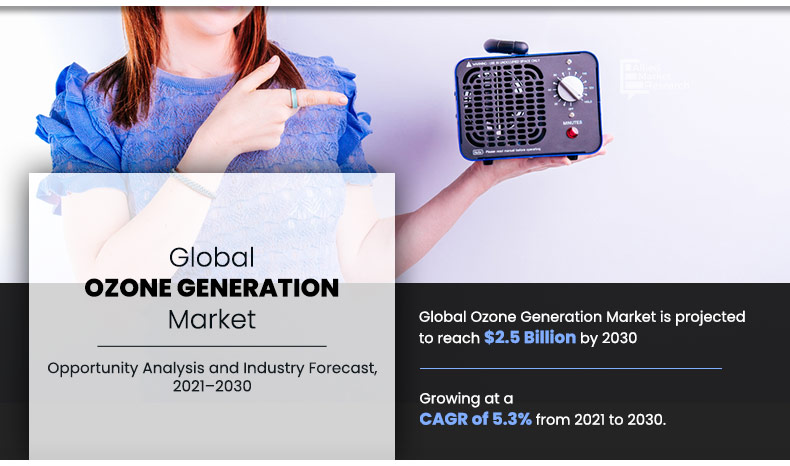
According to a new report published by Allied Market Research, titled, “Ozone Generation Market by Technology, Application, and End Use: Global Opportunity Analysis and Industry Forecast, 2020-2030,” the global ozone generation market size was valued at $1.5 billion in 2020, and is projected to reach $2.5 billion by 2030, at a CAGR of 5.3% from 2021 to 2030.
Ozone (O₃), also known as trioxygen, is a molecule composed of three oxygen atoms and is recognized for its high reactivity and instability under normal atmospheric conditions. Due to its short lifespan, ozone used in commercial applications must be generated on-site using ozone generators. In nature, ozone exists in low concentrations in the lower atmosphere, while higher concentrations—up to 6 ppm—are found in the stratosphere, forming the well-known ozone layer. It is naturally produced through UV radiation and lightning. The stability of ozone in water depends on variables such as temperature, concentration, and water composition.
Decades of research and development have led to four main methods for industrial ozone production: corona discharge, ultraviolet radiation, electrolysis, and radiochemical sources. Among its many uses, ozone is widely regarded as one of the most powerful oxidizing agents available for water treatment. It is extensively used for disinfection and purification in municipal and industrial water systems. The growing demand for efficient water treatment solutions globally is expected to be a significant driving force behind the expansion of the ozone generation market.
Download PDF Brochure: https://www.alliedmarketresearch.com/request-sample/A02278
Ozone Generation Market Dynamics
The primary driver of the ozone generation market is the rising demand for advanced water and wastewater treatment solutions. With increasing concerns over water scarcity and contamination, industries and municipalities are investing heavily in efficient purification technologies. Ozone is highly effective in eliminating bacteria, viruses, and organic pollutants, making it a preferred choice for disinfection over traditional methods like chlorination. Its ability to decompose harmful contaminants without leaving toxic residues significantly boosts its appeal across sectors such as pharmaceuticals, food & beverage, and municipal water treatment.
Another key growth factor is the expanding application of ozone in air purification and industrial processes. Ozone generators are increasingly used to eliminate airborne pathogens and odors in commercial buildings, hospitals, and manufacturing facilities. Furthermore, industries such as pulp & paper, textile, and chemical manufacturing employ ozone for bleaching and oxidation processes, enhancing operational efficiency while reducing environmental impact. These diverse applications contribute to steady market expansion across developed and developing regions.
However, the market faces restraints due to the high initial investment and operational costs associated with ozone generation systems. The complexity of ozone generation and the need for trained professionals for safe operation can hinder adoption, especially among small- and medium-sized enterprises. Additionally, health concerns over ozone exposure in enclosed spaces, due to its strong oxidative properties, have led to stringent regulatory requirements, potentially limiting usage in specific applications.
Technological advancements in ozone generation are creating new market opportunities. Innovations such as energy-efficient corona discharge systems, compact and portable ozone generators, and the integration of IoT and automation are making these systems more cost-effective and user-friendly. The development of hybrid systems that combine ozone with other treatment technologies like UV or advanced oxidation processes (AOPs) is also gaining traction, particularly in high-demand sectors such as industrial effluent management and healthcare.
Snag Discount: https://www.alliedmarketresearch.com/checkout-final/A02278
Finally, regional dynamics are shaping the growth patterns of the ozone generation market. Asia-Pacific is witnessing rapid market expansion due to growing urbanization, industrialization, and government initiatives for clean water and pollution control. Countries like China and India are heavily investing in water infrastructure, creating strong demand for ozone-based systems. Meanwhile, North America and Europe remain mature markets, driven by strict environmental regulations and high adoption of advanced purification technologies. These regional trends highlight a robust and evolving landscape for the global ozone generation market.
Segment Overview
The ozone generation market analysis is segmented on the basis of technology, application, end use, and region. On the basis of technology, he market is classified into ultraviolet, cold plasma, corona discharge, and electrolytic. By application, it is categorized into waste water treatment, air purification, medical equipment, food & beverages, and others. On the basis of end use, it is categorized into industrial, residential, municipal, and others. Region-wise, the market is analysed across North America, Europe, Asia-Pacific, and LAMEA.
Ozone Generation Market Regional Analysis
The Asia-Pacific region dominates the ozone generation market and is expected to witness the fastest growth during the forecast period. This growth is primarily driven by rising industrialization, rapid urbanization, and increasing investments in water and air treatment infrastructure. Countries such as China, India, Japan, and South Korea are investing heavily in wastewater treatment, especially in industrial zones, to meet stringent environmental regulations. In addition, growing awareness about the health impacts of polluted air and contaminated water is encouraging municipalities and commercial facilities to adopt ozone-based purification technologies. The surge in demand for ozone generators in applications like food processing, healthcare sanitation, and semiconductor manufacturing further supports regional market expansion.
North America and Europe hold significant shares in the global ozone generation market due to their well-established industrial infrastructure, stringent environmental regulations, and high adoption of advanced treatment technologies. In North America, the U.S. leads the market, supported by robust demand from municipal water treatment, pharmaceutical, and food & beverage sectors. Similarly, Europe’s market growth is fueled by initiatives promoting clean energy, sustainable manufacturing practices, and environmental compliance. Countries such as Germany, the UK, and France are actively incorporating ozone generators into smart water treatment plants and industrial facilities, driven by both environmental mandates and the push for improved operational efficiency.
For Purchase Inquiry: https://www.alliedmarketresearch.com/purchase-enquiry/A02278
Ozone Generation Competitive Analysis
The ozone generation market is highly competitive, with numerous global and regional players striving to expand their market presence through innovation, strategic partnerships, and product differentiation. Leading companies such as SUEZ SA, Xylem Inc., Ebara Corporation, Mitsubishi Electric Corporation, and Ozonetech Systems OTS AB are at the forefront, investing heavily in R&D to enhance the efficiency, reliability, and energy consumption of ozone generators. These players also focus on expanding their global footprint through acquisitions and collaborations, particularly in emerging markets where industrialization and urban development are driving demand for advanced water and air treatment technologies.
In addition, many key players are prioritizing sustainable solutions and smart integration, offering ozone generation systems with digital monitoring and control capabilities. This allows end-users to optimize operations and ensure regulatory compliance. Regional players, especially in Asia-Pacific and Latin America, are increasingly gaining traction by providing cost-effective and tailored solutions for local markets. As environmental awareness grows and stricter regulations are enforced globally, the competitive landscape is expected to intensify, compelling companies to continuously innovate and offer value-added services to maintain their competitive edge.
Key Findings of the Study:
- Rising Demand for Water & Air Treatment: The ozone generation market is primarily driven by increasing global concerns regarding clean water and air, with ozone widely used for disinfection and purification.
- Corona Discharge Technology Leads: Among production methods, corona discharge technology dominates due to its high efficiency and scalability in industrial applications.
- Asia-Pacific as the Fastest Growing Region: Asia-Pacific holds the largest market share and is expected to grow at the fastest CAGR, fueled by rapid industrialization and environmental regulations.
- Industrial Sector is a Major End User: The industrial segment, including food processing, pharmaceuticals, and wastewater treatment, accounts for a significant portion of ozone generator demand.
- Technological Advancements Boost Market Growth: Integration of smart monitoring systems and energy-efficient ozone generators is a key trend, enhancing operational control and reducing environmental impact.




