

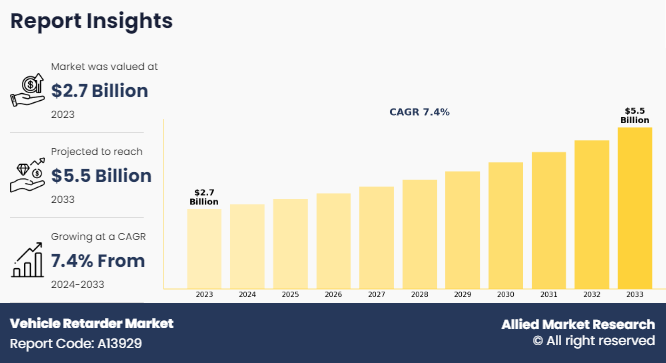
According to a new report by Allied Market Research, titled “Vehicle Retarder Market”, the global vehicle retarder market was valued at $2.7 billion in 2023 and is projected to reach $5.5 billion by 2033, growing at a CAGR of 7.4% from 2024 to 2033. This growth is underpinned by the rising demand for safety, braking efficiency, and sustainable mobility solutions across the commercial transport sector.
🔧 What Are Vehicle Retarders?
A vehicle retarder is a critical auxiliary braking system designed to reduce the speed of heavy-duty vehicles such as trucks, buses, and construction equipment—without engaging the primary friction brakes. By converting kinetic energy into heat and dissipating it efficiently, retarders enable smoother deceleration, lower brake wear, enhanced control on steep descents, and increased operational lifespan of braking systems. Retarders are available in hydraulic, electromagnetic, and mechanical variants, each catering to specific industry needs.
Download Sample Report – https://www.alliedmarketresearch.com/request-sample/A13929
🚚 Market Drivers
Rising Demand for Heavy Commercial Vehicles
Growing logistics, mining, and construction activities are escalating the use of heavy-duty vehicles, leading to increased adoption of retarders to ensure safe and effective braking under load.Focus on Safety & Efficiency
Retarders minimize reliance on service brakes, providing smoother and safer operation during prolonged braking situations, especially in urban traffic and mountainous terrains.Technological Advancements
Integration of electronic control units (ECUs) and smart braking technologies is enhancing braking precision and responsiveness, especially in next-gen vehicles.Sustainability Push
With governments tightening emissions regulations, electric and hybrid vehicle adoption is rising. Electric retarders not only complement regenerative braking systems but also improve energy recovery and vehicle control—essential for eco-friendly commercial fleets.
🌆 Trends Transforming the Market
Smart Cities & Autonomous Vehicles
As urbanization accelerates and self-driving commercial vehicles emerge, the need for autonomous-compatible braking solutions is growing. Retarders integrated with smart systems and AI offer enhanced vehicle control and safety.Electric & Hybrid Commercial Fleets
As electrification of transport accelerates, electric retarders play a pivotal role in supporting regenerative braking and extending vehicle range.Urban Transport & Logistics Boom
Retarders are becoming essential in urban buses and delivery trucks where frequent braking is required. Their ability to reduce wear and improve fuel economy is highly valued in city-based operations.
Inquiry Before Buying: https://www.alliedmarketresearch.com/purchase-enquiry/A13929
🚫 Challenges in Adoption
Despite strong demand, the vehicle retarder market faces several restraints:
High Initial and Maintenance Costs
The expense of installing advanced retarder systems can deter adoption—particularly in cost-sensitive markets.Weight & Space Constraints
Certain vehicle platforms face design limitations that restrict the integration of large or complex retarder systems.Limited Penetration in Emerging Markets
In regions with lower awareness and budget constraints, uptake remains modest, curbing full market potential.
🌍 Opportunities Ahead
Electrification of Commercial Transport
The shift toward electric and hybrid trucks and buses opens lucrative opportunities for retarder manufacturers. These vehicles require sophisticated braking solutions to manage torque and energy recovery.Rise in Autonomous Fleets
Retarders are poised to become integral components in the braking architecture of self-driving vehicles, supporting automation, predictive control, and real-time system integration.
The key players analyzed in this report are
Cummins Inc., Frenelsa, INDUSTRIAS ZELU (Klam Retarder), Scania AB, Shaanxi Fast Auto Drive Group Company, SORL Auto Parts, Inc., TBK Co., Ltd., Telma S.A., Voith Group, and ZF Friedrichshafen AG. The companies have adopted strategies such as expansion, partnership, product launch, and others to improve their market positioning. Strategic collaborations with OEMs are key drivers in improving vehicle retarder market share for leading companies.
For Report Customization: https://www.alliedmarketresearch.com/request-for-customization/A13929




