

Solar Simulator Market Size, Share and Trend Analysis Report : Global Opportunity Analysis and Industry Forecast 2022-2031
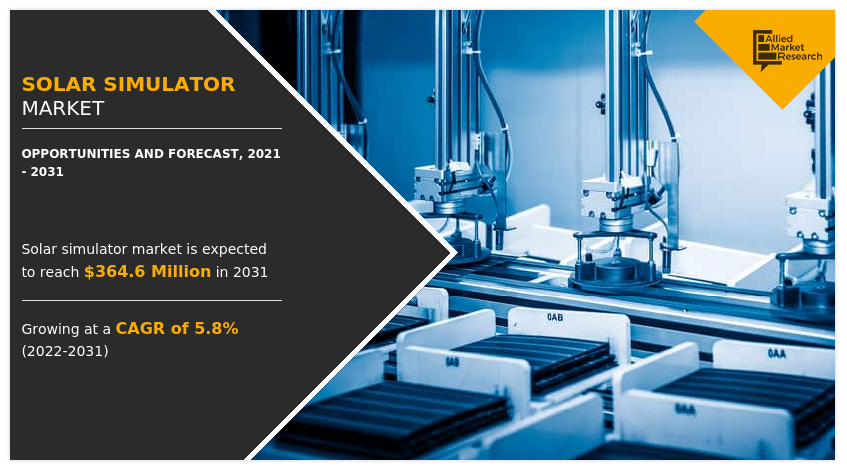
According to a new report published by Allied Market Research, the solar simulator market size was valued at $203.6 million in 2021, and is estimated to reach $364.6 million by 2031, growing at a CAGR of 5.8% from 2022 to 2031.
Solar Simulator: Replicating Sunlight for Testing and Research
A solar simulator is a device that replicates the spectral characteristics of sunlight, allowing for controlled testing and evaluation of solar technologies, materials, and systems. These simulators are essential in research and development, enabling accurate assessments of solar panels, photovoltaic cells, and solar thermal systems.
Download PDF Brochure: https://www.alliedmarketresearch.com/request-sample/A16503
Solar simulators are used in testing of solar cells, modules, solar materials & products, automotive testing, textile, biomass study, and other indoor testing facilities for R&D purposes.
Asia-Pacific garnered the dominant share in 2021, and is anticipated to maintain this dominance in solar simulator market trend during the forecast period. This is attributed to the presence of key players and huge consumer base in the region.
Rapid expansion of the renewable energy sector, rise in investment toward building & construction of renewable energy infrastructure, and increase in research & development efforts in the region are further anticipated to fuel the growth of the market in the upcoming years.
The key players operating and profiled in the global solar simulator industry report include ABB, Ltd., ABET Technologies, Inc., Asahi Spectra Co., Ltd., Endeas, Gsolar Power Co., Ltd., Iwasaki Electric Co., Ltd., Sciencetech, Inc., Schneider Electric, Solar Light Company, LLC, and Spectrolab.
Other players operating in the value chain of the global solar simulator market are OAI, Wacom Electric Co. Ltd., Nisshinbo Mechatronics, Inc., Spire Solar, and others.
Significant development of the end-use industries such as textile, automotive, paint & coatings, solar, pharmaceutical, chemicals, and healthcare has fueled the demand for solar simulators to check performance parameters of the products or materials from above mentioned industries, which in turn drives the growth of the solar simulator market during the forecast period.
Increase in demand for solar products from developing economies such as India, China, and Japan fuel the growth of the market, globally.
High cost associated with solar simulators and disadvantages such as high-power consumption, high electronic drive costs, and short life cycles are the key factors that are expected to hamper the global solar simulator market growth in the upcoming years.
On the basis of application, the PV cell/module and material testing segment holds the largest share, in terms of revenue, and is expected to grow at a CAGR of 5.9%. This is due to rapid growth in the solar energy industry over the last decade is projected to continue in the upcoming years and owing to increased investments in renewable energy across the globe.
Automotive testing application segment is expected to grow at the fastest rate, registering a CAGR of 6.2%, throughout the forecast period.
Rise in demand for solar panels to energize home appliances such as lights and pumps rises the demand for solar based products, which in turn is expected to drive the growth of the solar simulator for the testing of modules and PV materials during the forecast period.
On the basis of light source, the xenon arc lamp segment holds the largest share, in terms of revenue, and is expected to maintain its dominance during the forecast period.
This growth is attributed to rise in demand for xenon arc lamp based solar simulator owing to its ability to produce stable spectral equal to the sunlight without filtering from various applications including testing of PV cell or module applications.
LED lamp is the fastest-growing light source segment in the global solar simulator market, and is expected to grow at a CAGR of 6.1% during 2022–2031.
Advantages
- Controlled Environment: Allows for consistent testing conditions, independent of external weather variables.
- Spectral Accuracy: Can be designed to match the solar spectrum closely, enabling reliable performance assessments.
- Versatility: Useful for various applications, including material testing, performance evaluation, and educational purposes.
Increase in use of xenon arc lamp based solar simulator owing to advantages associated with it such as good match to sunlight spectrum, stable spectrum, ability to produce high intensity beams and others fuel the growth of the xenon arc lamp based solar simulator market in the coming years.
Procure This Report (239 Pages PDF with Insights, Charts, Tables, and Figures): https://bit.ly/3D7Guy1
Depending on type, the pulsed solar simulator segment held the highest market share of about 56.7% in 2021, and is expected to maintain its dominance during the solar simulator market forecast period. This is attributed to rise in demand for pulsed solar simulators from PV module testing and other applications.
- Xenon Arc Lamp Simulators
- Description: Use xenon gas to produce a bright, continuous spectrum similar to sunlight.
- Applications: Ideal for testing photovoltaic cells due to their broad spectrum.
- Metal Halide Lamp Simulators
- Description: Provide a continuous spectrum with good color rendering, though with some spectral limitations.
- Applications: Commonly used for general testing and in research environments.
- LED-Based Simulators
- Description: Utilize LEDs to create specific wavelengths and can be tuned for different spectral outputs.
- Applications: Increasingly popular for their energy efficiency and the ability to customize spectral profiles.
Increase in demand for rapid & accurate measurement of electrical power output, characteristics of PV cells, modules, and solar panels for manufacturing of standard products is further expected to fuel the growth of the market in the coming years.
Applications
- Photovoltaic Testing: Used to evaluate the efficiency and performance of solar cells and modules under controlled conditions.
- Material Research: Tests the durability and performance of materials exposed to simulated sunlight.
- Solar Thermal Systems: Assesses the performance of solar thermal collectors and systems.
- Education and Training: Provides hands-on learning experiences in solar energy technologies.
Future Trends
- Technological Advancements: Ongoing innovations are improving the efficiency and accuracy of solar simulators.
- Integration with Automation: Enhanced software for automated testing and data analysis is becoming more common.
- Sustainability Focus: Growing emphasis on renewable energy solutions is driving demand for effective testing technologies.
Conclusion
Solar simulators are vital tools in the advancement of solar technology, providing a controlled environment for research and testing. By accurately replicating sunlight, these devices support the development of more efficient solar energy solutions, contributing to the broader transition toward renewable energy sources. As technology evolves, solar simulators are expected to play an increasingly important role in the energy landscape.
Other Trending Reports:-
About Us:
Allied Market Research (AMR) is a market research and business-consulting firm of Allied Analytics LLP, based in Portland, Oregon. AMR offers market research reports, business solutions, consulting services, and insights on markets across 11 industry verticals. Adopting extensive research methodologies, AMR is instrumental in helping its clients to make strategic business decisions and achieve sustainable growth in their market domains. We are equipped with skilled analysts and experts and have a wide experience of working with many Fortune 500 companies and small & medium enterprises.
Pawan Kumar, the CEO of Allied Market Research, is leading the organization toward providing high-quality data and insights. We are in professional corporate relations with various companies. This helps us dig out market data that helps us generate accurate research data tables and confirm utmost accuracy in our market forecasting. Every data company in the domain is concerned. Our secondary data procurement methodology includes deep presented in the reports published by us is extracted through primary interviews with top officials from leading online and offline research and discussion with knowledgeable professionals and analysts in the industry.




