
It is learned that Meta (META) faces fierce competition in the artificial intelligence race, including from competitors such as OpenAI and Google. At present, Meta is reorganizing its AI team to speed up the launch of new products and new features.
Reorganizing AI team
According to an internal memo, Chief Product Officer Chris Cox outlined the new structure, dividing the work into two teams: an AI product team led by Connor Hayes, and an AGI foundation department co-led by Ahmad Al-Dahle and Amir Frenkel.
The company’s artificial intelligence research department, FAIR (Basic Artificial Intelligence Research), remains independent of the new organizational structure, but Meta hopes to split a large organization into smaller teams to speed up product development and provide the company with greater flexibility when adding more technical leaders.
Acquisition of io company to integrate AI technology strength
At the same time, as the global demand for AI computing power surges, OpenAI acquired io, a device startup founded by former Apple designer Jony Ive, for nearly $6.5 billion, which is OpenAI’s largest acquisition to date. Jony Ive will be responsible for the design and creativity of OpenAI and io, and the results of the cooperation are expected to be made public in 2026.
OpenAI said that it hopes to develop a series of devices that allow people to create various things with AI. The goal is to bring AI from software into the physical world and create “physical AI” devices such as robots, self-driving cars, smart glasses, etc. This move will accelerate competition in the field of artificial intelligence terminals and promote the integration of artificial intelligence technology and physical devices.
Anthropic launches its most powerful model
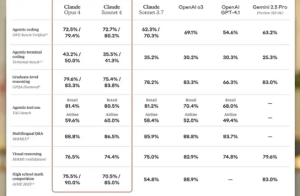
In addition, the artificial intelligence startup Anthropic recently held its first developer conference in San Francisco. This conference released the latest generation of “cutting-edge” artificial intelligence models Claude Opus 4 and Claude Sonnet 4, known as the “world’s best coding model”, which beat OpenAI and Google in benchmark tests.
It is reported that in a benchmark test comparing the performance of different large-scale language model software engineering tasks, Anthropic’s two models directly beat OpenAI’s latest model, while Google’s best model fell behind. Anthropic is a company with a valuation of over $61 billion, and its strength should not be underestimated.
In addition, Anthropic’s new model can autonomously encode for nearly seven hours, has long-term task perception capabilities, can flexibly switch tools, and strictly follows the ASL-3 safety standard, leading the industry to launch detailed model cards. This result also gave everyone a new understanding of Anthropic’s technical strength.
Industry insiders further pointed out that in terms of model release, Anthropic’s release of Claude Opus 4 and Claude Sonnet 4 is undoubtedly a major breakthrough in the field of artificial intelligence. This is in sharp contrast to OpenAI and Google.
WiMi’s technical layout highlights the cutting-edge direction
Nowadays, artificial intelligence enables the development of multiple industries under a global perspective. According to the data, as a leading AI vision manufacturer, Wimi Hologram Cloud Inc (WIMI), its technology layout covers AI large models, humanoid robots, AR/VR, quantum computing, brain-computer interfaces, AIGC and other fields, showing a keen insight into emerging technology trends and strategic layout, outlining a clear path for the AI industry to leap from “technological breakthroughs” to “value creation”.
At present, WiMi has redefined the AI full-scene smart terminal experience through the multi-dimensional collision of technology foresight and industrial practice, equipped with multimodal AI interaction and imaging technology breakthroughs. In addition, in response to open source trends such as DeepSeek and OpenAI, WiMi has opened model code and computing resources to support third-party developers to call large models such as DeepSeek, accelerating the commercialization of vertical applications.
Conclusion
With the deepening of global collaboration and the improvement of compliance systems, AI models are accelerating their integration into thousands of industries, injecting new momentum into the global economy in the intelligent era. Looking to the future, AI models can quickly form disruptive production capabilities, and compliance integration of open source technologies in enterprises will become the focus of competition. Therefore, all sectors need to pay close attention and firmly grasp the new opportunities for artistic creation brought by this round of technological development.




