
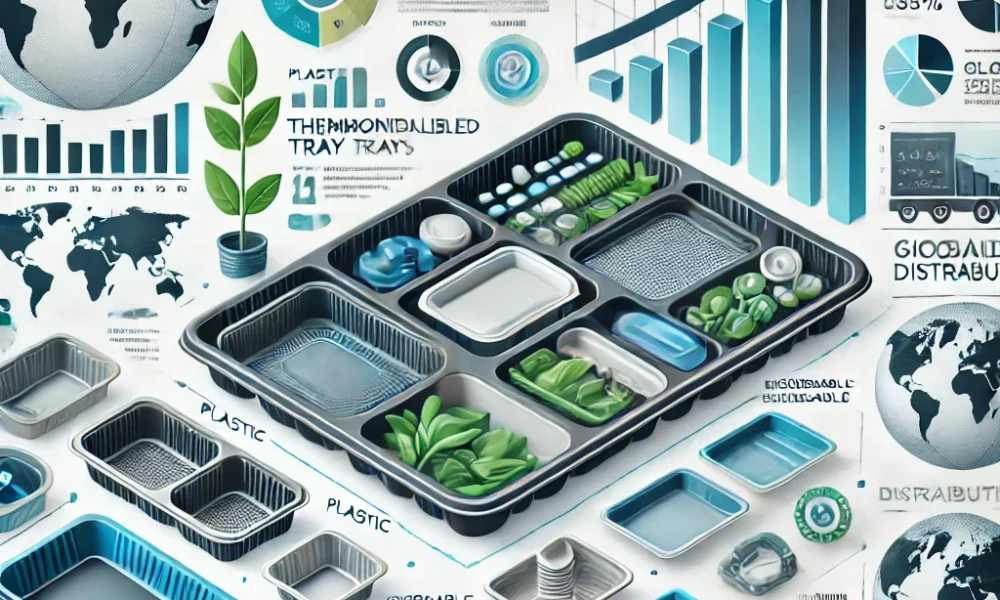
The thermoformed tray market is growing due to increasing demand for lightweight, durable, and cost-effective packaging solutions in food, healthcare, and electronics industries. Thermoformed trays offer superior product protection, extended shelf life, and enhanced visibility, making them ideal for ready-to-eat meals, medical devices, and consumer goods. Sustainability is a key driver, with manufacturers focusing on recyclable, biodegradable, and compostable materials.
Innovations in high-barrier films, smart packaging, and automation are shaping the market. Future trends include bio-based plastics, minimalistic designs, and regulatory compliance for sustainable packaging, driving further adoption across industries seeking eco-friendly and functional packaging solutions.
Request For Sample: https://www.futuremarketinsights.com/report-sample#5245502d47422d32323138
The global thermoformed tray industry is set to grow steadily from USD 5.5 billion in 2024 to an anticipated USD 7.6 billion by 2034 , with a CAGR of 3.4% during the forecast period. This growth is driven by increasing demand across various industries, including food packaging, pharmaceuticals, and consumer goods, as well as the rising preference for lightweight, cost-effective, and sustainable packaging solutions.
Key Drivers of Market Growth:
- Growing Demand for Food Packaging Solutions: The primary driver of the thermoformed tray market is the escalating demand for food packaging solutions . Thermoformed trays are widely used for packaging ready-to-eat meals, fruits, vegetables, and meat products due to their versatility, efficiency, and ability to protect products during transportation. As consumer demand for fresh, packaged foods continues to rise, especially in emerging markets, the demand for thermoformed trays is expected to grow significantly.
- Rise in E-Commerce and Retail Packaging Needs: The booming e-commerce sector is contributing to the rising need for secure, lightweight, and durable packaging solutions, making thermoformed trays an increasingly popular choice for product packaging. These trays are ideal for packaging small to medium-sized consumer goods, including electronics, toys, and cosmetics, offering easy stacking, protection, and cost-effectiveness.
- Sustainability and Eco-Friendly Packaging Solutions: Consumers and manufacturers alike are seeking packaging solutions that align with sustainability goals. Thermoformed trays made from recyclable materials such as PET and RPET are gaining traction as eco-friendly alternatives. The growing demand for sustainable packaging solutions across various industries is expected to propel the thermoformed tray market in the coming years.
- Technological Innovations: Advancements in thermoforming technology are improving the quality and functionality of trays, making them more durable, lightweight, and aesthetically pleasing. Innovations such as the introduction of biodegradable thermoformed trays are expected to open up new growth opportunities in the food packaging industry.
Access Full Report: https://www.futuremarketinsights.com/reports/thermoformed-trays-market
Competitive Landscape
The key players working in the thermoformed trays market are trying to focus on increasing their sales and revenues by escalating their capabilities to meet the rising demand. The key players are trying to adopt a merger & acquisition strategy to expand their resources and are developing new products to meet customer needs. Also, the players are focusing on improving their facilities to cater to the demand. Some of the recent key developments by the leading players are as follows –
- In May 2022, NEFAB GROUP launched a range of sustainable plastic packaging, including thermoformed trays.
- In April 2022, Amcor plc declared an investment to expand thermoforming capabilities in its Sligo and Ireland facilities for medical packaging.
Key Companies Profiled
- Dordan Manufacturing
- Nelipak Corporation
- Universal Plastics Group, Inc.
- PLACON Corporation
- UFP Technologies, Inc.
- Brentwood Industries, Inc.
- Blisterpak, Inc.
- Lacerta Group, Inc.
Explore Innovative Packaging Formats for Your Business! https://www.futuremarketinsights.com/industry-analysis/packaging-formats
How does Thermoforming offer Cost and Time Advantage as Compared to Injection Molding?
Thermoformed shallow trays offer manufacturers and customers the benefit of lower costs and shorter lead times as compared to injection-molded trays. Apart from material and other production expenses, thermoforming differs heavily from injection molding in terms of tooling costs and lead times. Tooling forms a substantial part of manufacturing costs for smaller to moderate volumes.
Though tooling amounts to a one-time expenditure, high-tooling costs discourage purchase decisions with multiple design requirements. Tooling cost incurred in thermoforming is on average 15%-45% cheaper than tooling in injection-molded process. Further, lead times in injection molding are 2-3 times longer than thermoforming. Thermoforming practices are observed to enhance the order-fulfilling capacities of packaging manufacturers.
Thermoformed tray manufacturers work collaboratively with their customers to ensure that the production process and material selection result in the best value offering when integrated with the choice of technology implemented.
Historic Market Outlook:
The global thermoformed trays market recorded a CAGR of 3.6% during the historic period between 2015 and 2021 with a market valuation of US$ 6.5 Bn in 2021.
Thermoformed trays have become a significant portion of the tray packaging market. The protection and stability of products are major factors driving the sales of thermoformed trays. Thermoformed trays, specially insert trays, match this function efficiently. Delicate products like ampoules, vials, and electronics can be easily transported and stored using this function of thermoformed trays.
Market by Category
By Product Type,
- Plastic Insert Trays
- Dunnage Trays
- POP Display Trays
- Medical Handling Trays
By Material Type,
- Polyvinyl Chloride (PVC)
- Polyethylene Terephthalate Glycol (PETG)
- High-density polyethylene (HDPE)
- High Impact Polystyrene (HIPS)
- Recycled Polyethylene Terephthalate (rPET)
By End Use,
- Food & Beverage
- Electronics
- Pharmaceutical
- Cosmetics
By Region,
- North America
- Latin America
- Europe
- South Asia
- East Asia
- Middle East & Africa
- Oceania




