
On February 2, 2025, before boarding his plane, Donald Trump made a striking statement about South Africa, declaring that he would immediately cut aid to the country. He cited “terrible things” happening there, specifically mentioning land confiscation. However, what he did not explicitly state is what many critics have long accused the South African government of: systemic persecution of the white minority, including land expropriation without compensation, targeted killings, economic marginalization, and racialized violence.
The Issue of Land Confiscation
Since the African National Congress (ANC) came to power in 1994, South Africa has wrestled with the redistribution of land from white owners, who, despite making up a small fraction of the population, still own a significant share of arable farmland. In 2018, the South African government, led by President Cyril Ramaphosa, formally moved forward with plans to amend the constitution to allow for the expropriation of land without compensation. This move was justified as an effort to rectify historical injustices from the apartheid era, but critics argue that it is a thinly veiled attack on white landowners, akin to what occurred in Zimbabwe under Robert Mugabe.
Beyond the political rhetoric, the reality on the ground is grim. Many white farmers who have resisted selling their land have been subjected to violent attacks. Reports indicate that farm murders, which are often characterized by extreme brutality, remain alarmingly high. The government, however, refuses to acknowledge these attacks as racial or political, instead categorizing them as common criminal activity. This denial has led to accusations that the state is either complicit in or indifferent to these atrocities.
The Role of Julius Malema and Radicalized Politics
Julius Malema, the leader of the far-left Economic Freedom Fighters (EFF), has been at the forefront of advocating for land expropriation without compensation. His rhetoric is often inflammatory; he has been recorded chanting songs like “Kill the Boer,” a phrase historically associated with incitement to violence against white farmers. Despite such overt calls for violence, Malema remains a prominent figure in South African politics, with his party holding significant influence.
The consequences of Malema’s rhetoric have not been theoretical. Thousands of white South Africans, particularly farmers, have fallen victim to what many believe is a politically motivated campaign of violence. The brutality of these murders—including cases of torture, rape, and mutilation—has been widely documented by independent journalists, yet mainstream media and international governments largely turn a blind eye.
A corrupt DEI obsessed Biden administration and a Sorros backed EU and UK appealed to the majority government in South Africa for the sake of business. Instead of condemning these atrocities, a policy of appeasement was followed.
Rape as a Weapon: A Silent Crisis
Beyond farm murders, another deeply disturbing issue in South Africa is the use of rape as a weapon—an act that disproportionately affects white prisoners and marginalized communities. Reports suggest that white inmates, particularly those arrested for minor offenses, are frequently targeted for sexual violence in South African prisons. Activists argue that this is a deliberate tactic of humiliation and retribution, yet the South African government refuses to acknowledge the racial element of the crisis.
Rape as a weapon is not limited to prisons. Many white South African families report that their daughters and wives are frequent targets of violent crime in ways that appear racially motivated. The South African Police Service (SAPS), which is itself accused of corruption and inefficiency, has been largely ineffective in addressing these crimes. In some cases, police officers have been implicated in misconduct, further eroding trust in the justice system.
Economic Exclusion and Starvation Through Affirmative Action
Affirmative action policies in South Africa have gone far beyond the usual measures seen in other countries. The ANC government’s Black Economic Empowerment (BEE) policy, intended to redress historical injustices, has instead created an exclusionary economic environment where whites find themselves systematically disadvantaged in employment, business opportunities, and education.
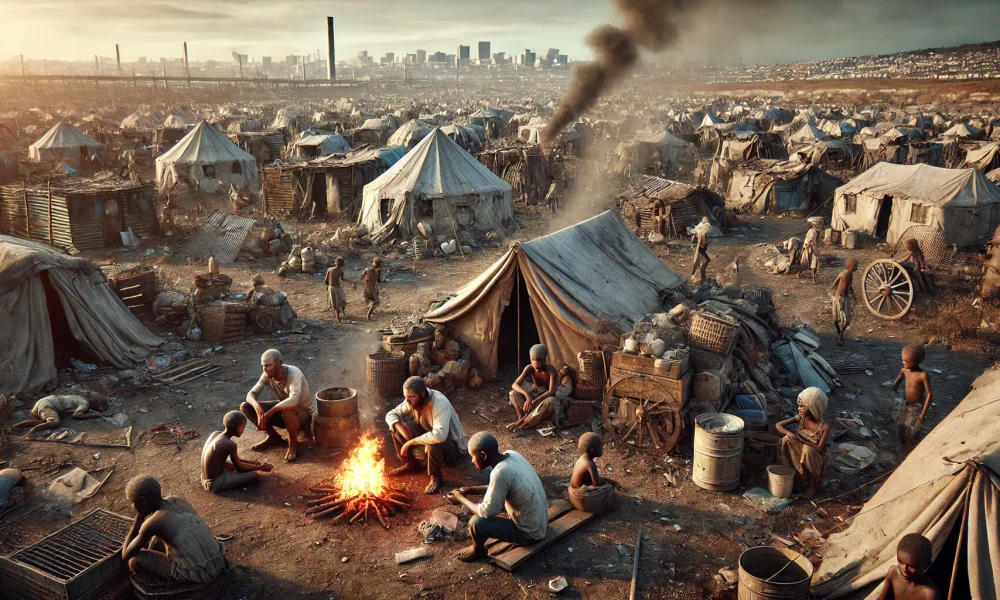
Under these laws, white South Africans often struggle to find employment because companies are required to meet racial quotas, prioritizing black candidates over equally or more qualified white applicants. The result has been widespread poverty among the white population, particularly among those who do not have the means to emigrate. Reports indicate that entire communities of impoverished whites—referred to as “white squatter camps”—now exist, something virtually unthinkable three decades ago. These camps are often ignored by humanitarian organizations and receive little to no government assistance.
The Silence of the West: Britain and the EU’s Role
One of the greatest betrayals that white South Africans face comes not from their own government, but from their ancestral homelands—Britain and the Netherlands. Despite the deteriorating conditions for Dutch-descended Afrikaners and British-descended South Africans, neither the Netherlands nor the UK have implemented any structured immigration policies to allow their kin to return. The United Kingdom, in particular, has actively turned away South African whites seeking asylum, despite taking in large numbers of immigrants from other parts of the world under much less dire circumstances.
The European Union, which claims to stand for human rights and democracy, has remained largely indifferent. Countries that historically benefitted from South Africa’s white minority—whether economically, culturally, or politically—have refused to acknowledge their suffering, let alone offer them a path to safety.
Even Putin Took A Moral High Over Europe and The UK:
Even Vladimir Putin, despite his close ties with the ANC government, has been quietly welcoming white South African farmers to Russia, offering them land and resources to help revitalize the country’s agricultural sector. Faced with increasing hostility, land seizures, and economic marginalization under South Africa’s policies, many skilled Afrikaner farmers have accepted Russia’s invitation, relocating to regions such as Stavropol and Kaluga. This move highlights a stark contrast—while South Africa pushes ahead with policies that many argue amount to systemic discrimination against its white minority, even a leader like Putin, known for his pragmatic geopolitical strategy, recognizes their agricultural expertise as an asset rather than a burden.
Elon Musk: A South African Voice with Global Influence?
One might wonder whether figures like Elon Musk, a South African-born entrepreneur with immense global influence, could help bring awareness to the plight of white South Africans. Musk, whose father, Errol Musk, was a businessman in South Africa, has largely refrained from discussing the country’s racial and economic turmoil. However, as someone with both the platform and the resources, it is not inconceivable that he may at some point choose to highlight the crisis.
Outright Incitement of Genocide by South African Government Officials
Julius Malema (Leader of the Economic Freedom Fighters – EFF)
- “One Boer, One Bullet” – This slogan, historically used by the ANC’s military wing (MK), has been chanted at EFF rallies and endorsed by Malema.
- “Kill the Boer, Kill the Farmer” – Malema has led public chants of this apartheid-era struggle song, despite legal rulings and widespread condemnation of its implications.
- “We are not calling for the slaughter of white people… at least for now.” – (2016) A particularly chilling statement implying that violence against white South Africans could be a future course of action.
- “The land must be taken without compensation.” – (Various speeches) While not directly violent, this rhetoric fuels racial tensions and economic uncertainty.
- “You have not seen what we are capable of… you must pray to God that we don’t come for you.” – A threat directed at white South Africans.
- “We are cutting the throat of whiteness.” – (2018) A statement made during a speech about removing white influence from South African politics and economy.
Other Black Leaders & Political Figures
- Peter Mokaba (Former ANC Youth League Leader)
- “Kill the Boer, Kill the Farmer” – Popularized the chant in the 1990s, which has been echoed by Malema and his supporters.
- Tony Yengeni (ANC Politician)
- “Let us take up the spear and do what we must do to liberate our land.” – A reference to violent resistance in favor of land expropriation.
- Andile Mngxitama (Leader of Black First Land First – BLF)
- “For every one black person killed, we will kill five white people.” – A direct call for racially targeted violence.
- “If white people take one of us, we will kill their children, we will kill their women, we will kill anything we find on our way.” – A statement made in a political gathering.
Conclusion: A Forgotten Minority Facing Systemic Persecution
South Africa’s white minority is enduring a crisis that much of the world refuses to acknowledge. Land confiscation, politically motivated violence, economic exclusion, and the use of rape as a weapon are all realities that many are too afraid—or too politically constrained—to speak about. The ANC government, alongside radical figures like Julius Malema, continues to push policies that exacerbate racial divisions, all while the international community turns a blind eye.
Western nations that historically benefited from South Africa’s European-descended population have abandoned them in their time of need. The European Union refuses to take back Dutch descendants, and the UK has repeatedly denied asylum to British-descended South Africans. This ongoing neglect only worsens the plight of a community that has few places left to turn.
Donald Trump’s decision to cut aid to South Africa may bring renewed attention to these issues, but unless significant international pressure is applied, the fate of South Africa’s white minority remains uncertain. It is time for the world to acknowledge and address these injustices before it is too late.