
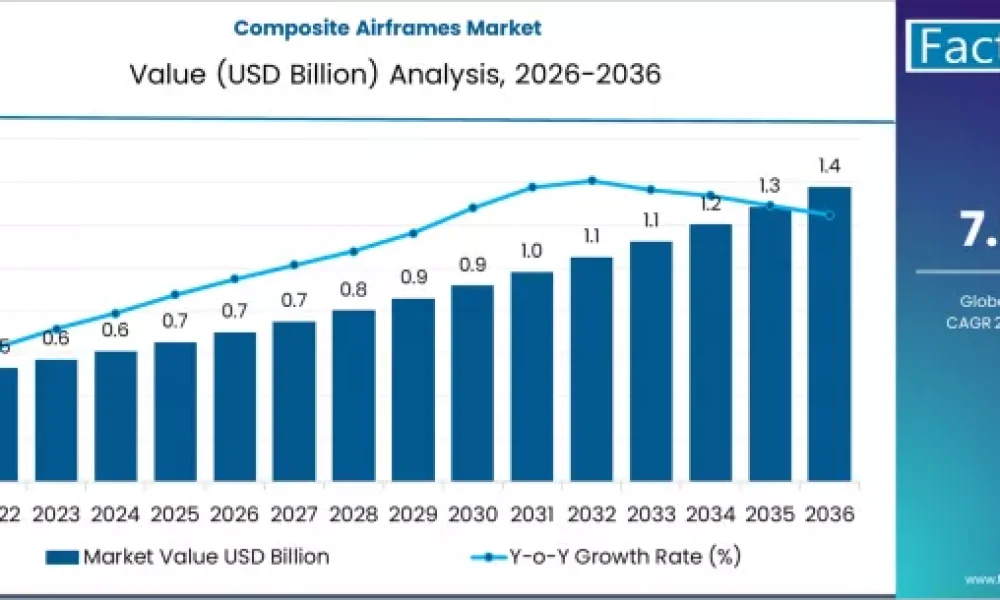
The global composite airframes market is entering a phase of rapid industrialization, with its valuation projected to grow from USD 28.5 billion in 2026 to USD 66.8 billion by 2036. According to a specialized industry analysis, this represents a robust compound annual growth rate (CAGR) of 8.9%, signaling a transformative shift in aerospace manufacturing.
The surge is driven by a convergence of heightened pressure to reduce carbon emissions and a fundamental transition in aircraft design. For aerospace leaders and investors, composite materials—primarily Carbon Fiber Reinforced Polymers (CFRP)—represent the most viable path toward the “NextGen” aircraft fleet, offering a high strength-to-weight ratio that traditional aluminum cannot match.
Summary Table: Composite Airframes Market Outlook
| Metric | Details |
| Market Value (2026E) | USD 28.5 Billion |
| Forecast Value (2036F) | USD 66.8 Billion |
| Projected CAGR (2026-2036) | 8.9% |
| Leading Material | Carbon Fiber Reinforced Polymers (52.4% Share) |
| Leading End-Use | Commercial Aviation (45.8% Share) |
| Highest Growth Market | India (10.2% CAGR) |
Request for Sample Report | Customize Report | Purchase Full Report – https://www.factmr.com/connectus/sample?flag=S&rep_id=13563
Core Market Dynamics: Answering the Strategic ‘How’ and ‘Why’
Composite airframes are increasingly replacing metallic structures to lower aircraft weight, which directly translates to reduced fuel consumption and increased payload capacity.
Who is leading? Global aerospace titans including Boeing, Airbus, Lockheed Martin, Northrop Grumman, and Bombardier are at the forefront, integrating composite wings, fuselages, and empennages into both commercial and defense platforms.
What is the primary material? Carbon Fiber Reinforced Polymers (CFRP) command a dominant 52.4% market share. Their superior fatigue resistance and immunity to corrosion make them the gold standard for long-haul commercial jets like the 787 Dreamliner and A350.
Where is the growth? India is emerging as the fastest-growing market with a 10.2% CAGR, followed by China at 9.5%, driven by massive domestic fleet expansions. North America remains the largest revenue hub, accounting for over 35% of the global market share.
Why is the market expanding? Beyond fuel savings, composites allow for higher cabin pressure and humidity levels, significantly improving the passenger experience. Furthermore, the rise of Urban Air Mobility (UAM) and electric vertical takeoff and landing (eVTOL) aircraft is creating an entirely new demand segment for lightweight composite structures.
Sector Insights: Commercial Aviation and Military Modernization
The Commercial Aircraft sector remains the primary end-user, projected to hold a 45.8% market share by 2026. However, the Military & Defense segment is seeing increased adoption for stealth technology, as composite surfaces can be engineered to reduce radar cross-sections.
“The aviation industry is at a crossroads where sustainability meets structural performance,” the analysis states. “Composite airframes are no longer a luxury reserved for premium wide-body jets; they are becoming the baseline for narrow-body success and the essential foundation for the emerging hydrogen and electric flight sectors.”
Key Market Trends and Future Outlook
1. Optimization through Automated Fiber Placement (AFP)
As the leading manufacturing technology, AFP and Automated Tape Laying (ATL) are reducing production cycle times and material waste. These robotic systems allow for the high-rate production of complex geometries, making composites more cost-competitive with traditional alloys.
2. The Rise of Thermoplastic Composites
While thermosets currently dominate, Thermoplastic composites are gaining traction due to their recyclability and faster processing times. This shift aligns with the industry’s push toward a “circular” aerospace economy where airframe components can be repurposed at the end of their lifecycle.
3. Strategic Expansion in the Asia-Pacific Corridor
In China and India, the market is buoyed by “Make in India” and “Made in China 2025” initiatives. These nations are not just consumers but are rapidly becoming manufacturing hubs for tier-1 composite components, providing a critical absolute dollar opportunity for global material suppliers.
Investment Perspective: The Absolute $ Opportunity
The composite airframes market represents a significant opportunity for material science firms and automated machinery manufacturers. As the industry moves toward 2036, the integration of “smart” composites with embedded sensors for structural health monitoring is expected to further enhance safety and reduce maintenance costs, solidifying composites’ position as the backbone of modern aviation.
Have specific requirements or need assistance on report pricing or have a limited budget? Please contact [email protected]
About Fact.MR:
Fact.MR is a global market research and consulting firm, trusted by Fortune 500 companies and emerging businesses for reliable insights and strategic intelligence. With a presence across the U.S., UK, India, and Dubai, we deliver data-driven research and tailored consulting solutions across 30+ industries and 1,000+ markets. Backed by deep expertise and advanced analytics, Fact.MR helps organizations uncover opportunities, reduce risks, and make informed decisions for sustainable growth



