
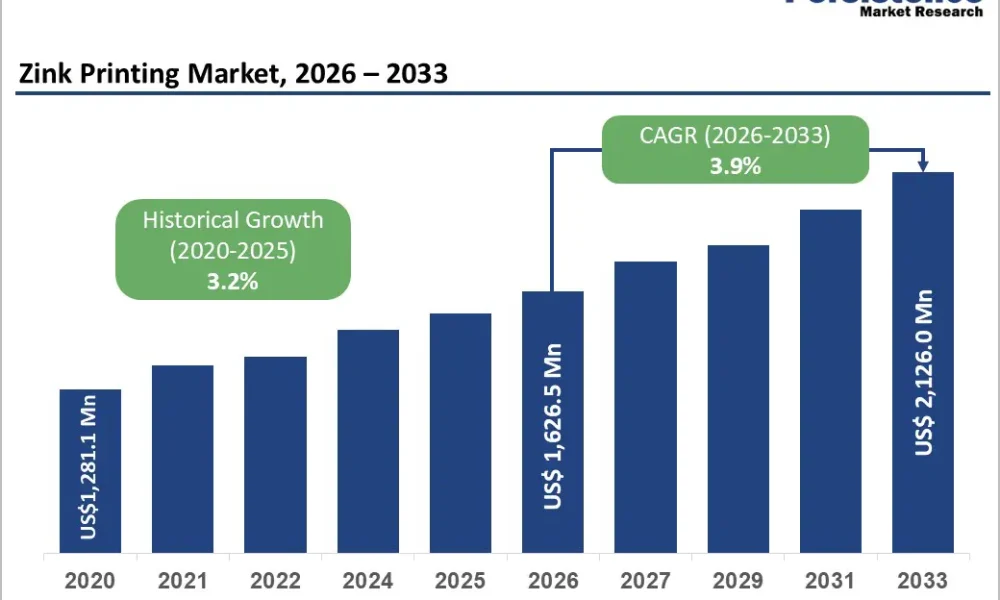
The global Zink printing market is experiencing steady growth as consumers increasingly seek instant, tangible photo printing solutions despite the dominance of digital media. According to industry estimates, the market is projected to reach US$ 1,626.5 million in 2026 and grow to US$ 2,126.0 million by 2033, expanding at a compound annual growth rate (CAGR) of 3.9% between 2026 and 2033.
Zink printing technology, which stands for Zero Ink printing, eliminates the need for traditional ink cartridges by using specially engineered paper embedded with dye crystals that activate under heat. This innovation enables portable printers to instantly produce photos, labels, and stickers without ink or toner, making it an attractive solution for both consumers and commercial users.
As the popularity of retro-style photography, instant sharing, and personalized physical keepsakes grows, Zink printing is gaining traction across multiple sectors including photography studios, retail, healthcare, insurance documentation, and home entertainment. Technological improvements in connectivity, miniaturization, and affordability are also accelerating adoption.
Key Market Highlights
Several important trends are shaping the trajectory of the Zink printing market:
- Market Value (2026): US$ 1,626.5 Mn
- Projected Market Value (2033): US$ 2,126.0 Mn
- Forecast CAGR (2026–2033): 3.9%
- Historical Growth (2020–2024): 3.2%
Key industry insights include:
- Zink paper dominates components with 61.6% market share, driven by recurring consumable demand.
- Printer hardware is the fastest-growing segment, expanding at approximately 8% CAGR.
- NFC connectivity leads the market with 46.4% share, enabling seamless smartphone integration.
- Commercial applications account for 63.1% of market demand.
- North America holds 35% of the global market, while Asia Pacific is the fastest-growing region.
These factors highlight the growing relevance of instant printing technologies in a world increasingly dominated by digital images.
Revival of Analog Photo Culture Drives Market Growth
One of the most significant drivers of the Zink printing market is the renewed consumer interest in tangible photography experiences.
While digital devices allow users to capture and store thousands of photos, many consumers—particularly millennials and Generation Z—are rediscovering the emotional value of physical prints. Surveys indicate that 68% of younger consumers prefer having physical photo memories, even though most images today remain stored digitally.
This phenomenon is part of a broader “retro-tech” trend, where modern consumers embrace technologies that deliver nostalgic experiences. Similar to the resurgence of vinyl records and film cameras, instant photo printing is becoming popular among younger demographics who value authenticity and physical memories.
Portable Zink printers allow users to print photos directly from smartphones within seconds, making them ideal for events such as:
- Weddings
- Parties
- Festivals
- Travel photography
- Scrapbooking and journaling
In addition, the ability to instantly share printed photos during social gatherings adds a unique social experience that digital sharing cannot replicate.
Technological Advancements and Falling Hardware Costs
Rapid technological innovation has significantly improved the accessibility and usability of Zink printing solutions.
Over the past five years, printer hardware costs have declined by approximately 35%, making portable printers more affordable for everyday consumers. Entry-level devices that previously cost US$ 400–800 are now available for US$ 100–300, dramatically expanding the potential user base.
Several technological improvements are fueling adoption:
- Miniaturization of Printer Devices
Modern Zink printers are compact and lightweight, often weighing 200–400 grams and fitting easily in a pocket or bag. This portability supports mobile printing in social environments and outdoor settings.
- Advanced Connectivity Features
Integration with smartphones is a critical factor in user adoption. Most modern devices now support:
- NFC connectivity
- Bluetooth pairing
- Mobile app integration
- Cloud-based photo libraries
These technologies simplify setup and enable instant printing directly from mobile devices.
- Improved Battery Performance
Battery innovations now allow portable printers to operate 8–12 hours on a single charge, making them suitable for extended use during events or field operations.
- Lower Manufacturing Costs
Economies of scale have reduced Zink paper production costs by approximately 20%, improving profitability for manufacturers and making printing more affordable for users.
Elevate your business strategy with comprehensive market data. Request a sample report now: https://www.persistencemarketresearch.com/samples/21202
Expanding Commercial Applications
While consumer photography remains a major use case, commercial applications dominate the Zink printing market, accounting for 63.1% of total demand.
Businesses value Zink printers because they provide instant, portable, and cost-effective printing without the complexity of traditional ink-based systems.
Key commercial applications include:
Event Photography
Photography studios frequently use portable printers to produce instant photo souvenirs at weddings, concerts, and festivals.
Insurance Documentation
Insurance companies deploy portable printers for on-site claims documentation, enabling field agents to print photos and reports instantly.
Healthcare and Medical Labeling
Hospitals and clinics use Zink printers for:
- Patient identification labels
- Medication labeling
- Diagnostic documentation
These applications require quick, reliable printing solutions that can operate in mobile environments.
Retail and Promotional Printing
Retailers use Zink printers for product labeling, promotional stickers, and instant photo booths, enhancing customer engagement.
Challenges from Digital Photography Dominance
Despite its advantages, the Zink printing market faces several structural challenges.
The most significant challenge is the overwhelming dominance of digital photography. Consumers capture more than 1.4 trillion digital photos each year, while only 15–20 billion photos are printed globally.
High-resolution smartphone displays, especially OLED and AMOLED screens, provide vibrant image viewing experiences that reduce the need for physical prints.
Cloud storage services also play a role in reducing print demand. Platforms such as digital photo storage ecosystems allow users to store thousands of images online, eliminating traditional concerns about physical storage space.
In addition, social media platforms encourage digital sharing rather than physical photo distribution, reinforcing consumer behavior that prioritizes digital formats.
Supply Chain Limitations and Cost Considerations
Another constraint affecting the Zink printing market is the concentrated supply chain for Zink paper.
Production of the specialized thermal paper used in Zink printing is controlled largely by ZINK Holdings LLC, which licenses the technology to printer manufacturers.
This centralized manufacturing model creates several challenges:
- Limited supplier diversity
- Pricing control over paper cartridges
- Barriers for new entrants
Zink paper cartridges typically cost US$ 0.75–1.50 per print, which is more expensive than digital sharing or large-scale inkjet printing.
Environmental concerns have also emerged in the past due to chemical compounds used in early thermal paper formulations. Although newer versions have improved safety profiles, regulatory scrutiny continues in certain markets.
Emerging Opportunities in Healthcare and IoT Applications
Despite these challenges, new growth opportunities are emerging in several specialized industries.
Healthcare and Pharmaceutical Labeling
The healthcare sector represents a rapidly expanding market for Zink printing technology. Hospitals and pharmaceutical companies require reliable labeling systems for:
- Medication packaging
- Patient identification
- Laboratory samples
- Diagnostic documentation
These applications often require portable, ink-free printing solutions, making Zink printers particularly well suited for medical environments.
Industry analysts estimate that healthcare-related Zink printing applications could generate US$ 50–100 million in market value, with annual growth exceeding 12%.
IoT-Enabled Labeling Systems
The rise of the Internet of Things (IoT) is also creating new demand for automated labeling technologies.
Connected Zink printers can integrate with:
- Warehouse management systems
- Retail inventory platforms
- Asset tracking software
- Enterprise resource planning systems
These systems enable automated printing of labels for logistics operations, product identification, and shipping documentation.
By 2033, IoT-integrated Zink printing solutions could account for 20–30% of commercial deployments, representing an incremental US$ 200–300 million market opportunity.
Regional Market Analysis
North America
North America currently leads the global Zink printing market with approximately 35% market share.
The region is projected to generate nearly US$ 800 million in revenue by 2033, driven by strong consumer adoption of portable photo printing technologies.
Event photography, entertainment venues, and insurance documentation applications are key contributors to regional demand.
Europe
Europe represents approximately 25% of the global market, supported by a long-standing cultural appreciation for photography.
Countries such as Germany, the United Kingdom, France, and Spain collectively account for the majority of regional demand. Commercial photography studios and retail photo services play an important role in maintaining market growth.
Asia Pacific
The Asia Pacific region is the fastest-growing market, expected to increase its share from 22% to nearly 30% by 2033.
Rapid smartphone adoption and expanding middle-class consumer segments are driving demand for affordable portable printers.
Manufacturers are increasingly investing in production capacity and distribution networks across Asian markets to capture this growth.
Competitive Landscape
The global Zink printing market is moderately consolidated, with a mix of consumer electronics companies and specialized printer manufacturers competing through product innovation and brand positioning.
Leading companies include:
- HP Inc.
- Eastman Kodak Company
- Brother Industries Ltd.
- LG Electronics
- Dell Inc.
- Polaroid
These companies focus on improving printer portability, connectivity, and design aesthetics to attract consumer interest.
Specialized startups such as Lifeprint and Prynt emphasize lifestyle branding and social media engagement to target younger users.
Future Outlook
The future of the Zink printing market will be shaped by a combination of technological innovation, evolving consumer preferences, and expanding commercial applications.
Key trends expected to influence market growth include:
- Increased adoption of portable lifestyle printers among younger consumers
- Integration of IoT-enabled printing solutions in logistics and retail
- Expansion of medical and pharmaceutical labeling applications
- Continued decline in printer hardware costs
- Development of eco-friendly thermal printing materials
Although digital photography will remain dominant, the emotional and experiential appeal of physical photos ensures that Zink printing will maintain a distinct niche within the global imaging market.
As manufacturers continue to innovate and expand into new industrial applications, the Zink printing market is poised for steady growth through 2033, reaching a projected value of more than US$ 2.1 billion worldwide.
Related Reports:




