
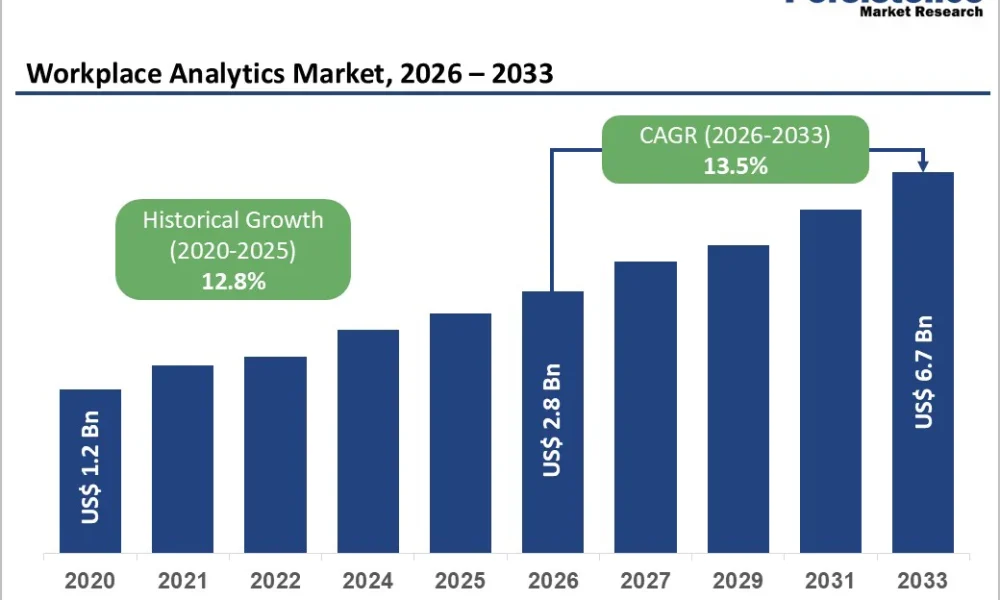
The global workplace analytics market is undergoing a rapid transformation as organizations increasingly recognize the strategic importance of data-driven workforce management. Valued at US$ 2.8 billion in 2026, the market is projected to reach US$ 6.7 billion by 2033, expanding at a robust CAGR of 13.5% between 2026 and 2033. This impressive growth trajectory highlights how analytics-driven decision-making is becoming central to enterprise performance, employee engagement, and operational excellence.
As businesses navigate hybrid work environments, digital transformation, and evolving employee expectations, workplace analytics solutions are emerging as indispensable tools for optimizing human capital and improving organizational outcomes.
Understanding Workplace Analytics
Workplace analytics refers to the use of advanced data analytics tools and techniques to measure, analyze, and improve workforce productivity, engagement, collaboration, and operational efficiency. By integrating HR systems, collaboration platforms, performance data, and enterprise software, organizations can derive actionable insights that guide strategic workforce planning.
Modern workplace analytics platforms leverage artificial intelligence (AI), machine learning (ML), predictive modeling, and cloud-based dashboards to offer real-time visibility into workforce dynamics. From talent acquisition to performance management and retention strategies, analytics has reshaped how HR and business leaders approach decision-making.
Key Market Growth Drivers
- Rapid Adoption of Cloud-Based HR Analytics Platforms
The growing shift toward cloud-based HR and workforce management systems is a major catalyst driving market expansion. Cloud platforms enable organizations to:
- Access real-time workforce insights
- Scale operations efficiently
- Reduce infrastructure costs
- Integrate multiple enterprise systems seamlessly
The flexibility and scalability of Software-as-a-Service (SaaS) analytics platforms have accelerated enterprise adoption across industries.
- Integration of Artificial Intelligence and Machine Learning
AI and ML technologies are redefining workforce management. Intelligent analytics tools can:
- Predict employee attrition risks
- Identify high-performing talent clusters
- Optimize workforce scheduling
- Analyze collaboration patterns
- Enhance employee engagement strategies
By embedding predictive capabilities into human capital management (HCM) systems, enterprises are moving from reactive HR strategies to proactive workforce optimization.
- Rising Focus on Employee Engagement and Retention
Employee engagement has become a critical performance metric, especially in hybrid and remote work environments. Organizations are increasingly leveraging analytics tools to measure sentiment, productivity patterns, collaboration effectiveness, and performance indicators.
Data-driven insights allow leaders to improve workplace culture, reduce turnover rates, and foster employee well-being—key competitive advantages in a talent-constrained global economy.
Component Analysis: Services Lead, Software Surges
Services Dominate with 65.3% Market Share
Services currently account for the largest portion of the workplace analytics market, holding a 65.3% share. This dominance is driven by:
- Deployment and integration support
- Customization services
- Managed analytics services
- Continuous optimization and consulting
Enterprises require specialized expertise to integrate analytics solutions with existing HR, ERP, and collaboration systems.
Analytics Software: The Fastest-Growing Segment (17% CAGR)
While services lead in share, analytics software is the fastest-growing component, expanding at a 17% CAGR. The rise of cloud-native SaaS platforms is reducing dependency on traditional professional services and enabling self-service analytics capabilities.
Organizations increasingly prefer plug-and-play solutions with intuitive dashboards, AI-powered insights, and seamless scalability.
Deployment Model Trends
Cloud-Based Deployment Leads with 60% Share
Cloud-based workplace analytics solutions dominate the market, capturing 60% share. Their advantages include:
- Lower upfront investment
- Remote accessibility
- Faster implementation cycles
- Seamless updates and feature upgrades
- Enhanced data integration capabilities
As enterprises embrace digital transformation strategies, cloud deployment continues to gain momentum.
On-Premises Solutions Growing at 18% CAGR
Despite cloud dominance, on-premises solutions are witnessing the fastest growth rate at 18% CAGR, particularly in highly regulated sectors such as:
- Banking, Financial Services, and Insurance (BFSI)
- Defense
- Government agencies
Data sovereignty requirements, regulatory compliance mandates, and stringent cybersecurity protocols are driving localized infrastructure investments.
Organization Size Insights
Large Enterprises Hold 62.3% Market Share
Large enterprises remain the primary adopters of workplace analytics, accounting for 62.3% of the market. Their leadership stems from:
- Significant digital transformation budgets
- Complex workforce structures
- Enterprise-wide analytics initiatives
- Global talent management requirements
Large organizations use analytics to streamline operations across multiple geographies and departments.
SMEs: The Fastest-Growing Segment (17.8% CAGR)
Small and medium-sized enterprises (SMEs) are emerging as the fastest-growing segment, expanding at 17.8% CAGR. Affordable SaaS pricing models and simplified deployment frameworks are democratizing access to advanced analytics tools.
SMEs are increasingly adopting analytics to improve hiring efficiency, workforce planning, and productivity tracking without requiring heavy IT infrastructure investments.
End-User Vertical Analysis
Healthcare Leads with 32.3% Share
Healthcare organizations hold the largest share at 32.3%, driven by:
- Workforce optimization needs
- Patient flow management
- Staffing efficiency requirements
- Growing digital health initiatives
Hospitals and healthcare systems rely on analytics to balance staffing levels, manage shift rotations, and improve patient care delivery outcomes.
Manufacturing: Fastest-Growing Vertical (19% CAGR)
Manufacturing is witnessing the highest growth rate at 19% CAGR. The surge is fueled by Industry 4.0 initiatives, automation integration, and predictive workforce analytics.
Manufacturers leverage analytics to:
- Optimize labor productivity
- Enhance safety compliance
- Predict equipment-related workforce disruptions
- Improve operational efficiency
Workforce data is becoming central to smart factory transformation strategies.
Elevate your business strategy with comprehensive market data. Request a sample report now: https://www.persistencemarketresearch.com/samples/31555
Regional Outlook
North America Leads with 35% Share
North America maintains its leadership position, accounting for 35% of global market share. The region benefits from:
- Mature IT infrastructure
- High cloud adoption rates
- Advanced analytics integration
- Strong presence of leading software vendors
Enterprises in the United States and Canada are early adopters of AI-driven workforce analytics platforms.
Asia Pacific: Fastest-Growing Region (16.3% CAGR)
Asia Pacific is the fastest-growing region, expanding at 16.3% CAGR. Rapid digitalization, expanding enterprise ecosystems, and increasing cloud adoption are driving market growth.
India: A Key Growth Engine (19% CAGR)
India stands out with an impressive 19% CAGR. The country’s growth is supported by:
- Rapid enterprise digitization
- Manufacturing expansion
- Growing startup ecosystem
- Rising SaaS adoption
- Expanding IT and services sectors
As organizations in India modernize workforce management practices, demand for analytics-driven insights continues to accelerate.
Emerging Market Trends
Rise of People Analytics and Predictive Insights
Workplace analytics is evolving into comprehensive people analytics frameworks that integrate behavioral data, collaboration metrics, and performance indicators. Predictive insights help HR teams forecast workforce trends and mitigate risks before they escalate.
Integration with Collaboration Tools
Analytics platforms are increasingly integrating with communication and collaboration tools to measure productivity patterns and team engagement across hybrid environments.
Emphasis on Ethical Data Governance
As organizations collect extensive employee data, ethical AI usage and privacy compliance are becoming central concerns. Vendors are prioritizing transparent algorithms, anonymized datasets, and compliance-ready frameworks.
Real-Time Decision Dashboards
Executives demand real-time analytics dashboards that offer instant insights into workforce health, attrition risks, diversity metrics, and productivity benchmarks.
Competitive Landscape
The workplace analytics market is characterized by a mix of global technology providers, HR software vendors, and specialized analytics firms. Competition centers on:
- AI-powered feature differentiation
- Data integration capabilities
- Scalability and customization
- Industry-specific analytics modules
- Security and compliance certifications
Strategic partnerships, acquisitions, and continuous product innovation are common strategies adopted by leading players.
Historical Growth Context
Between 2020 and 2024, the workplace analytics market recorded a CAGR of 12.8%, reflecting steady adoption across enterprises transitioning to digital HR ecosystems. The projected CAGR of 13.5% between 2026 and 2033 signals further acceleration driven by AI integration and workforce digitization.
Future Outlook: What Lies Ahead?
The future of workplace analytics is expected to be shaped by:
- Increased AI automation in HR processes
- Greater personalization of employee engagement strategies
- Expansion into mid-market and SME segments
- Industry-specific predictive workforce solutions
- Enhanced cybersecurity and privacy controls
As organizations prioritize human capital optimization alongside operational efficiency, workplace analytics will become a core strategic function rather than a supplementary tool.
By 2033, the market is expected to nearly double in value, reaching US$ 6.7 billion, underlining its critical role in shaping the future of work.
Conclusion
The global workplace analytics market is entering a dynamic growth phase, driven by cloud adoption, AI integration, and a heightened focus on employee productivity and engagement. With services dominating current revenues and analytics software emerging as the fastest-growing segment, the industry reflects both maturity and innovation.
Regional expansion in Asia Pacific—particularly India—alongside strong North American leadership, highlights the global nature of this transformation. As enterprises embrace data-driven workforce strategies, workplace analytics will continue to redefine organizational performance frameworks.
In an era where talent is the ultimate competitive differentiator, analytics-powered workforce intelligence is no longer optional—it is essential for sustainable growth and long-term success.
Related Reports:




