
Workforce Management Market Overview:
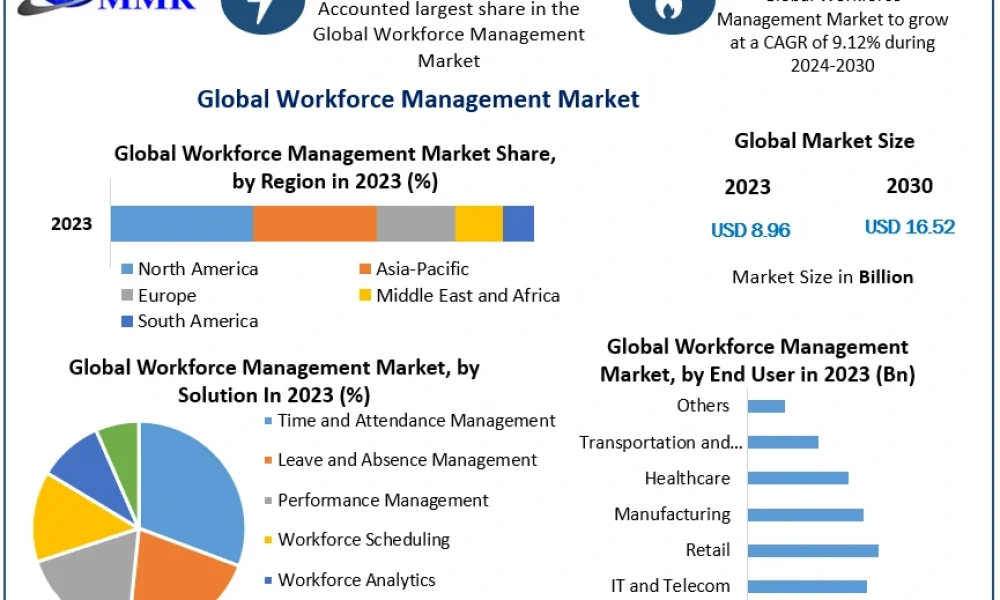
Workforce Management Market is evolving rapidly, driven by digital transformation, adoption of AI and cloud technologies, and the growing importance of data-driven HR strategies. With a market size of USD 8.96 billion in 2023, it is projected to climb to USD 16.52 billion by 2030, registering a robust CAGR of 9.12%. North America stands out as the leading region, powered by its early technology adoption, strong regulatory frameworks, and high enterprise IT investment.
Key Highlights & Insights
Market Size & Growth: The market is expected to grow from USD 8.96 billion in 2023 to USD 16.52 billion by 2030, at a CAGR of 9.12%.
Dominating Region: North America holds the largest market share—41% as of 2023—thanks to rapid uptake of digital workforce solutions, a mature IT sector, and major workforce management vendors having deep regional presence.
Leading Segment: Small and Medium Enterprises (SMEs) are emerging as the leading segment, with their share valued at USD 3.64 billion in 2023. Cloud deployment also takes precedence, valued at USD 3.78 billion that year, as organizations seek scalable, agile, and integrated workforce management.
Key Driver: Advancements in AI, mobility, and cloud technologies, coupled with heightened emphasis on workforce analytics, automation, and regulatory compliance, are core drivers. Enterprises increasingly demand solutions that enable productivity, strategic planning, and adaptability in hybrid and remote work environments.
► Get a sample of the report:https://www.maximizemarketresearch.com/request-sample/97844/
Recent Developments
2024–2025: Innovation in AI-powered scheduling, analytics, and mobile workforce solutions accelerated by Oracle, Kronos, ADP, SAP, Workday, and other global tech leaders.
Major product launches in cloud-based platforms streamline HR, time and attendance, performance management, and workforce scheduling.
Strategic alliances among software players, consulting firms, and cloud providers expand solution portfolios and service reach.
Regional companies in Asia Pacific and Europe ramp up customization of workforce management solutions for regulatory compliance and local industry needs.
Market Dynamics
Growth Drivers:
Increasing digitization and adoption of IoT, mobile, and AI in HR operations.
Growing need for efficiency, compliance, and workforce insights in a diversifying, globalized workplace.
Accelerating trend toward remote and hybrid work environments, boosting demand for flexible, real-time workforce management.
Challenges:
Resistance to change and workforce retraining in adapting to new technology platforms.
Lack of awareness and digital infrastructure in emerging markets may restrain rapid adoption.
Concerns over data privacy, integration complexity, and evolving compliance requirements.
Regional Analysis
North America: Leads the market in value and technological maturity, characterized by early adoption, active vendor ecosystem, and innovation in HR analytics and process automation.
Asia Pacific: Poised for fastest growth (CAGR 9.81%), propelled by labor law reforms, technology upgrades, and large-scale cloud adoption especially in India and China.
Europe: Focused on labor and compliance regulations, driving adoption of workforce scheduling, time management, and analytics solutions.
Latin America, Middle East & Africa: Steady market maturation as organizations across sectors digitize workforce management for efficiency and transparency.
Product Segmentation
By Solution: Time and attendance management, leave and absence management, performance management, workforce scheduling, workforce analytics, and others.
By Deployment: Cloud (fastest-growing), On-premise.
By Organization Size: SMEs (leading segment), large enterprises.
By End-User: BFSI, IT & telecom, retail, manufacturing, healthcare, transportation & logistics, among others.
Key Trends
Growing adoption of cloud-based and mobile-first workforce management tools.
Integration of big data and advanced analytics for real-time decision-making.
Automation of scheduling, payroll, performance, and compliance processes.
Personalized workforce experiences via AI and intelligent self-service platforms.
Enhanced focus on employee engagement, well-being, and productivity measurement.
Frequently Asked Questions
Q1. Which region holds the highest market share?
North America is the leading regional market, attributed to rapid technology adoption and a strong ecosystem of solution providers.
Q2. What is the largest segment by organization size?
SMEs are the largest segment, driven by cost efficiency and scalability needs.
Q3. What is the market size by 2030?
USD 16.52 billion.
Q4. What is the primary growth driver?
The ongoing digital transformation of workplaces, emphasizing analytics, automation, and cloud adoption.
Quote
“Digital transformation is redefining workforce management worldwide, with North America leading in innovation and adoption. Cloud-based, analytics-driven solutions are empowering businesses of all sizes to optimize their most valuable asset—their people.”
Conclusion
The workforce management market is entering a period of accelerated growth and diversification. Increased adoption of cloud and AI, responsive solutions for remote work, and heightened focus on efficiency and compliance are reshaping the landscape. With North America at the forefront and Asia Pacific gaining ground, organizations worldwide are investing in next-generation workforce management solutions to future-proof operations and unlock greater value from their talent.
◉ Get Market Research Latest Trends
♦ Nonclinical information system market
♦ Maximize Market Research is launching a subscription model for data and analysis in the MMR Statistics
Contact Maximize Market Research:
3rd Floor, Navale IT Park, Phase 2
Pune Bangalore Highway, Narhe,
Pune, Maharashtra 411041, India
[email protected]
+91 96071 95908, +91 9607365656
About Maximize Market Research:
Maximize Market Research is a multifaceted market research and consulting company with professionals from several industries. Some of the industries we cover include medical devices, pharmaceutical manufacturers, science and engineering, electronic components, industrial equipment, technology and communication, cars and automobiles, chemical products and substances, general merchandise, beverages, personal care, and automated systems. To mention a few, we provide market-verified industry estimations, technical trend analysis, crucial market research, strategic advice, competition analysis, production and demand analysis, and client impact studies.




