

Overview
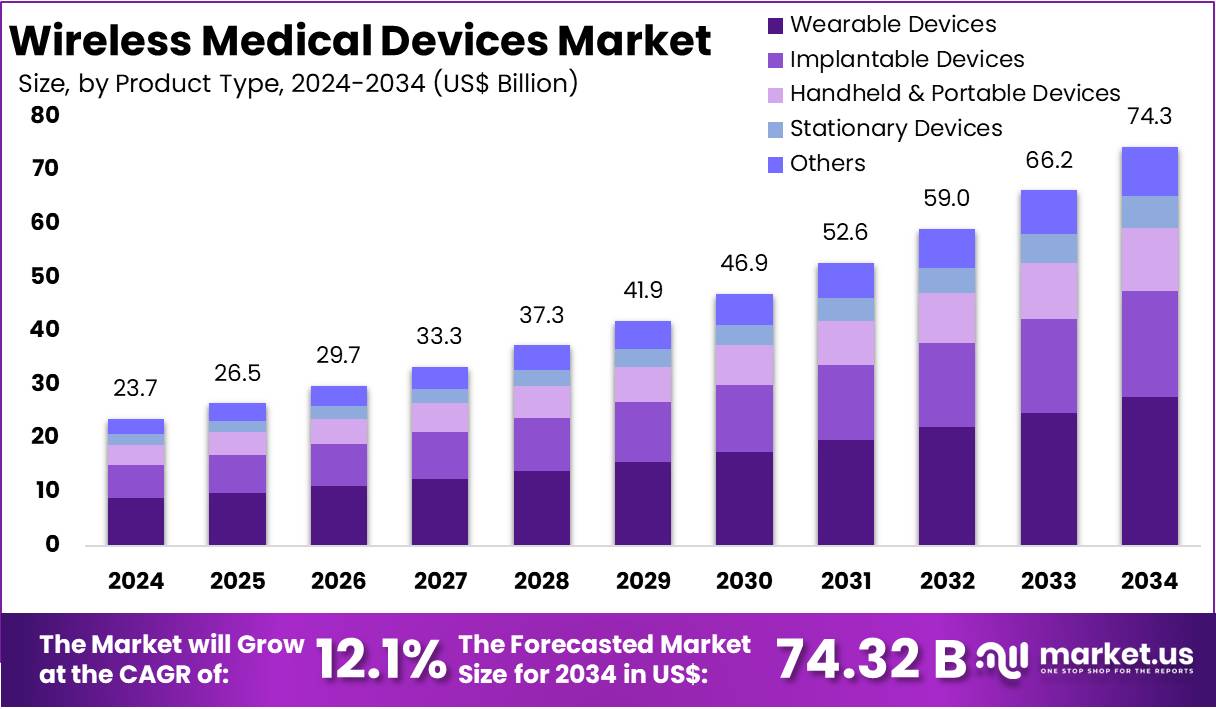
The Global Wireless Medical Devices Market is projected to grow from USD 23.7 billion in 2024 to USD 74.3 billion by 2034. This reflects a CAGR of 12.1% during the forecast period. North America currently leads the market, accounting for over 38.7% of global revenue, valued at USD 9.33 billion in 2024. The market’s expansion is driven by the rapid advancement of telemedicine, remote patient monitoring, and wearable technologies. These devices enhance healthcare delivery by providing real-time data transmission and reducing hospital visits through remote tracking systems.
Wireless medical devices use technologies such as Bluetooth, Wi-Fi, RFID, and IoT. These tools support real-time monitoring, improving patient outcomes and enabling proactive healthcare interventions. The market comprises wearable devices, implantable systems, and portable monitors. Key factors such as the rising incidence of chronic illnesses, aging populations, and the global shift toward home-based care contribute significantly to growth. These technologies enable users to track vital health metrics continuously, which supports early diagnosis and chronic disease management in a convenient, non-clinical setting.
Product segmentation includes three major categories: wearable, implantable, and portable monitoring systems. Wearable devices like smartwatches, ECG trackers, and biosensors offer personalized health insights. Implantable systems include pacemakers and neurostimulators that deliver continuous internal monitoring. Portable monitors such as glucometers and cardiac trackers support remote, real-time analysis. These products cater to growing demands for self-care, chronic disease management, and reduced in-hospital care. With more individuals seeking convenient health solutions, demand for mobile and wireless monitoring platforms is on the rise globally.
Strategic collaborations are boosting innovation across the market. In December 2024, Nokia partnered with Fraunhofer HHI and Charité – Universitätsmedizin Berlin to explore sub-terahertz (sub-THz) wireless sensing. The research focuses on frequencies between 90 GHz and 300 GHz to enable non-invasive diagnostics. These technologies offer radar-like precision and enhance real-time health assessments. The goal is to deploy high-resolution sensing systems in clinical environments. This would allow continuous patient monitoring without contact, leading to improved diagnostics and hospital efficiency.
Chronic diseases are a key driver of this market. According to the CDC, over 129 million U.S. adults have at least one chronic illness. These include heart disease, cancer, diabetes, and obesity. Around 42% of adults live with two or more conditions. These diseases account for nearly 90% of the country’s $4.1 trillion in annual healthcare costs. Wireless devices provide cost-effective solutions for long-term disease management. Their ability to reduce hospital admissions while improving patient outcomes underscores their growing role in modern healthcare systems.
Key Takeaways
- In 2024, the Wireless Medical Devices market earned US$ 23.7 billion and is forecasted to reach US$ 74.3 billion by 2034.
- The market is expanding at a strong compound annual growth rate (CAGR) of 12.1% over the 2025 to 2034 forecast period.
- Wearable devices dominated product types in 2024, accounting for 37.4% of the total market share due to their ease of use and versatility.
- Among device types, Diagnostic & Monitoring systems captured the largest share in 2024, contributing 55.5% to the overall market revenue.
- By technology, Bluetooth emerged as the leading communication method, securing a 29.7% share in the Wireless Medical Devices market.
- The Point of Care segment led in applications, holding 32.2% of the market, driven by demand for real-time diagnostics and patient monitoring.
- Hospitals & Clinics represented the largest end-user segment, contributing 31.7% to the total market due to high institutional adoption of wireless devices.
- Geographically, North America led the market in 2023, holding a dominant share of 38.7%, supported by strong healthcare infrastructure and digital adoption.
Regional Analysis
North America holds the leading position in the wireless medical devices market. This is due to the presence of major players such as Medtronic, GE Healthcare, and Philips. These companies continuously invest in product innovation and wireless technology. The rising burden of chronic diseases like diabetes and heart conditions is boosting the demand for remote monitoring devices. Additionally, the aging population and increased preference for home-based care support market growth. The region’s advanced healthcare infrastructure plays a vital role in driving adoption across clinical settings.
The United States dominates the North American market. This is attributed to favorable regulatory support, including the FDA’s initiatives to accelerate digital health innovation. The widespread use of artificial intelligence (AI) and the Internet of Things (IoT) in medical devices enhances their functionality. Canada is also witnessing steady growth. Rising healthcare spending and a growing focus on patient-centric care are important drivers. Together, these factors position North America as the most influential market in wireless medical technology adoption.
Strategic partnerships and continuous innovation are further strengthening North America’s position. For instance, in May 2023, DeviceLab and Nouslogic Telehealth formed a collaboration. Their goal is to create next-generation wireless devices for remote patient monitoring. This partnership brings together advanced engineering and real-time patient care solutions. These initiatives underline the region’s commitment to technological progress in healthcare. As a result, North America remains a hub for emerging wireless health technologies and advanced medical solutions.
Europe ranks as the second-largest region in the wireless medical devices market. The region benefits from robust healthcare systems and strong public sector investment. Countries like Germany, France, and the United Kingdom are leading adopters of remote monitoring and telemedicine. Government support and patient awareness have contributed significantly to market expansion. The region also places emphasis on chronic disease management. Aging demographics and lifestyle-related illnesses increase the need for wireless medical interventions. These factors ensure sustained growth in the European market.
Regulatory support is also key in driving Europe’s wireless medical device landscape. The Medical Device Regulation (MDR) has established stringent safety and performance standards. In October 2024, Olympus Europa SE & Co. KG announced that Odin Vision’s AI-powered devices received CE marking under MDR. These include CADDIE, CADU, and SMARTIBD systems. This milestone enhances Europe’s position in AI-led diagnostics. Although healthcare budget constraints remain a challenge, Europe continues to be a significant contributor to the global wireless medical device market.
Conclusion
Get in Touch with Us:
Market.us (Powered By Prudour Pvt. Ltd.)
Address: 420 Lexington Avenue, Suite 300, New York City, NY 10170, United States.
Contact No: +1 718 874 1545 (International), +91 78878 22626 (Asia).
Email: [email protected]
View More



