
Market Overview
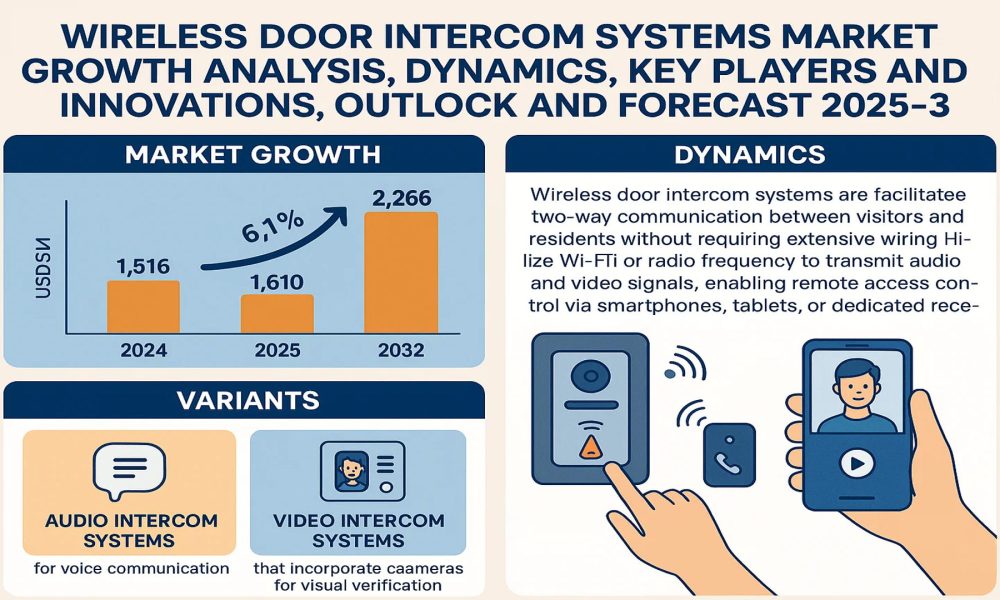
The global wireless door intercom systems market was valued at USD 1,516 million in 2024 and is projected to grow from USD 1,610 million in 2025 to USD 2,266 million by 2032, reflecting a CAGR of 6.1%.
Wireless door intercoms enable two-way communication and access control without complex wiring, utilizing Wi-Fi, RF, or Bluetooth technologies. They are increasingly integrated into smart home ecosystems and are available in audio-only or video-enabled formats, the latter becoming the dominant segment due to enhanced security features.
Get the Complete Report & TOC at https://www.intelmarketresearch.com/machines/8893/wireless-door-intercom-systems-market
In 2024, Asia-Pacific accounted for over 35% of global demand, fueled by urbanization and rising smart home adoption in China and India. Residential use dominates (62% share), though commercial applications are rapidly expanding with adoption in offices, retail, and hospitality.
Leading players such as Panasonic, Honeywell, and Legrand are driving innovation with IoT-enabled, AI-powered, and cloud-based solutions, strengthening the industry’s growth trajectory.
Market Dynamics
Drivers
- Smart Home Security Adoption: Over 45% of new residential projects now include smart security systems, making wireless intercoms a core component of home automation.
- Advances in Wireless Technology: Wi-Fi 6, Bluetooth 5.0, and RF systems have enhanced reliability, reduced interference, and extended device lifespans.
- Urbanization & Multi-Housing Growth: Cost savings of up to 60% vs. wired systems make wireless solutions attractive for high-density housing and gated communities.
Restraints
- Cybersecurity Concerns: Around 30% of models tested showed security flaws, raising adoption barriers in sensitive sectors like government and finance.
- Signal Interference: Dense urban environments can disrupt performance, often requiring additional boosters or repeaters.
Opportunities
- Integration with Smart Building Ecosystems: Intercoms are evolving into IoT nodes, connecting with HVAC, lighting, and access control systems.
- Retail & Hospitality Adoption: Hotels and retail chains are deploying wireless intercoms for touchless guest services and curbside logistics, opening new premium segments.
Challenges
- Battery Life Limitations: Video systems face high power demands, with many requiring frequent recharging or costly power-optimized solutions.
- Price Competition: Low-cost Asian brands offer systems at 40–50% lower prices, creating margin pressure for established players.
Segment Insights
| Segment | Sub-Segments | Key Insights |
| By Type | Audio, Video | Video intercoms dominate due to demand for visual verification and security. |
| By Application | Residential, Commercial | Residential leads (62%), though commercial demand is accelerating. |
| By Technology | Wi-Fi, RF, Bluetooth | Wi-Fi systems hold the largest share, supported by smartphone integration. |
| By Installation | New Construction, Retrofit | Retrofit is the fastest-growing, as property owners upgrade wired systems. |
Competitive Landscape
The market is moderately fragmented with global leaders and emerging regional players:
- Leaders: Panasonic, Honeywell (collective ~28% share, 2024)
- Strong Regional Players: Commax (South Korea), Anjubao (China)
- European Specialists: ABB, Legrand (premium smart systems)
- Strategic Moves:
- TKH Group acquired Commend International to strengthen enterprise security presence.
- Samsung entered the market with AI-powered smart intercoms.
- Aiphone and Fermax are introducing cloud and facial recognition solutions.
WIRELESS DOOR INTERCOM SYSTEMS MARKET TRENDS
Smart Home Integration Accelerates Market Growth
The increasing adoption of smart home ecosystems is driving demand for wireless door intercom systems, as they seamlessly integrate with IoT-enabled platforms like Amazon Alexa, Google Assistant, and Apple HomeKit. Modern wireless intercoms not only facilitate audio and video communication but also allow remote property monitoring through smartphone apps. The global market, valued at $1.516 billion in 2024, is projected to grow at a CAGR of 6.1%, reaching $2.266 billion by 2032. Asia-Pacific leads in adoption due to rapid urbanization and rising disposable income, closely followed by North America, where security concerns are pushing residential and commercial investments in smart access solutions.
Other Trends
Video Intercoms Gain Traction
Video-enabled wireless intercom systems now dominate over 60% of the market share, reflecting consumer preference for visual verification before granting access. Enhanced features like AI-powered facial recognition, night vision, and cloud storage for recorded footage are becoming standard, particularly in high-security applications such as gated communities and corporate offices. Manufacturers are prioritizing low-latency transmission and HD video quality to improve user experience, ensuring real-time responsiveness remains a key differentiator in this competitive space.
Commercial Sector Expansion Fuels Innovation
The commercial segment accounts for nearly 40% of total market revenue, driven by demand from offices, hospitals, and retail spaces requiring scalable access control. Wireless intercoms reduce installation complexity compared to wired systems, making them ideal for retrofitting older buildings. Integration with access control panels and visitor management software has further enhanced their utility. Meanwhile, collaborative partnerships between security firms and intercom providers are introducing multi-tenant solutions, enabling centralized management for property developers. While residential growth remains steady, the commercial sector’s emphasis on cost-efficiency and modularity continues to shape R&D priorities industry-wide.
Regional Outlook
- Asia-Pacific: Largest market (>35% share), led by China & India; growth tied to urbanization and smart city projects.
- North America: Strong adoption in the U.S. due to security awareness and smart home penetration.
- Europe: Growth shaped by GDPR compliance, energy efficiency, and retrofitting needs.
- South America: Gradual growth in Brazil & Argentina, limited by economic volatility.
- Middle East & Africa: Driven by luxury real estate and hospitality projects in the UAE & Saudi Arabia; Africa’s adoption remains niche.
Report Scope – Key Coverage
- Market Size & Forecasts: 2024–2032, by value and volume
- Segmentation Analysis: Type, Application, Technology, Installation
- Regional Insights: North America, Europe, Asia-Pacific, South America, Middle East & Africa
- Competitive Landscape: Market share, key strategies, innovation trends
- Technology & Innovation: AI, IoT, cloud, low-power design, sustainability initiatives
- Opportunities & Challenges: Growth hotspots, pricing pressures, cybersecurity risks
FAQs
- What is the current market size?
USD 1,516 million in 2024; projected to reach USD 2,266 million by 2032. - Who are the major players?
Panasonic, Honeywell, Aiphone, Legrand, Samsung, ABB, Fermax, Commax, Anjubao, DNAKE, Zartek, TCS, Aurine Technology. - What drives market growth?
Smart home adoption, urbanization, security needs, and wireless convenience. - Which region dominates?
Asia-Pacific, followed by North America and Europe. - What are the emerging trends?
AI-based facial recognition, cloud management, video intercom dominance, and smart ecosystem integration.
Recent Developments (2024–2025)
- AI-first video intercoms: Major brands rolled out edge-AI features (facial recognition, package detection, visitor analytics) that work on-device to cut latency and cloud costs.
- Cloud-native deployments: Rapid shift to cloud VMS and multi-tenant management portals for MDUs, offices, and campuses—enabling remote provisioning, OTA updates, and centralized audit logs.
- Wi-Fi 6/6E & better RF stacks: New models use Wi-Fi 6/6E, BLE 5.x, and improved RF hopping for lower latency video, better penetration in dense buildings, and fewer dropouts.
- Interoperability push: Wider support for ONVIF, SIP, and smart-home ecosystems (Alexa, Google, Apple Home) plus early trials of Matter bridges for access devices.
- Cybersecurity hardening: Vendors added end-to-end encryption, secure elements/TPM, signed firmware, and zero-trust onboarding; several products now tout GDPR-ready data handling and SOC 2/ISO 27001-aligned cloud.
- Battery & power innovations: Longer-life packs, supercap-assisted cold starts, and solar trickle charging options for low-power door stations; smarter power management extends service intervals.
- 5G/private LTE pilots: Trials in large campuses and logistics hubs use 5G backhaul for high-reliability video intercoms where Wi-Fi is congested.
- Computer vision enhancements: Night vision gets a lift via starlight sensors, HDR/WDR, and noise reduction—improving facial match rates in low-light entryways.
- Business model evolution: More subscription bundles (cloud recording, AI features, health monitoring), hardware-as-a-service for property managers, and tiered licensing for multi-site portfolios.
- Vertical solutions: Retail curbside pickup, hotels (contactless check-in), hospitals (visitor screening), and warehousing (dock access) see tailored SKUs with ruggedized enclosures and SIP/PBX integration.
- MDU scale-ups: Property-tech integrations link intercoms with access control, visitor management, and parcel lockers; mobile credentials and QR guest passes now common.
- M&A & alliances: Security and building-tech players deepen portfolios via acquisitions/partnerships (e.g., enterprise intercom specialists combining with broader access/VMS stacks) to deliver end-to-end platforms.
- Regional momentum: Asia-Pacific vendors expand globally with competitive video SKUs; North America and Europe emphasize cybersecurity certifications and deep smart-home integration.
- Sustainability & compliance: More RoHS/REACH attention, low-standby power designs, and recyclable packaging; vendors publish transparent data retention and privacy controls.
Get the Complete Report & TOC at https://www.intelmarketresearch.com/machines/8893/wireless-door-intercom-systems-market
CONTACT US:
276 5th Avenue, New York , NY 10001,United States
International: (+1) 646 781 7170
Email: [email protected]
Follow Us On linkedin :- https://www.linkedin.com/company/24-market-reports




