
The wireless chipsets market plays a foundational role in today’s hyperconnected digital economy, enabling seamless communication across consumer devices, industrial systems, vehicles, and smart infrastructure. Wireless chipsets are integrated circuits that support wireless communication standards such as Wi-Fi, Bluetooth, cellular (4G/5G), and IoT protocols. These chipsets are essential for enabling data transmission, device interoperability, and real-time connectivity in a wide range of applications.
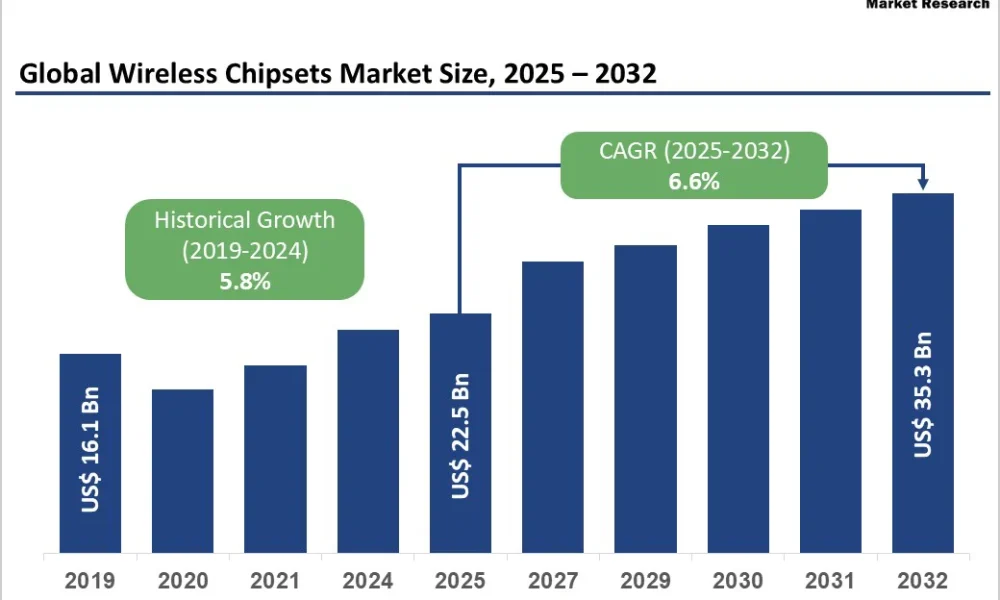
The global wireless chipsets market is likely to be valued at US$ 22.5 billion in 2025 and is projected to reach US$ 35.3 billion by 2032, expanding at a CAGR of 6.6% during the forecast period from 2025 to 2032. Market growth is supported by the surging demand for high-speed internet, widespread adoption of IoT-enabled devices, and accelerating deployment of advanced wireless standards such as Wi-Fi 6, Wi-Fi 6E, and 5G. Remote work trends, digital transformation initiatives, and government-backed connectivity programs are further reinforcing market momentum.
Market Statistics, Growth Drivers, and Leading Segments
Wireless connectivity has become a non-negotiable requirement across both consumer and enterprise environments. The explosion of smart devices, cloud-based services, and edge computing is driving sustained demand for high-performance, energy-efficient wireless chipsets. Enterprises are upgrading network infrastructure to support bandwidth-intensive applications, while consumers increasingly expect seamless, low-latency connectivity across multiple devices.
From a segmentation perspective, the Wi-Fi & Bluetooth segment dominates the market with around 48% share in 2025, owing to its ability to deliver multiple wireless functions within a single integrated chipset. In terms of geography, North America leads with nearly 30% market share, driven by early adoption of advanced connectivity technologies and strong investments in 5G and next-generation Wi-Fi. Consumer electronics remains the leading application segment, accounting for approximately 42% of market revenue, while industrial automation and automotive applications are expected to grow at the fastest pace through 2032.
Key Highlights from the Wireless Chipsets Market Report
- The global wireless chipsets market is projected to grow from US$ 22.5 billion in 2025 to US$ 35.3 billion by 2032.
- Rising demand for high-speed internet and connected devices is accelerating chipset adoption worldwide.
- Wi-Fi & Bluetooth chipsets dominate the market due to integration efficiency and widespread use.
- North America leads the market, supported by rapid adoption of Wi-Fi 6 and 5G technologies.
- Asia Pacific is the fastest-growing region, driven by smart city initiatives and digital infrastructure expansion.
- 5G and IoT wireless ICs represent the most dynamic growth segment during the forecast period.
Wireless Chipsets Market Segmentation Analysis
The wireless chipsets market is segmented based on connectivity technology, application, and end-use industry, reflecting the diverse use cases of wireless communication. By connectivity, the market includes Wi-Fi, Bluetooth, cellular (4G/5G), Zigbee, LoRa, and other IoT-focused protocols. Wi-Fi and Bluetooth chipsets dominate due to their extensive use in smartphones, laptops, wearables, and smart home devices, where reliable short-range connectivity is essential.
By application, the market spans consumer electronics, automotive, industrial automation, healthcare, IT & telecom, and smart infrastructure. Consumer electronics leads due to continuous innovation in smartphones, tablets, smart TVs, and wearables. However, industrial automation and automotive applications are emerging as high-growth segments, driven by Industry 4.0 adoption, connected vehicles, advanced driver-assistance systems (ADAS), and vehicle-to-everything (V2X) communication requirements.
Elevate your business strategy with comprehensive market data. Request a sample report now: https://www.persistencemarketresearch.com/samples/7057
Regional Insights and Market Trends
North America remains the dominant regional market for wireless chipsets, supported by strong technology adoption, advanced telecom infrastructure, and early commercialization of 5G and Wi-Fi 6 technologies. The presence of leading chipset manufacturers and close collaboration between semiconductor companies, network providers, and device OEMs further strengthens the region’s leadership position.
Asia Pacific is expected to register the fastest growth from 2025 to 2032, fueled by large-scale digital infrastructure investments and smart city projects in China and India. Expanding manufacturing ecosystems, rising smartphone penetration, and government-led initiatives to improve broadband connectivity are accelerating demand for wireless chipsets across the region.
Market Drivers Supporting Industry Growth
One of the primary drivers of the wireless chipsets market is the exponential growth in connected devices. The proliferation of smartphones, IoT sensors, smart appliances, and wearable devices has created sustained demand for compact, power-efficient wireless chipsets. As users consume more data-intensive applications, demand for higher bandwidth and lower latency connectivity continues to rise.
Another significant driver is the global rollout of 5G networks and next-generation Wi-Fi standards. These technologies enable faster data speeds, improved reliability, and support for massive device connectivity. Enterprises and governments are investing heavily in network upgrades to support digital transformation, cloud computing, and smart infrastructure initiatives, directly boosting chipset demand.
Market Restraints Affecting Adoption
Despite strong growth prospects, the wireless chipsets market faces several challenges. Semiconductor supply chain disruptions and fluctuating raw material prices can impact production timelines and pricing stability. These issues can be particularly challenging for smaller manufacturers and OEMs operating on tight margins.
Additionally, increasing design complexity and power consumption constraints pose technical challenges. As chipsets support multiple wireless standards within a single solution, ensuring interoperability, security, and energy efficiency becomes more difficult. Regulatory compliance and spectrum allocation differences across regions also add to development and deployment complexities.
Market Opportunities and Future Outlook
The rapid expansion of 5G & IoT wireless ICs presents a significant opportunity for market players. These chipsets are critical for enabling connected factories, smart cities, autonomous vehicles, and advanced healthcare systems. Vendors that can deliver scalable, low-power solutions tailored to industrial and automotive use cases are likely to gain a competitive edge.
Another promising opportunity lies in the integration of AI and edge computing capabilities within wireless chipsets. Intelligent connectivity solutions that optimize network performance, reduce latency, and enhance security will see rising demand. As digital ecosystems grow more complex, advanced wireless chipsets will become central to enabling reliable, real-time communication across industries.
Reasons to Buy the Wireless Chipsets Market Report
✔ Access detailed market size, share, and growth forecasts through 2032
✔ Understand key drivers, restraints, and emerging opportunities shaping the industry
✔ Analyze market segmentation by connectivity, application, and end-use industry
✔ Identify high-growth regions and investment hotspots
✔ Gain competitive insights and recent developments from leading chipset manufacturers
Company Insights: Key Players in the Wireless Chipsets Market
- Qualcomm Technologies Inc.
- Broadcom Inc.
- MediaTek Inc.
- Intel Corporation
- Texas Instruments Incorporated
- NXP Semiconductors
- Infineon Technologies AG
- STMicroelectronics
- Samsung Electronics
- Nordic Semiconductor
Recent Developments:
- Leading chipset manufacturers are accelerating the development of Wi-Fi 6E and Wi-Fi 7 solutions to meet rising bandwidth demands.
- Strategic partnerships between semiconductor companies and telecom operators are expanding the deployment of 5G and IoT-focused wireless chipsets.
Conclusion
The wireless chipsets market is at the core of global connectivity, enabling the seamless flow of data across devices, industries, and digital ecosystems. As demand for high-speed internet, IoT adoption, and smart infrastructure continues to grow, wireless chipsets will remain a critical enabler of innovation and digital transformation.
With strong growth across consumer electronics, industrial automation, and automotive applications, the market is well-positioned for sustained expansion through 2032. Companies that invest in advanced connectivity standards, energy-efficient designs, and intelligent wireless solutions will be best equipped to capitalize on the next phase of the connected world.
Related Reports:




