
The global sports analytics market has moved from a niche support function to a strategic cornerstone of modern sports ecosystems. Sports analytics refers to the systematic analysis of data generated from athletes, teams, fans, venues, and digital platforms to drive performance optimization, business intelligence, and audience engagement. By combining artificial intelligence (AI), machine learning (ML), computer vision, and big data analytics, sports organizations are gaining deeper, faster, and more actionable insights than ever before.
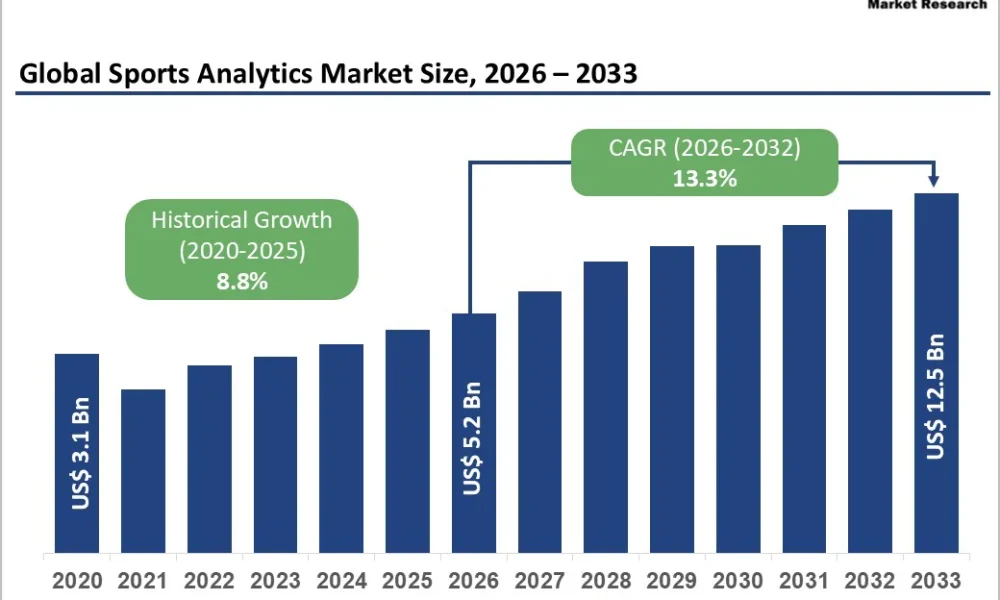
In 2026, the global sports analytics market is expected to be valued at US$ 5.2 billion, reflecting strong adoption across professional leagues, collegiate sports, broadcasters, and betting operators. The market is projected to reach US$ 12.5 billion by 2033, growing at a healthy CAGR of 13.3% between 2026 and 2033. This growth is driven by the intensifying demand for competitive advantage on the field and diversified revenue generation off the field through digital engagement and data-driven monetization.
Market Statistics, Growth Drivers, and Leading Segments
The rapid evolution of sports into a data-intensive industry has reshaped how decisions are made across athlete performance, coaching strategies, fan engagement, and commercial operations. Teams increasingly rely on analytics to reduce injury risks, improve tactical planning, and extend athlete career longevity. Simultaneously, leagues and franchises are using data insights to maximize sponsorship value, optimize ticket pricing, and personalize fan experiences across digital platforms.
From a segmentation standpoint, solutions dominate the market with nearly 60% share, as organizations prioritize integrated analytics platforms that unify performance, video, and business intelligence. Geographically, North America leads the global sports analytics market with a 32% share, supported by heavy investments from NFL, NBA, MLB, and NHL franchises. The region benefits from early adoption of AI-enabled tracking systems, advanced video analytics, and performance science programs that embed analytics into everyday operations.
Key Highlights from the Sports Analytics Market Report
- The global sports analytics market is projected to grow from US$ 5.2 billion in 2026 to US$ 12.5 billion by 2033.
- Demand for competitive advantage is accelerating adoption across athlete performance, coaching, and tactical analysis.
- Solutions account for nearly 60% of total market share due to rising demand for integrated analytics platforms.
- North America remains the largest regional market, driven by professional league investments and mature data ecosystems.
- Asia Pacific is the fastest-growing region, fueled by expanding professional leagues and digital fan bases.
- AI-powered video analytics and computer vision represent the most lucrative growth opportunity for vendors.
Sports Analytics Market Segmentation Analysis
The sports analytics market is segmented based on offering type, application, deployment model, and end-user, each contributing uniquely to overall market expansion. By offering, the market is divided into solutions and services. Solutions dominate due to their ability to integrate athlete performance metrics, video analysis, injury prevention models, and business intelligence into a unified platform. Services, including consulting, integration, and managed analytics, are gaining traction as organizations seek customized implementations.
From an application perspective, sports analytics is broadly classified into on-field analytics and off-field analytics. On-field analytics focuses on performance optimization, injury management, scouting, and tactical analysis, while off-field analytics supports fan engagement, sponsorship valuation, ticket pricing, and revenue optimization. Off-field analytics is emerging as the fastest-growing segment as teams increasingly view data as a core commercial asset rather than solely a performance tool.
Elevate your business strategy with comprehensive market data. Request a sample report now: https://www.persistencemarketresearch.com/samples/32621
Regional Insights and Market Trends
North America continues to dominate the sports analytics market due to its mature professional sports ecosystem and strong financial backing. U.S.-based leagues and franchises invest heavily in AI-driven tracking systems, wearable technologies, and advanced video analytics to maintain competitive advantage. The region also benefits from strong partnerships between sports organizations, technology providers, and academic research institutions.
Asia Pacific is experiencing rapid growth, driven by the professionalization of sports leagues in China, Japan, India, and Australia. Rising digital consumption, mobile-first fan engagement strategies, and government-backed sports development programs are accelerating analytics adoption. As regional leagues mature, investments in data-driven performance and fan monetization tools are expected to surge.
Market Drivers Accelerating Industry Growth
One of the primary drivers of the sports analytics market is the growing emphasis on data-driven competitive advantage. Teams and athletes are under constant pressure to improve performance margins, reduce injuries, and gain tactical superiority. Analytics enables objective decision-making, replacing intuition with measurable insights across training, match preparation, and in-game strategy.
Another major driver is the commercialization of sports through digital platforms. Broadcasters, sponsors, and betting operators rely heavily on analytics to enhance viewer engagement, personalize content, and maximize advertising returns. The rise of fantasy sports and sports betting has further intensified demand for real-time data, predictive models, and advanced visualization tools.
Market Restraints Impacting Adoption
Despite strong growth prospects, the sports analytics market faces several adoption challenges. High implementation costs remain a key restraint, particularly for smaller clubs, amateur leagues, and developing sports markets. Advanced analytics platforms often require significant investments in hardware, software, and skilled personnel, limiting accessibility for budget-constrained organizations.
Data privacy and governance concerns also present obstacles, especially when handling sensitive athlete health and performance data. Regulatory compliance, ethical data usage, and athlete consent are becoming increasingly important as analytics systems grow more sophisticated. Additionally, resistance to cultural change within traditional coaching environments can slow adoption of data-driven methodologies.
Market Opportunities and Future Outlook
The integration of AI-powered video analytics and computer vision represents one of the most significant growth opportunities in the sports analytics market. Automated event tagging, player tracking, and tactical modeling allow teams to extract insights at unprecedented speed and scale. Generative AI is further enhancing this space by delivering real-time insights and scenario simulations for coaches and analysts.
Another promising opportunity lies in fan-centric analytics. As stadiums evolve into smart venues and digital engagement becomes central to sports consumption, analytics platforms that personalize fan experiences, optimize pricing strategies, and measure sponsorship ROI will see strong demand. Vendors that combine performance analytics with commercial intelligence are well-positioned for long-term success.
Reasons to Buy the Sports Analytics Market Report
✔ Gain comprehensive insights into current and future market size, trends, and revenue forecasts through 2033
✔ Understand key drivers, restraints, and opportunities shaping the global sports analytics ecosystem
✔ Analyze market segmentation by offering, application, deployment, and end-user
✔ Identify leading regions and high-growth markets for strategic expansion
✔ Access competitive intelligence and recent developments from major industry players
Company Insights: Key Players in the Sports Analytics Market
- SAP SE
- IBM Corporation
- Oracle Corporation
- SAS Institute Inc.
- Catapult Group International
- Hudl
- Stats Perform
- Sportradar Group
- Genius Sports
- Zebra Technologies
Recent Developments:
- Leading sports analytics vendors are expanding AI-powered video and computer vision capabilities to deliver automated tactical insights and real-time performance feedback.
- Strategic partnerships between analytics providers and professional leagues are accelerating the deployment of integrated performance and fan engagement platforms.
Conclusion
The sports analytics market is undergoing a profound transformation as data becomes central to both competitive success and commercial sustainability. From optimizing athlete performance to redefining fan engagement and revenue models, analytics is reshaping every layer of the sports industry. The convergence of AI, video analytics, and real-time data processing is pushing the market beyond traditional statistics into predictive and prescriptive intelligence.
With strong growth across professional leagues, emerging markets, and digital platforms, the sports analytics market is positioned for sustained expansion through 2033. Organizations that invest early in advanced analytics capabilities will not only gain competitive advantage but also unlock new monetization pathways in an increasingly data-driven sports economy.
Related Reports:




