
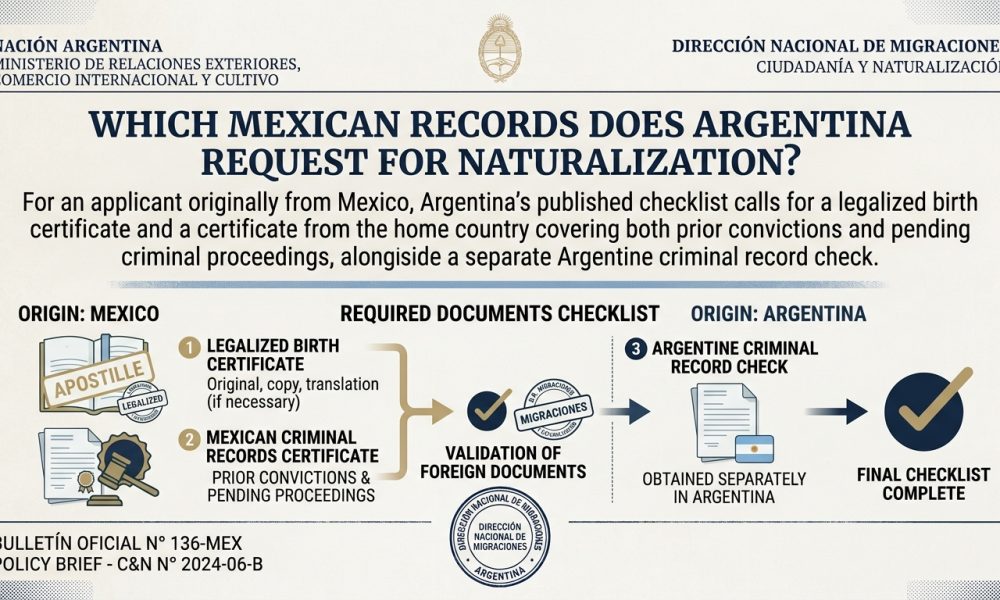
Mexican applicants preparing for Argentine citizenship must assemble a legalized birth certificate, properly authenticated evidence concerning previous convictions and pending criminal proceedings, and a separate Argentine background check, while ensuring that identity, residence and financial records remain consistent.
WASHINGTON, D.C., November 26, 2026
Mexican residents pursuing Argentine citizenship must prepare official records from both countries, because the immigration agency’s published naturalization checklist requires proof of birth, evidence addressing criminal histories at home, and a separate Argentine criminal-record certificate before formal review can advance.
Those requirements may appear straightforward, but determining which Mexican authority can issue each document, obtaining the correct apostille, and confirming whether a certificate addresses pending proceedings can create difficulties for applicants whose records span several jurisdictions.
Argentina Requires More Than a Mexican Passport
Argentina’s published naturalization procedure requires a legalized birth certificate and a legalized certificate from the applicant’s country of origin confirming no previous convictions or pending criminal proceedings, along with separate evidence of Argentine criminal records.
A valid Mexican passport provides key identity and nationality information. Still, it does not replace the specified civil and judicial documents, and an Argentine residence card cannot independently confirm the completeness of records held by Mexican authorities.
The Birth Certificate Establishes Civil Identity
A Mexican birth certificate identifies the registered birth, the person’s legal name and relevant family information, allowing Argentine authorities to compare those details with current Identification, immigration files and the applicant’s broader personal history.
Applicants should obtain an official certified record from the competent Mexican civil registry, then verify that the names, dates, and identifying details match the records already submitted during Argentine residence procedures and any later applications for nationality recognition.
Birth Records May Originate From Different States
A person born in Jalisco may need to obtain an official birth record associated with that state’s civil registry. At the same time, someone registered in Mexico City should follow the procedures applicable to the issuing capital authority.
The appropriate apostille office is linked to the issuing authority rather than simply the applicant’s current address, creating a practical distinction for Mexican citizens who have moved repeatedly before beginning their Argentine citizenship application.
Parents who registered children years before modern electronic systems should consider requesting a fresh certified copy, since older handwritten or damaged records can be difficult to authenticate or compare with contemporary passports and identity databases during a foreign naturalization procedure.
State Documents Need the Correct Apostille
Mexico’s federal government explains that documents issued by state authorities, including many civil birth records, must generally be apostilled by the relevant state government, not through the federal process used for national agency documents.
This distinction matters when applicants order records through digital portals, because electronic delivery alone does not determine whether the receiving Argentine institution will accept the selected certificate and its authentication format.
An Apostille Authenticates Official Origin
An apostille generally verifies the authenticity of an official signature, seal, or public capacity associated with a document, rather than independently confirming every underlying statement contained in the birth certificate or criminal-history record.
Families should therefore distinguish proper authentication from correcting errors in the original record, since a correctly apostilled certificate with an incorrect date or inconsistent surname can still raise legitimate questions during subsequent government review of nationality.
A Mexican Criminal Certificate Has a Specific Purpose
Argentina’s citizenship checklist requires a certificate from competent authorities in the applicant’s country of origin that reliably addresses both prior criminal convictions and any pending criminal proceedings, making the document’s scope especially important.
A general statement that a person has no criminal record may not fully answer the published question if the issuing authority does not address ongoing proceedings, so applicants should confirm coverage before assuming the document is adequate.
Federal and State Records Are Not Necessarily Identical
Mexican criminal-record information can exist within federal and state systems, and the relevant issuing institution may have a different mandate from a municipal police office or local authority providing a more limited certificate.
The Mexican Embassy in Argentina advises Mexican residents seeking Argentine immigration documentation to obtain a federally valid criminal-record certificate with the Hague apostille. Check this starting point against naturalization-specific instructions.
Federal Certificates Require Federal Authentication
Mexico distinguishes the apostille of federal public documents from that of state-issued records, so a federal criminal-record certificate should follow the corresponding federal authentication procedure rather than the one used for a local birth certificate.
Applicants should retain the original or accepted electronic record and confirmation of the apostille, ensuring that the identity information remains consistent and that the certification can be verified by the authority receiving the Argentine filing.
If the applicant previously received a judicial dismissal or acquittal, the relevant court order may help explain the case history. At the same time, the receiving authority must still decide whether the submitted Mexican certificate satisfies its separate requirement concerning pending proceedings.
Pending Proceedings Require Careful Disclosure
A person with an unresolved criminal case should not assume that the absence of a final conviction establishes a completely clear record, because Argentina explicitly requests information about proceedings that remain pending in the country of origin.
Where official records contain errors, dismissals, or concluded cases, obtaining accurate court dispositions and appropriate corrections provides a lawful response rather than omitting material information or offering an unsupported explanation.
Argentine Criminal Records Are a Separate Requirement
The National Directorate of Migration asks applicants to demonstrate the absence of disqualifying Argentine criminal history through a certificate issued by the National Registry of Recidivism, an institution distinct from the Mexican authorities that supply foreign documents.
A Mexican certificate cannot substitute for the Argentine check, and residence in Buenos Aires does not make evidence of earlier proceedings in Mexico irrelevant, because the two certificates address different judicial systems and periods.
The Argentine registry describes its criminal-record certificate as an electronic document recording convictions and pending cases reflected in judicial information, reinforcing why a foreign clearance and domestic clearance serve complementary functions rather than providing redundant paperwork.
Verify the Argentine Certificate’s Current Validity
Argentina’s immigration announcement states that the domestic criminal certificate is current. Hence, the issuance date matters even for applicants who previously obtained a similar report when applying for temporary residence several years earlier.
The applicant should review the specific timing and retrieval instructions applicable to the naturalization file, rather than assume that a historical clearance issued during an earlier immigration application remains acceptable indefinitely when government officials request updated information.
Criminal History Does Not Always Mean Automatic Refusal
The relevance of a conviction, pending proceeding, or corrected record depends on the governing nationality rules and the underlying facts, so applicants should avoid assuming that every disclosed case produces the same legal result.
Equally, individuals should not interpret completion of a sentence or dismissal of an allegation as permission to alter official records, because the proper response is to provide reliable judicial documentation explaining the actual procedural outcome.
Proof of Residence Supports the File
Argentina’s published administrative pathway also examines qualifying temporary or permanent residence, meaning applicants should preserve the original approvals, renewals, and Identification records that establish when lawful residence began and whether it continued throughout the relevant period.
A tourist arrival date is not necessarily the start of the current agency’s two-year calculation. At the same time, a provisional application receipt should not automatically be treated as equivalent to approved residence without assessing its precise legal effect.
The Current Residence Rule Is Contested
Decree 366/2025 transferred naturalization decisions from federal judges to immigration officials and introduced strict legal-residence requirements, including a published interpretation requiring no international departures during the preceding two-year period immediately before the application.
The National Electoral Chamber invalidated the decree in June 2026, and the government’s appeal raised further questions about institutional authority, making legal advice necessary before assuming that every published administrative restriction has been finally settled.
News Coverage Explains the Court Dispute
A La Nación report on Argentina’s June 2026 ruling described the constitutional objections to transferring citizenship authority, showing why applicants must distinguish the immigration agency’s active documentation checklist from the unresolved legal questions governing final nationality decisions.
The judicial dispute should not encourage applicants to disregard identity or criminal-history documentation, since reliable records remain important under either an administrative or judicial naturalization procedure, regardless of which institution ultimately retains authority.
Employment and Income Records Also Matter
Argentina’s online citizenship instructions require proof of lawful occupation or means of support, so Mexican applicants may need employment records, tax Identification, and financial documents alongside authenticated birth and criminal-history certificates when formally requesting citizenship.
Professionals receiving income from Mexico should truthfully explain the source. At the same time, landlords and retirees should distinguish rental income, pensions, and investment proceeds rather than presenting unexplained bank deposits as automatically sufficient evidence of lawful support.
The CUIT or CUIL Can Be Relevant
The agency’s published announcement includes documentation of an Argentine CUIT or CUIL Identification number, linking the naturalization application to employment, taxpayer, or social security records that can help verify economic activity in Argentina.
A person without an ordinary employer should determine which identifier and evidence apply to their circumstances, instead of entering inaccurate registration information or using another person’s number to satisfy an electronic form during a government review.
RaDEX Begins With Electronic Submission
The current administrative instructions direct applicants to register through RaDEX, complete a form, and upload supporting records; after that, the immigration authority may email additional instructions if the preliminary material meets the published requirements.
Creating an account or uploading a scanned certificate does not mean citizenship has been granted, and applicants should keep confirmation messages and respond accurately to subsequent requests for original documents or additional verification.
Because public documents sometimes contain QR codes or electronic verification mechanisms, applicants should preserve original digital files whenever available and avoid software that strips identifying features, changes document appearance, or obscures information necessary for official authentication.
Clear Scans Reduce Avoidable Delays
Electronic copies should show full names, issuance dates, seals, apostilles, and every required page, since cropped or blurred images may prevent reviewers from confirming that the uploaded material matches the original public record.
Applicants should name files clearly and keep secure originals. Still, they should never digitally alter signatures, remove inconvenient information,n or reconstruct missing pages in ways that misrepresent the official document submitted for nationality verification.
Mexican Names May Need Reconciliation
Mexican birth certificates often contain paternal and maternal surnames. At the same time, Identification or foreign administrative systems may display names differently, creating possible discrepancies that should be resolved with authentic supporting civil records and official explanations.
Marriage, adoption, or a lawful name change may also require explanatory documentation, allowing Argentine reviewers to connect records without assuming that format differences necessarily indicate separate people or fraudulent Identification during the official government review process.
Applicants born outside Mexico who later obtained Mexican nationality should also avoid presenting a Mexican birth certificate that does not exist; instead, identify the actual issuing country and seek guidance on which origin-country records the receiving institution requires.
Prior Nationalities Complicate the Paper Trail
Someone originally born outside Mexico who later became Mexican through naturalization should establish the correct country of origin and document any additional nationality history, rather than assume a Mexican passport settles every question about birth and background certificates.
Birthplace and naturalization timing may also affect which foreign authorities hold relevant criminal records, making a case-specific document plan more reliable than using an identical checklist for every person with Mexican nationality.
American Dual Nationals Have Separate Obligations
The U.S. State Department’s dual-nationality guidance explains continuing obligations connected with American citizenship, a consideration for Mexican American applicants who also need to preserve truthful Identification and travel records when pursuing Argentine naturalization.
An additional passport does not erase previous immigration or criminal history, and a person holding several nationalities should provide the documents legally requested without concealing material information about identities or jurisdictions where records are maintained.
Privacy Cannot Replace Authentic Documentation.
Readers considering Amicus International Consulting’s new identity services should distinguish lawful changes of personal information from fabricated birth records or concealed legal proceedings, because official citizenship determinations depend on truthful evidence across multiple governmental systems.
Even a legally recognized name change requires reliable links to earlier records, ensuring criminal-history certificates and residence documentation can be accurately attributed to the person seeking Argentine nationality and later Identification documents issued by the appropriate Argentine authorities.
Second Citizenship Requires Broader Planning
Families examining Amicus International Consulting’s second passport services may compare Argentina with other legitimate nationality pathways. Still, no private adviser can waive criminal checks, create authentic Mexican civil records, or guarantee a government citizenship decision.
Naturalized Mexican citizens should also consider Mexico’s Article 37 before voluntarily acquiring Argentine nationality, because their constitutional position differs from that of Mexicans by birth and requires separate professional analysis before a second naturalization.
An applicant who orders records before moving to Argentina may find it easier to coordinate with the process with Mexican authorities. However,h criminal certificates should not be obtained so early that they become outdated before the intended application date.
Preparation Should Begin Before Filing
Obtaining the birth certificate, verifying criminal-record coverage, and arranging the correct apostilles can take coordination across multiple public institutions, so applicants should not wait until the intended citizenship filing date to identify potential discrepancies.
A careful preliminary review should also examine the residence timeline, authentic identity documents, and financial evidence, making the resulting application clearer to officials without overstating eligibility or concealing difficulties that might require legal attention.
Government checklists can change as courts review administrative authority, so the most dependable practice is to compare current instructions against the applicant’s circumstances shortly before submission and preserve proof of exactly which documents were requested and provided.
Three Records Form the Core of the Checklist
For Mexican applicants, the decisive documentary distinction remains a properly legalized birth certificate, a home-country criminal certificate addressing convictions and pending proceedings, and a separate Argentine certificate covering records within Argentina’s justice system.
Those documents do not guarantee citizenship, but their authentic issuance, proper authentication, and consistency with the applicant’s residence history provide the foundation for a defensible naturalization application. At the same time, the broader constitutional dispute remains unresolved.




