
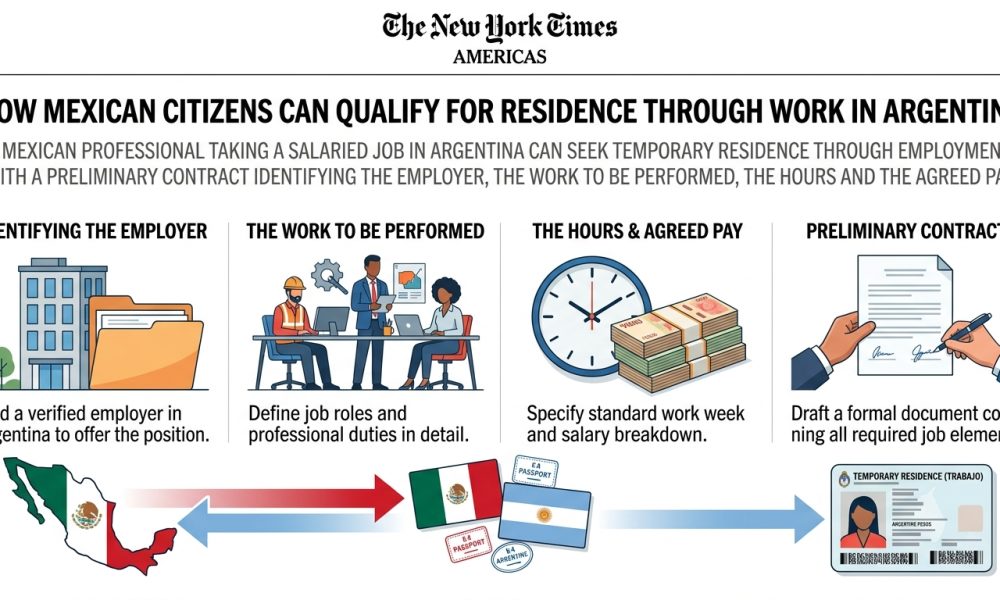
Mexican professionals accepting salaried employment in Argentina may qualify for temporary residence through a documented employment relationship, provided their employer meets registration requirements, and the applicant satisfies immigration, Identification, and background-screening rules.
WASHINGTON, D.C., November 26, 2026
Mexican professionals considering employment in Buenos Aires or another Argentine city can pursue temporary residence through a qualifying salaried position. However, obtaining a job offer alone does not establish immigration authorization or guarantee permission to work.
Argentina’s employment-based immigration framework requires documented cooperation between the foreign worker and an Argentine employer, with particular attention to the preliminary employment contract, employer registration, criminal background records, and subsequent payroll documentation.
Argentina Offers a Residence Category for Migrant Workers
Article 23(a) of Argentina’s Migration Law 25,871 establishes a temporary residence category for foreign nationals entering the country to perform lawful, remunerated activities under an employment relationship with an employer operating within Argentina.
For Mexican applicants, this route can provide a legal basis for employment and longer-term residence. However, eligibility depends on meeting specific documentation requirements, not simply demonstrating professional qualifications or sufficient personal savings.
A Genuine Job Offer Is the Starting Point
A Mexican engineer recruited by a Buenos Aires technology company, for example, may seek temporary residence based on a genuine employment relationship supported by a preliminary contract identifying the position and its essential conditions.
The employer must be prepared to comply with immigration and labor regulations, so an informal promise of future employment is insufficient when authorities require documentary confirmation of the proposed working relationship.
The Preliminary Contract Must Describe the Employment
Argentina’s immigration instructions require a preliminary employment contract signed by both parties that identifies the employer and employee, the services to be performed, working hours, employment duration, workplace address, and agreed remuneration.
The contract must also identify the employer’s tax registration number (CUIT), and the salary must comply with the applicable collective bargaining agreement governing the proposed occupation or industry.
This level of detail helps authorities distinguish a genuine salaried appointment from a general invitation or unsupported business proposal, while providing applicants with a clearer understanding of the position being offered.
Signatures Require Proper Certification
The National Directorate of Migration requires signatures on the preliminary employment agreement to be certified by a public notary or executed before an authorized immigration official when the residence application is initiated.
If an employer uses an authorized representative, they may also need documentation establishing that person’s authority, making corporate signing arrangements an important part of preparing a complete immigration application.
Employers Must Be Properly Registered
An Argentine company sponsoring a foreign employee must register with the country’s tax authority, the Agencia de Recaudación y Control Aduanero, commonly called ARCA, and meet the relevant immigration sponsorship requirements.
Employers must also appear in the National Directorate of Migration’s Registro Nacional Único de Requirentes de Extranjeros, known as RENURE, which records entities authorized to request foreign workers under applicable immigration procedures.
Payroll Registration Has a Separate Deadline
Argentina’s current requirements include an early employment-registration confirmation issued through ARCA and signed by the employer, which must be submitted within 30 calendar days after initiation of the residence application.
This requirement makes coordination between human resources, payroll personnel, and immigration advisers essential, because delays in employment registration can affect an application even when the preliminary contract has been correctly prepared.
Mexican Applicants Need Valid Identification
Applicants generally must present a valid passport and establish lawful entry into Argentina, together with the personal documentation required by the National Directorate of Migration for the applicable temporary residence category.
Mexican citizens should ensure their passport information matches the employment contract and supporting records, because inconsistent names, birth dates, or identificationor identification numbers can create avoidable complications during government verification.
Criminal Background Documentation Is Required
The immigration agency requires an Argentine criminal-record certificate for applicants older than 16, together with qualifying foreign criminal-history documentation covering relevant countries where the individual resided during the preceding three years.
Foreign certificates must meet applicable reporting requirements and may need authentication or translation, so preparation is especially important for professionals whose employment histories include residence in several countries.
Foreign Documents May Require Authentication
Mexican civil and criminal records may require appropriate apostilles or legalization before Argentine authorities accept them. In contrast, documents issued in another language can require translation by an authorized professional under applicable Argentine procedures.
Applicants should confirm the receiving authority’s current documentary standards before obtaining expensive certificates, because issuing dates, translation requirements, and authentication procedures can influence whether a submission is considered complete.
Applications Begin Through Argentina’s RaDEX System
Argentina’s published employment-residence procedure begins through RaDEX, the country’s electronic immigration application platform, where applicants register, complete the appropriate forms, pay applicable fees,s and upload required documents.
Applicants who meet the preliminary submission requirements receive instructions for a subsequent appointment, making the process partly electronic while retaining an in-person verification step before the government completes its assessment.
The National Directorate of Migration’s worker residence requirements identify the supporting documents and administrative steps, providing a useful reference for employers and Mexican professionals preparing an application.
Initial Residence Is Generally Granted for One Year
Argentina’s current official service page specifies an initial temporary residence authorization of one year for the ordinary migrant-worker procedure, with the possibility of extension if the applicant continues to meet the relevant conditions.
Although the underlying migration legislation describes a broader statutory framework permitting certain worker authorizations of up to three years, applicants should follow the current published one-year procedure rather than assume a longer permit will be issued.
Employment Rights Depend on Immigration Authorization
A Mexican professional admitted as a tourist should not begin ordinary salaried employment merely because a company has issued a job offer, since the immigration category governing temporary visitors differs from work authorization.
If a provisional residence certificate is issued during processing, verify its work authorization and effective dates before employment begins, especially because recent procedural changes have affected the timing of these documents.
Argentine Labor Laws Continue to Apply
Foreign workers lawfully employed in Argentina remain subject to applicable employment protections concerning compensation, working conditions, and social security. At the same time, employers must satisfy domestic labor obligations independently of immigration sponsorship requirements.
A preliminary contract designed for migration approval should therefore reflect a genuine employment arrangement, rather than describing artificial duties or compensation terms that differ materially from the work the applicant will perform.
Professional Licensing Can Be a Separate Requirement
Engineers, healthcare professionals, accountants and other regulated specialists may need recognition of foreign qualifications or professional registration before undertaking particular activities, even where their employer can otherwise support temporary residence.
A Mexican physician recruited by an Argentine healthcare institution should consequently verify licensing and credential recognition separately from immigration eligibility, because permission to reside does not automatically authorize every regulated professional activity.
Family Relocation Requires Additional Planning
Mexican professionals moving with spouses or children should investigate the applicable family residence categories and supporting relationship documentation, since the principal worker’s authorization does not automatically complete every dependent’s immigration registration.
Consider school enrollment, housing arrangements, and healthcare coverage before departure, especially when family members need separate identity documents or the employer’s relocation assistance does not cover all household expenses.
Renewal Depends on Continued Eligibility
Argentina’s immigration authorities provide procedures for extending worker residence, including evidence of continuing employment or a qualifying new contract, together with employer Identification and other documents required for the renewal application.
A professional changing employers should determine whether the new company must complete RENURE registration and additional paperwork, instead of assuming the original sponsorship arrangements automatically cover a different employment relationship.
Employment Changes Can Affect Residence Planning
Workers who resign, lose employment or accept a substantially different position should seek advice concerning their continuing immigration status, because the legal basis supporting their temporary residence may require reassessment after employment circumstances change.
Maintaining valid authorization during a job transition can be especially important for professionals contemplating eventual permanent residence or citizenship, where administrative continuity and lawful residence histories may matter in later applications.
Argentina’s 2025 Immigration Reforms Increased Scrutiny
A May 2025 Associated Press report on Argentina’s immigration reforms described tighter entry and residence measures under President Javier Milei, including increased attention to criminal histories and the financial circumstances of foreign residents.
The reforms underscore the importance of treating employment residence as a regulated immigration process rather than an informal relocation arrangement, especially when an applicant’s immigration or criminal history requires additional assessment.
Employment Residence Is Not Automatic Citizenship
A Mexican national working legally in Argentina may eventually explore naturalization, but holding an employment-based residence permit does not itself confer Argentine nationality or guarantee that the separate citizenship requirements will be satisfied.
Argentina’s 2025 naturalization reforms also generated constitutional litigation over decision-making authority and residence requirements, so it’s important to distinguish current worker-residence procedures from the unresolved issues around citizenship approval.
Travel History May Matter for Future Naturalization
Employees whose work requires frequent international travel should examine how departures might affect a later Argentine citizenship application, especially under the strict uninterrupted-residence interpretation published following the government’s 2025 reforms.
That naturalization question should be evaluated independently of the rules governing travel during a valid worker-residence permit, because permission to leave and reenter Argentina does not necessarily settle eligibility for citizenship.
Mexican Nationality Requires Separate Consideration
Mexican citizens by birth generally receive constitutional Protection against deprivation of their nationality. In contrast, people who obtained Mexican citizenship through naturalization face different rules concerning voluntary foreign naturalization and prolonged residence abroad.
A naturalized Mexican considering Argentine citizenship should therefore obtain qualified Mexican legal advice before pursuing that additional nationality, even if their original employment-based residence in Argentina were lawfully obtained.
Taxes and Payroll Require Independent Review
A Mexican professional relocating to Buenos Aires should review Argentine tax residence and employment withholding obligations, while considering whether continuing income, investments,s or property in Mexico create additional reporting requirements.
A valid Argentine residence permit does not determine every international tax consequence, so coordinated advice is valuable if an individual retains Mexican financial connections or receives compensation from several countries.
American Dual Nationals Have Additional Responsibilities
Mexican American professionals relocating to Argentina should also consider U.S. citizenship obligations, because acquiring Argentine residence or nationality does not automatically end American passport requirements or worldwide-income reporting responsibilities under applicable federal law.
The U.S. State Department’s international business travel guidance encourages Americans working abroad to review destination-country permits and professional requirements, reinforcing the distinction between lawful travel and authorization to work.
Authentic Records Support a Reliable Application
Professionals who have legally changed names or acquired additional nationality should preserve documents connecting their previous and current identities, allowing Argentine officials and employers to verify consistent records across employment and immigration systems.
Readers considering Amicus International Consulting’s new identity services should distinguish lawful identity documentation from fabricated employment histories, because authentic contracts and truthful personal information are essential to immigration compliance.
Employment Can Support a Broader Relocation Strategy
Mexican professionals reviewing Amicus International Consulting’s second passport services may consider Argentine residence as part of a longer-term mobility plan. Still, they should keep employment authorization separate from assumptions about eventual citizenship approval.
A practical relocation strategy should establish genuine employment, complete required government registrations, and maintain lawful immigration status, while realistically budgeting for housing, healthcare, taxation, and unexpected administrative delays.
A Genuine Contract Is the Foundation
For Mexican citizens seeking lawful employment in Argentina, the essential starting point is a legitimate salaried position supported by a properly documented preliminary contract and an employer prepared to meet immigration and labor requirements.
The broader opportunity lies in establishing authentic residence through productive employment, with accurate records and continuing legal compliance providing a stronger foundation for future international mobility than unsupported promises of immediate citizenship or automatic permanent residence.