
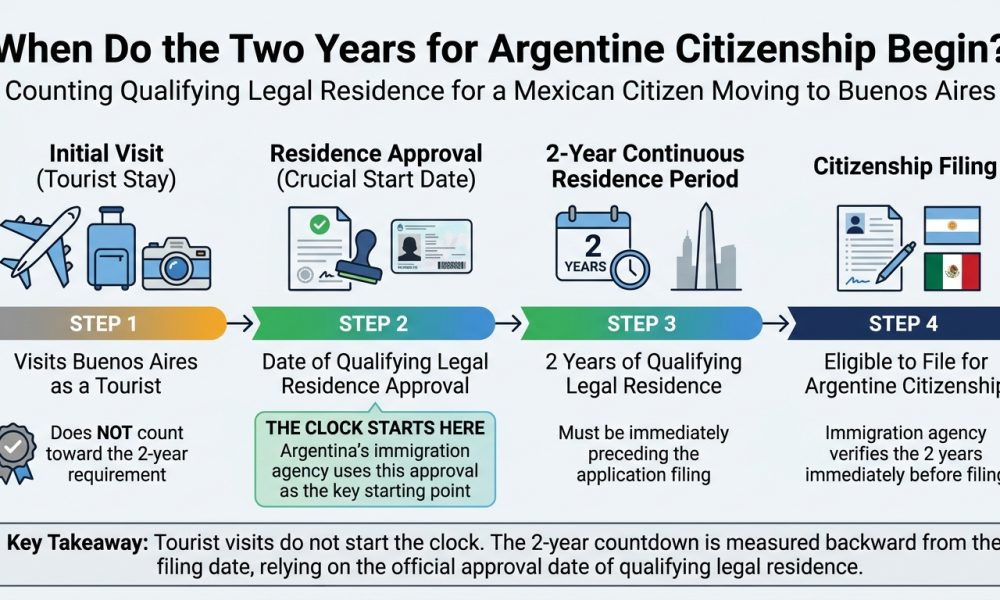
For a Mexican citizen who first visits Buenos Aires and later moves there, Argentina’s immigration agency counts qualifying legal residence during the two years before filing, making the residence approval date important, even as an ongoing constitutional dispute creates uncertainty.
WASHINGTON, D.C., November 25, 2026
Mexican citizens considering Argentine naturalization should distinguish their first visit to Buenos Aires from the beginning of qualifying legal residence, because Argentina’s published immigration procedures require two continuous years of authorized residence immediately preceding a citizenship application.
The distinction has become more significant following Argentina’s 2025 immigration reforms, which introduced stricter requirements concerning lawful residence and international departures, while subsequent judicial decisions raised constitutional questions about the government’s authority to implement those changes.
Tourist Arrival Does Not Automatically Start the Clock
A Mexican national arriving in Argentina for tourism may legally visit under the applicable entry arrangements, but that temporary admission should not be confused with an approved temporary or permanent residence status recognized for naturalization purposes.
Someone visiting Buenos Aires in January and receiving qualifying residence authorization in July should therefore examine the July approval and its legally effective date, rather than automatically count the earlier tourist arrival toward the required period.
The Residence Approval Date Is Particularly Important
Argentina’s National Directorate of Migration currently describes naturalization eligibility as requiring temporary or permanent residence obtained more than two years earlier, together with continuous lawful residence throughout the two years immediately preceding the application.
The agency’s published position makes the legal start date of authorized residence central to planning, although applicants should verify the effective date in their individual immigration decision rather than assume every administrative document establishes the same starting point.
An Example Illustrates the Difference
Consider a Mexican citizen who visits Argentina on January 15, 2026, returns home after exploring Buenos Aires and subsequently obtains temporary residence effective September 1, 2026, before establishing a permanent household there.
Under the immigration agency’s published administrative interpretation, the prospective qualifying period would ordinarily be assessed from the legally recognized residence period, making September 2028 a potential eligibility point only if the applicant satisfies every applicable continuity and documentation requirement.
Filing Eligibility Does Not Guarantee Approval
Reaching the second anniversary of qualifying residence is not the same as becoming an Argentine citizen, because authorities must still determine whether the applicant satisfies identity, lawful-income, criminal-history, and other requirements under the applicable legal framework.
An application submitted before the qualifying period is complete mayfacer objections evenife the individual has spent considerable additional timeing Argentina, making accurate immigration records more useful than an informal calendar of physical presence.
Argentina’s 2025 Decree Tightened the Rules
Decree of Necessity and Urgency 366/2025, published May 29, 2025, amended Citizenship Law 346 to require two years of continuous legal residence immediately before filing and placed naturalization decisions within the National Directorate of Migration.
The reform also adopted an unusually strict interpretation of continuity, requiring applicants using that procedure to have remained inside Argentina throughout the relevant two-year period without making any international departure, regardless of the trip’s duration.
Even Short Foreign Trips Can Become Relevant
Under the decree’s published wording, a weekend visit to Uruguay or a brief return to Mexico during the qualifying period could prevent an applicant from meeting the agency’s strict no-departure requirement.
This approach differs from the more flexible treatment sometimes associated with earlier judicial naturalization practice, making travel history a potentially decisive issue for applicants whose family, employment or financial circumstances require regular international journeys.
Courts Have Challenged the Decree
On June 30, 2026, Argentina’s National Electoral Chamber invalidated the decree in litigation involving a Chinese national seeking citizenship, finding constitutional problems with transferring naturalization authority from federal courts to executive immigration officials.
A June 2026 report by La Nación explained that the judgment also challenged the revised residence restrictions, illustrating why applicants should not treat the agency’s current administrative position as a final judicial settlement of the governing law.
The Supreme Court Dispute Remains Significant
The government appealed the electoral chamber’s decision, and the matter advanced to Argentina’s Supreme Court in September 2026, creating ongoing uncertainty about the institutional authority and legal requirements applicable to naturalization proceedings.
As of November 25, 2026, the verified procedural developments do not establish a final Supreme Court resolution conclusively settling the contested provisions, making individualized legal review important before selecting a filing strategy.
The Constitutional Question Concerns More Than Residence
Argentina’s constitutional framework has long emphasized citizenship and associated political rights, which is why the judiciary’s role in naturalization became central to the challenge against the government’s executive decree.
The eventual resolution could clarify whether immigration officials may exercise the disputed powers under current legislation. However, applicants should not assume that constitutional litigation automatically eliminates every substantive residence or background-screening requirement.
Temporary Residence Is Different From Tourist Permission
Argentina’s immigration framework distinguishes transitory entry, temporary residence, and permanent residence, with each category carrying different administrative consequences and documentation requirements that may affect a foreign national’s long-term settlement plans.
A Mexican visitorseekinge naturalization should identify a residence category available under Argentine law, rather than repeatedlyenteringr as a touristande assuming accumulated visits will satisfy the agency’s published citizenship requirements.
Residence Applications Require Their Own Documentation
The immigration process may require Identification, criminal-record certificates, evidence supporting the selected residence category, and other documents, making approval depend on compliance with the rules rather than merely renting an apartment.
Applicants should preserve the authorization decision and related correspondence, because the period between submitting a residence application and receiving approval may raise important questions about the legal status held during that interval.
Filing a Residence Application Is Not Always Enough
An appointment confirmation, online application number, or pending immigration request should not automatically be treated as equivalent to an approved temporary or permanent residence authorization for purposes of calculating the agency’s current naturalization requirement.Ife an applicantreceivesd provisional documentation during processing, qualified Argentine counsel should examine its precise legal effect and effective datesrather thanf assuming the temporary paperautomatically startss an uninterrupted two-year citizenship countdown.
Immigration Status Must Remain Valid
Maintaining proper legal status throughout the relevant period matters under current agency procedure, because an expired authorization or unresolved immigration irregularity may affect the applicant’s ability to demonstrate qualifying legal residence.
Applicants should track renewal deadlines and preserve evidence of timely submissions, particularly where government processing delays create temporary gaps between the expiration of an earlier document and delivery of a replacement authorization.
Physical Presence and Legal Residence Are Separate Questions
A person may be physically present in Argentina for two years without meeting the current administrative definition of lawful residence, while another applicant may have valid immigration permission but face questions about international absences.
This distinction makes a complete timeline essential, connecting initial entry, residence authorization, renewals, and departures with the applicable legal requirements rather than relying on the number of years someone informally describes living in Buenos Aires.
Mexican Citizens Need a Lawful Residence Basis
Mexican nationality does no,tby itself, exempt applicantsn from Argentina’s current naturalization residence rules, though Mexican citizens can explore available immigration arrangements and pursue qualifying authorization under applicable national procedures.
Employment, family connection,s and other lawful residence categories may be relevant depending on individual circumstances. Still, applicants should verify eligibility directly before relocating rather than relying on promotional claims about automatic permanent residence.
Family Members May Follow Different Timelines
Spouses and children accompanying a Mexican applicant may hold different immigration categories or receive approvals on separate dates, so the principal applicant’s residence history should not automatically apply to every relative.
Parents should review the status of dependent children and any possible Argentine nationality rights separately, particularly when a birth in Argentina or a relationship to an Argentine citizen introduces a different legal framework.
Criminal Records Remain Part of the Process
Argentina’s published naturalization procedure requires documentation concerning criminal history in Argentina and the applicant’s country of origin, making official background checks important regardless of how the constitutional dispute over administrative authority is eventually resolved.
Mexican applicants should obtain authentic records from competent authorities and preserve relevant court dispositions, rather than assume that an absence of local convictions eliminates every documentary question involving previous residence or legal proceedings.
Financial Records Can Support an Application
The immigration agency also requests evidence of lawful occupation or means of support, including employment documentation, registered business activity, or other acceptable records showing the applicant’s ability to support themselves legitimately.
A financially independent applicant should confirm which evidence is acceptable before filing, especiallywhene incomecomess from investments or activities outside Argentina and does not appear in a typical Argentine employment record.
Residence Planning Can Affect Taxes
Establishing actual residence in Argentina may produce taxation and reporting consequences independently of nationality, so an applicant should consider the financial implications before committing to an uninterrupted two-year stay under the agency’s current interpretation.
Mexican taxpayers maintaining investments, property or employment abroad should obtain coordinated advice on Argentine and Mexican tax residence rules, rather than assume an immigration authorization determines every income-tax obligation in both countries.
American Dual Nationals Face Additional Duties
Some Mexican nationals also possess American citizenship, and the U.S. State Department’s dual-nationality guidance explains that Americans remain subject to United States passport requirements even when they legally hold another nationality.
Acquiring Argentine citizenship would not automatically extinguish American obligations, and travelers with multiple passports should follow each country’s requirements rather than assume another nationality exempts them from existing legal duties.
Mexican Birthright Nationality Has Particular Protection
Mexico’s Constitution protects nationality acquired by birth against deprivation, an important distinction for Mexican-born applicants considering another citizenship after meeting Argentina’s naturalization requirements and completing the necessary official procedures.
Naturalized Mexican citizens face different nationality-loss provisions, making legal advice especially important before voluntarily acquiring Argentine citizenship or spending extended periods outside Mexico while maintaining Mexican naturalization status.
Passport Issuance Follows Citizenship Recognition
An Argentine passport becomes relevant only after citizenship is legally recognized, and the responsible authorities complete the required Identification procedures, making the residence anniversary an unsuitable substitute for official nationality documentation.
Applicants should distinguish immigration authorization, citizenship approval, national identity registration, and passport issuance, because each stage has its own legal function and does not automatically satisfy the next administrative requirement.
Identity Records Should Remain Consistent
Applicants who legally changed names or previously held additional nationalities should preserve documents linking earlier and current identities, since authorities may need to reconcile passports, birth certificates, and historical immigration records during verification.
Readers exploring Amicus International Consulting’s new identity services should distinguish lawful privacy planning from fabricated residence histories, because authentic Identification and truthful documentation are indispensable to legitimate naturalization applications.
A Second Passport Requires Careful Timing
Families considering Amicus International Consulting’s second passport services may compare Argentina with other lawful citizenship pathways. Still, private advisers cannot override the residence requirements or guarantee decisions by competent Argentine authorities.
A reliable plan should establish the exact effective residence date, evaluate anticipated international travel, and monitor the judicial dispute before making commitments that depend on receiving citizenship within a predetermined timetable.
The Correct Starting Date Is Legally Significant
For a Mexican citizen who first explores Buenos Aires as a tourist and then establishes qualifying residence, the practical starting point under the current agency procedure is the recognized legal residence period, not the initial sightseeing visit.
Ongoing constitutional litigation means applicants should confirm which legal standard applies to their case, preserve official immigration records, and plan around the distinction between two years of residence and an eventual citizenship decision.