
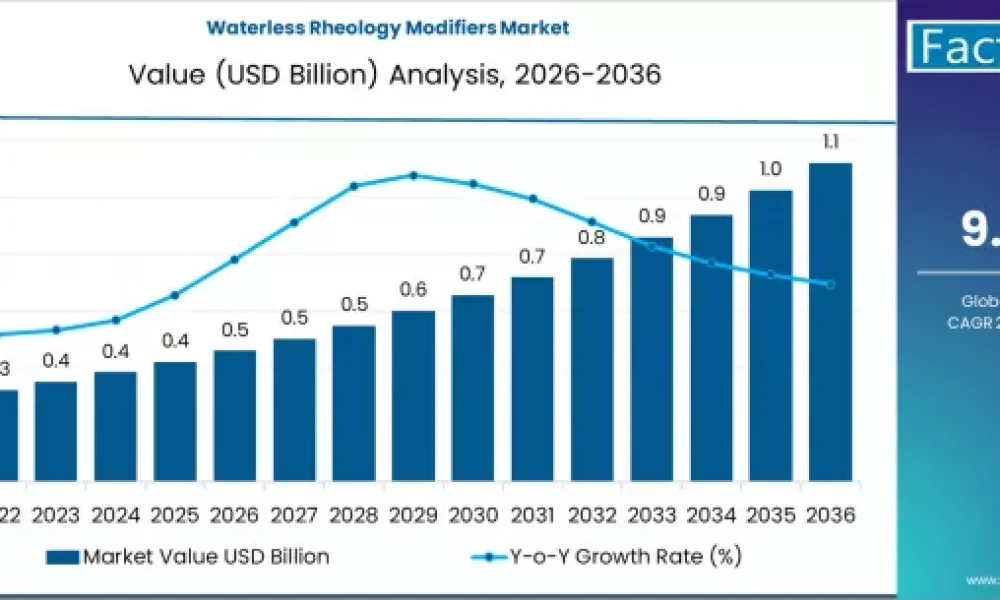
The global Waterless Rheology Modifiers Market is entering a decisive transformation phase, driven by sustainability imperatives, tightening environmental regulations, and rapid innovation across coatings, personal care, construction, and industrial formulations. The market is projected to grow at a compound annual growth rate (CAGR) of approximately 6.8% between 2025 and 2036, reaching an estimated USD 2.4–2.7 billion by 2036, up from roughly USD 1.1 billion in 2024.
This growth reflects a structural shift away from water-based additives toward water-free, low-VOC, and solvent-efficient rheology solutions that align with global decarbonization goals and circular economy strategies.
Market Context: Why Waterless Matters
Rheology modifiers are critical ingredients that control viscosity, flow, and stability in formulations. Traditionally, many of these systems relied on water as a carrier or processing medium. However, water scarcity, energy-intensive drying processes, and regulatory pressure on effluent discharge are accelerating demand for waterless alternatives.
To access the complete data tables and in-depth insights, request a Discount On The Report here: https://www.factmr.com/connectus/sample?flag=S&rep_id=13381
Key macro drivers include:
- Global water stress: By 2030, nearly 40% of the global population is expected to live in water-stressed regions, forcing manufacturers to reduce water dependency.
- Regulatory tightening: Regions such as the EU and North America are enforcing stricter limits on VOC emissions, wastewater discharge, and carbon intensity.
- Process efficiency: Waterless systems reduce drying time and energy consumption by 15–30% in coatings and inks, improving throughput and lowering operational costs.
Innovation Trends Shaping the Market
The market is witnessing five major innovation themes:
- Advanced Organoclay and Synthetic Polymer Systems
New-generation organoclays and polyamide-based modifiers deliver higher yield stress and better sag control at lower dosages, offering 10–20% performance gains compared to legacy grades. - Bio-Based and Renewable Feedstocks
Bio-derived rheology modifiers—using castor oil, cellulose derivatives, or bio-polyamides—now account for a growing share of new product launches, expected to exceed 35% by 2036. - High-Solids and 100% Active Formulations
Demand is rising for 100% active, solvent-free rheology modifiers, particularly in industrial coatings and adhesives, reducing formulation complexity and improving sustainability metrics. - Multi-Functional Additives
Manufacturers are developing modifiers that combine rheology control with dispersion stability, anti-settling, and thixotropy, reducing the need for multiple additives and cutting formulation costs by up to 12%. - Digital Formulation Support
AI-assisted formulation tools and digital twins are helping customers optimize rheology faster and reduce development cycles by 25–40%.
Sustainability Drivers
Sustainability has evolved from a compliance requirement to a core competitive differentiator in the waterless rheology modifiers market.
Key sustainability metrics include:
- Carbon footprint reduction: Switching from water-based to waterless systems can lower lifecycle CO₂ emissions by 8–18%.
- Wastewater elimination: Waterless modifiers can reduce wastewater generation by up to 90% in certain applications.
- Energy savings: Reduced drying and curing requirements translate into 10–25% lower energy consumption per production batch.
End-use industries—particularly architectural coatings, automotive OEMs, and personal care brands—are increasingly demanding quantified sustainability data, pushing suppliers to provide life cycle assessments (LCAs) and third-party certifications.
End-Use Sector Outlook
- Coatings (42% market share): Industrial, protective, and automotive coatings remain the largest consumers, with growth strongest in high-performance and low-VOC systems, projected at 7.2% CAGR through 2036.
- Personal Care & Cosmetics (21%): Waterless beauty trends—solid cosmetics, balms, and concentrated formulations—are driving adoption, with growth projected at 8.1% CAGR.
- Construction Materials (17%): Dry-mix mortars, sealants, and adhesives adopt waterless modifiers to improve shelf life and on-site performance.
- Inks, Adhesives & Others (20%): Packaging inks and specialty adhesives leverage waterless rheology for faster processing and regulatory compliance.
Competitive Positioning
The market is moderately consolidated, with the top five players accounting for approximately 45–50% of global revenue. Competitive strategies include:
- Portfolio diversification toward bio-based and multifunctional products
- Strategic partnerships with resin manufacturers and OEMs
- Capacity expansion in Asia-Pacific, expected to contribute over 38% of incremental demand by 2036
- M&A activity involving specialty additive startups with sustainable technologies
Smaller innovators are gaining traction by focusing on niche applications, customization, and sustainability leadership, while large multinationals leverage scale, regulatory expertise, and global distribution.
Regional Dynamics
- Asia-Pacific: Fastest-growing region (CAGR ~7.5%), driven by construction, automotive, and manufacturing expansion.
- Europe: Sustainability-led market with strong demand for bio-based and compliant solutions.
- North America: Technology-driven growth, especially in high-performance coatings and personal care.
- Rest of World: Gradual adoption, supported by infrastructure development and regulatory harmonization.
Outlook to 2036
By 2036, waterless rheology modifiers will be a mainstream formulation standard. Companies that invest early in innovation, sustainability transparency, and customer-centric formulation support are expected to outperform the market by 150–200 basis points annually.
The market will reward players who treat sustainability not as a cost, but as a catalyst for innovation, differentiation, and long-term value creation.”



