
Water Quality Sensor Market Overview:
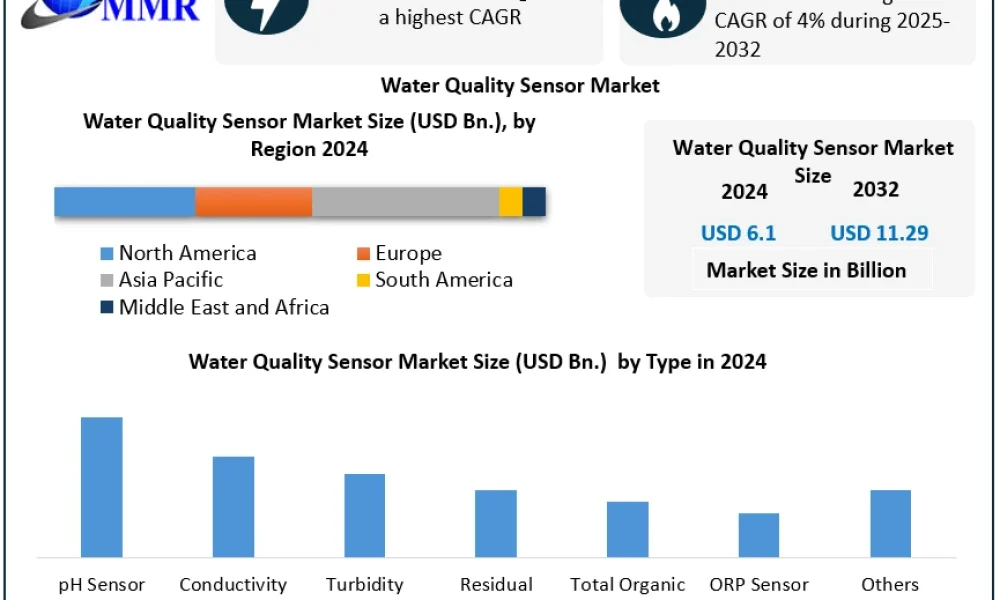
Water Quality Sensor Market, valued at USD 6.1 billion in 2024, is projected to grow at a CAGR of 4% from 2025 to 2032, reaching approximately USD 11.29 billion. Increasing environmental concerns, stringent regulatory standards, and emerging smart water infrastructure initiatives drive the adoption of advanced water quality sensors worldwide. Asia Pacific leads the market with the largest share, propelled by high population, industrial growth, and government initiatives focused on water preservation and smart city projects.
Key Highlights & Insights
Market Size & Growth: Market forecast to grow from USD 6.1 billion in 2024 to USD 11.29 billion by 2032 at 4% CAGR.
Dominating Region: Asia Pacific commands the largest market share due to expansive water quality monitoring deployments in China, India, Singapore, and Southeast Asia, combined with urgent water scarcity challenges and robust regulatory frameworks.
Leading Segment: pH sensors hold the largest market share, critical for assessing acidity or alkalinity in water treatment and ensuring water safety. Turbidity and conductivity sensors show rapid growth due to their role in pollution detection and water purity assessment.
Key Driver: Rising industrialization, regulatory compliance needs, and technological advancements in IoT-enabled multi-parameter sensors enhance real-time monitoring capabilities.
Request a Free Sample Copy or View Report Summary:https://www.maximizemarketresearch.com/request-sample/71798/
Recent Developments
In July 2024, Wessex Water and Southern Water in the UK deployed AI-enabled real-time water quality monitors, achieving high predictive accuracy for bacterial contamination at popular swimming and coastal sites.
China’s ZoneWu launched a LoRaWAN-enabled multi-parameter sensor with long-range and low-power data transmission, facilitating widespread smart water monitoring.
Siemens introduced next-generation water quality sensors with enhanced accuracy for turbidity, pH, and dissolved oxygen measurement, improving industrial and municipal water treatment.
Aqsen Innovations partnered with CENSIS (Scotland) to pilot affordable IoT-based water quality sensors in Lake Victoria, offering cost-effective monitoring suitable for low-income regions.
Market Dynamics
Growth Drivers:
Increasing awareness of water contamination impacts on health and environment.
Government regulations like the Clean Water Act (U.S.) and EU Water Framework Directive enforcing stricter water quality standards.
Digitalization and automation in water monitoring systems.
Adoption of multi-parameter, wireless, and IoT-enabled sensors improving operational efficiency.
Challenges:
High costs and maintenance of advanced sensor technologies.
Variation in regulatory standards by region.
Need for improvements in sensor durability under harsh environmental conditions.
Regional Analysis
Asia Pacific: Largest and fastest-growing market with strong government initiatives on water quality, smart cities, and river preservation; includes China, India, Japan, and ASEAN countries.
North America: Rapid growth fueled by consumer adoption of smart devices for water quality monitoring and investments in large-scale infrastructure.
Europe: Mature market with strong regulations and significant industrial and residential applications.
Middle East & Africa: Growth due to growing urban populations and increasing awareness of water scarcity.
South America: Increasing deployment of water quality sensors for municipal and agricultural use.
Product Segmentation
By Sensor Type: pH sensors (largest share), turbidity sensors, conductivity sensors, residual chlorine sensors, total organic carbon (TOC) sensors, ORP (oxidation-reduction potential) sensors, and others.
By Application: Industrial (largest segment), laboratories, residential, government, commercial spaces, agriculture.
Key Trends
Growing adoption of multi-parameter sensors that monitor various water characteristics simultaneously for cost-effectiveness and comprehensive analysis.
Increasing integration with IoT and cloud-based platforms for remote monitoring, data logging, and predictive analytics.
Rising use in agriculture and aquaculture for precision water management.
Development of compact, wireless, and auto-calibrating sensors to facilitate easier deployment.
Quote
“Asia Pacific’s leadership in the water quality sensor market is driven by its urgent need to manage water scarcity and pollution challenges through cutting-edge smart technologies. As governments and industries increasingly adopt real-time, IoT-enabled monitoring systems, the market will experience sustained growth globally.”
About Maximize Market Research:
Maximize Market Research is a multifaceted market research and consulting company with professionals from several industries. Some of the industries we cover include medical devices, pharmaceutical manufacturers, science and engineering, electronic components, industrial equipment, technology and communication, cars and automobiles, chemical products and substances, general merchandise, beverages, personal care, and automated systems. To mention a few, we provide market-verified industry estimations, technical trend analysis, crucial market research, strategic advice, competition analysis, production and demand analysis, and client impact studies.
Contact Maximize Market Research:
3rd Floor, Navale IT Park, Phase 2
Pune Banglore Highway, Narhe,
Pune, Maharashtra 411041, India
+91 96071 95908, +91 9607365656




