
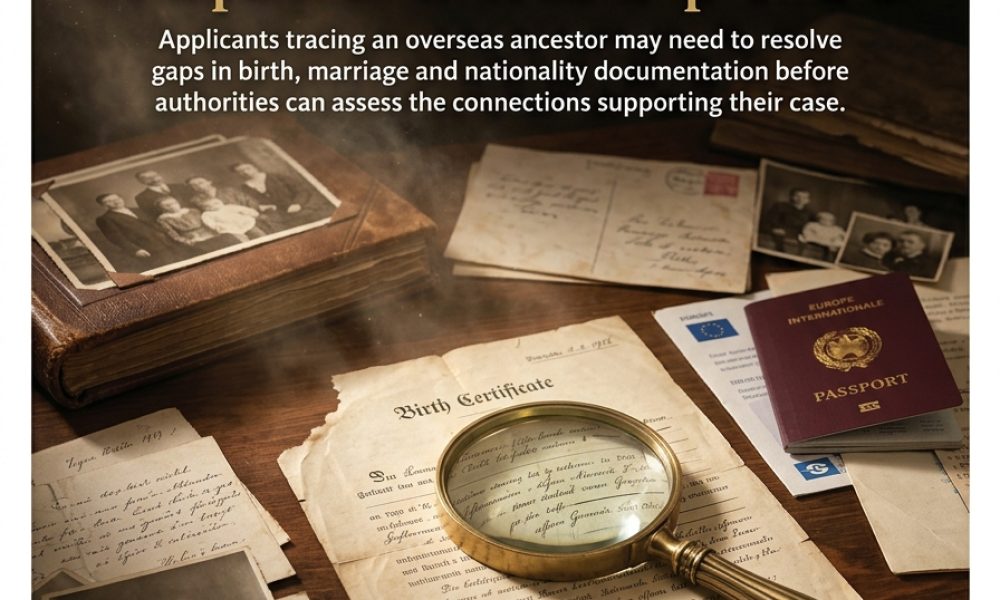
Applicants tracing overseas ancestors may encounter missing birth certificates, incomplete marriage registrations, inconsistent family names, and unavailable naturalization records, creating documentary challenges that must be resolved before foreign authorities can determine whether an ancestral connection supports legal recognition of citizenship.
WASHINGTON, DC, November 1, 2026 — Americans investigating citizenship through ancestry are discovering that the hardest obstacle is not always determining whether a parent, grandparent, or earlier relative came from another country, but obtaining reliable historical documentation showing that citizenship legally passed between generations.
As interest in second passports grows among internationally mobile families, historical birth certificates, marriage records, naturalization documents, and foreign civil registrations have become increasingly important evidence for applicants seeking to establish nationality rights through ancestors who emigrated decades earlier.
However, missing documents, inconsistent names, inaccessible archives, and changes in nationality legislation can complicate otherwise promising applications, particularly when the relevant government requires a complete documentary chain before recognizing citizenship or accepting an application for an official passport.
For applicants exploring citizenship through connections to Italy, Ireland, Canada, Poland, or other countries recognizing certain forms of nationality transmission, understanding the difference between genealogical evidence and legally acceptable documentation can prevent expensive mistakes and unrealistic expectations.
The central challenge is therefore establishing not merely that an ancestor existed or was born overseas, but that the relevant family relationship, citizenship status, and historical legal circumstances satisfy the requirements applicable to the present applicant.
Citizenship by Descent Depends on a Documented Legal Connection
Citizenship by descent generally involves nationality acquired or recognized through a qualifying parent or ancestor. However, each country determines which family relationships qualify and whether you must meet additional registration, residence, or administrative requirements.
A grandparent’s foreign birthplace may provide a useful starting point. Still, citizenship eligibility can depend on whether that grandparent held the relevant nationality and whether the law permitted transmission when the next generation was born.
Applicants must therefore distinguish evidence establishing biological or legally recognized ancestry from evidence demonstrating citizenship transmission, because those questions may require different documents and different interpretations of historical nationality legislation.
In some cases, applicants may already hold another citizenship under applicable law and need formal recognition. In contrast, others must complete a process before they can acquire nationality
Document Nationality Certificates Can Interrupt an Entire Application
Birth certificates often form the foundation of ancestry-based citizenship applications because they establish parent-child relationships, identify key dates, and connect the generations through which nationality allegedly passed.
When an applicant cannot locate a historical birth certificate, they may struggle to establish the required relationship even when family photographs, immigration records, and oral histories provide compelling evidence of the ancestor’s existence.
These challenges often arise when older records were kept locally, registration systems were incomplete, or an ancestor was born in a region affected by war, administrative disruption, or later changes in national borders.
Depending on the country and the circumstances, applicants may need to investigate municipal archives, historical registries, religious institutions, or legally authorized alternative evidence before a citizenship authority can assess the claim.
Marriage Records Help Establish Continuity Between Different Names
Marriage certificates can be especially important when tracing ancestry through individuals whose surnames changed after marriage, especially when original birth records and later immigration documents identify the same person differently.
An applicant might discover that a grandmother appears under her maiden name in a European birth register but under a married surname in American census records, creating an apparent documentary inconsistency.
Where several generations involve similar changes, a complete series of marriage records may be necessary to establish that the individuals named on successive birth certificates belong to the same legally recognized family line.
Government authorities may also require additional evidence when marriage dates, parental names, or other identifying details conflict, particularly where the discrepancies affect the legal relationship through which citizenship is claimed.
Naturalization Records Can Determine Whether Citizenship Was Transmitted
One of the most significant questions in ancestral citizenship research is whether an immigrant ancestor became an American citizen and whether that event affected the ancestor’s original nationality under the laws in effect at the time.
For certain historical nationality systems, the timing of American naturalization could determine whether an immigrant retained citizenship long enough to transmit it to a child born before or after the relevant event.
The U.S. National Archives guidance on historical naturalization records explains that naturalization documents can be distributed among federal, state, and local repositories, and records created before September 27, 1906, present particular challenges because numerous courts held naturalization authority.
The agency also distinguishes between unsuccessful searches of its own holdings and conclusive proof that a naturalization never occurred, an important limitation when foreign citizenship authorities require evidence concerning an ancestor’s historical nationality.
A Missing Naturalization Record Does Not Prove an Ancestor Never Naturalized
Applicants sometimes interpret the absence of a naturalization certificate as evidence that an ancestor retained foreign citizenship, but an unsuccessful archival search does not necessarily establish the historical facts required for nationality recognition.
Records may have been created in another court, transferred to a different repository, indexed under an alternative spelling, or maintained within collections that have not been fully digitized or searched.
The distinction matters because certain citizenship claims depend on proving that an ancestor did not naturalize before a legally significant date, rather than merely demonstrating that one historical database contains no matching entry.
Where appropriate, applicants may need to request a formal Certificate of Non-Existence from United States Citizenship and Immigration Services, while recognizing that such certifications cover only records within the agency’s custody and follow its procedures.
Historic Archives Often Contain Incomplete Information
Older civil and immigration documents were frequently created under administrative conditions substantially different from modern Identification systems, allowing inconsistent spellings, approximate dates, and incomplete family information to appear across otherwise legitimate records.
An ancestor who arrived from Europe during the early twentieth century might appear under several variations of the same surname, particularly where immigration officials, local clerks, or family members used different languages or transliteration conventions.
Historical census entries can contain additional discrepancies because household members sometimes supplied identifying information or recorded it approximately, rather than independently verifying it against official birth or citizenship documents.
Researchers should consequently compare several sources before concluding that inconsistent information establishes different identities, while preserving the distinction between a reasonable genealogical interpretation and evidence formally accepted by government authorities.
Italian Citizenship Reforms Make Documentary Accuracy Especially Important
Italy’s 2025 citizenship reforms substantially changed eligibility for certain foreign-born descendants with another nationality, increasing the importance of confirming whether an applicant meets current statutory requirements before gathering extensive historical documentation.
A Reuters report examining Italy’s restrictions on citizenship by descent, published March 28, 2025, described the government’s decision to narrow longstanding ancestry-based pathways amid growing application volumes and concerns about increasingly distant genealogical claims.
The resulting legal framework, established through Law No. 74 of May 23, 2025, includes specific eligibility exceptions and transitional provisions involving qualifying ancestors, citizenship status, parental residence, and applications submitted under earlier requirements.
For applicants with missing historical records, these developments demonstrate why genealogical research should begin with an evaluation of current law, since locating every ancestral certificate may not establish eligibility if the applicable nationality requirements cannot be satisfied.
Canadian Citizenship Rules Require Careful Review of Family Dates
Canada’s amendments effective December 15, 2025, expanded citizenship recognition for certain individuals born abroad who were previously affected by restrictions on nationality transmission beyond the first generation.
However, the revised framework also sets out specific conditions affecting citizenship transmission to children born abroad after the legislative changes, including a substantial connection requirement involving qualifying parental physical presence in Canada.
Applicants tracing Canadian grandparents or earlier ancestors must therefore reconstruct relevant family circumstances and examine the dates on which citizenship was acquired or transmitted, rather than relying exclusively on historical birthplaces.
Where records are missing, establishing parental identity or the relevant dates may become essential to determining whether the applicant qualifies under the amended legislation or requires a different immigration pathway.
Irish Citizenship Claims May Depend on Earlier Registrations
Ireland offers citizenship opportunities to certain descendants of Irish nationals, including qualifying applicants with Irish-born grandparents. Still, the procedures depend on family circumstances and the legal status of intervening generations.
In some cases, registration in the Foreign Births Register is necessary, and the timing of a parent’s registration can determine whether citizenship was legally transmitted to a child born outside Ireland.
A missing registration record can therefore matter more than an absent genealogical detail, especially where the applicant must establish that the parent held Irish citizenship before the applicant’s birth.
Families investigating Irish ancestry should obtain appropriate records and confirm whether registration was completed, because an established family relationship alone does not necessarily satisfy every condition governing transmission across successive generations.
Changing National Borders Can Complicate Historical Nationality
Ancestral citizenship investigations become particularly challenging when relatives were born in territories whose political boundaries changed, because historical nationality may depend on laws that differ substantially from those governing the same location today.
Families tracing ancestors through Central or Eastern Europe may encounter birthplaces recorded under different national administrations, along with documents issued in languages or political jurisdictions that no longer exist.
A historical certificate establishing birth within a particular territory does not automatically prove that the individual possessed citizenship of the modern country now governing that location.
Applicants may need professional interpretation of historical nationality legislation, relevant dates, and subsequent legal changes before determining whether the ancestor held citizenship that could be transmitted to later generations.
Religious Records May Help Where Civil Documents Are Missing
Church baptismal registers, marriage books, and other religious records can provide important information when historical civil registration was incomplete, particularly where religious institutions preserved family information before modern government recordkeeping became widespread.
In some jurisdictions, properly certified religious records may be accepted for particular legal purposes. However, their evidentiary value depends on the receiving country’s citizenship rules and the administrative circumstances surrounding the original registration.
A baptism record may identify a child’s parents and birthplace without independently establishing either parent’s legal nationality, so additional documentation is necessary when citizenship transmission is disputed.
Applicants should therefore determine whether the relevant authority recognizes religious extracts and whether further certification, translation, or civil registration procedures are required before the information becomes legally usable.
Historical Records Should Not Be Altered to Resolve Discrepancies
One of the most serious mistakes applicants can make involves attempting to modify historical records informally when names, birth dates, or parental information do not match across the documents needed for citizenship recognition.
A clerical discrepancy may be correctable through an authorized administrative or judicial procedure. Still, applicants should not assume they can revise a certificate simply because another document contains different information.
The appropriate process depends on the issuing jurisdiction, the record’s age, the evidence supporting the correction, and whether the relevant authority permits amendments to historical documents.
Where original records cannot legally be amended, applicants may need supporting explanations or formally accepted alternative evidence rather than attempting to create an artificial documentary consistency unsupported by the historical facts.
Certified Copies and Apostilles Serve Different Functions
Foreign citizenship applications often require certified civil records, official translations, and document authentication, but applicants should understand each procedure’s evidentiary function before ordering expensive services from multiple authorities.
A certified copy generally confirms that a document corresponds to a record maintained by the issuing institution. At the same time, an apostille authenticates specified aspects of a public document’s official origin under applicable international arrangements.
Neither process automatically establishes that all information contained in a document is factually correct or that the historical events described satisfy the citizenship laws governing the applicant’s claim.
Consequently, an authenticated birth certificate containing a material discrepancy may still require additional supporting evidence, even where the document bears a valid apostille issued by the appropriate authority.
Passenger Lists and Census Records Can Support Further Research
Historical passenger manifests may identify approximate immigration dates, former residences, relatives, and other details that help genealogists determine where an ancestor lived before and after arriving in the United States.
Census records can provide additional information concerning household relationships and reported naturalization status. However, such details were not always verified through official identity documents and may contain errors or incomplete entries.
These historical sources can help identify where relevant court or civil records might be located, but they should not automatically be treated as substitutes for official proof of citizenship.
A carefully reconstructed timeline can nevertheless narrow archival searches considerably, particularly when several individuals shared similar names or when family records contain conflicting accounts of migration and naturalization.
Adoption and Legal Parentage Introduce Additional Questions
Citizenship through descent can become complicated when an applicant’s family history includes adoption, changes in legal parentage, or confidential records not readily accessible through standard civil registration procedures.
Some countries provide special citizenship rules for qualifying adopted children, while others require evidence concerning the adoption date, legal recognition, parental nationality, and the child’s circumstances.
A missing adoption judgment or restricted original birth certificate may make it difficult to establish the necessary relationship, particularly where the citizenship authority requires formal evidence rather than an informal family explanation.
Applicants should seek appropriate legal guidance when confidential adoption records are involved, because access restrictions and nationality eligibility requirements must be considered, and biological ancestry alone does not determine the outcome.
DNA Testing Cannot Replace Official Citizenship Evidence
Commercial ancestry testing may reveal genetic connections with particular populations and help individuals discover previously unknown relatives. Still, these findings generally do not establish legal citizenship or the historical nationality of an identifiable ancestor.
A DNA report indicating substantial ancestry from Ireland, Poland, Italy, or another country does not show that a specific family member held citizenship under the legislation in force when subsequent generations were born.
Genetic information can sometimes help researchers identify potential family relationships, but citizenship authorities ordinarily require legally recognized documentary evidence establishing the relevant connection and applicable conditions.
Applicants should therefore distinguish the personal and genealogical value of DNA research from the formal evidentiary standards governments use to determine nationality and issue official citizenship documentation.
Private Research Services Cannot Guarantee Government Recognition.
Professional genealogists and document retrieval specialists can help locate records, identify historical relationships, and coordinate requests across archives in multiple countries.
However, finding a previously missing document does not guarantee that a citizenship application will succeed, because the government must still evaluate the evidence under the relevant legal framework.
A researcher may confirm that an ancestor was born overseas without establishing whether the ancestor retained citizenship or legally transmitted it, particularly where later naturalization or historical restrictions are involved.
Applicants should therefore distinguish genealogical research from regulated legal advice and government decision-making, ensuring that service agreements accurately describe the work performed and do not promise results outside the provider’s authority.
Passport Issuance Requires More Than a Completed Family Tree
An applicant may assemble a convincing historical family tree without immediately qualifying for a passport, because government recognition of nationality and issuance of a travel credential involve separate administrative determinations.
In some jurisdictions, the applicant may already hold citizenship under existing law and need formal documentary recognition, while other countries require registration or naturalization before nationality is acquired.
The issuing authority may then require a separate passport application supported by officially recognized citizenship evidence, personal Identification, and compliance with the administrative requirements governing the requested credential.
For this reason, commercial claims suggesting that ancestral certificates automatically produce a passport should be examined carefully, especially when the applicant has not received formal recognition from the relevant government.
Electronic Passport Authentication Does Not Establish Ancestral Eligibility
Modern biometric passports incorporate electronic chips and cryptographic security features intended to help inspection systems evaluate electronically stored identity information and assess selected document authentication protections.
Amicus International Consulting provides detailed guidance on how to scan a passport’s NFC chip and understand the results, explaining the difference between accessing electronically stored passport information and interpreting the results of particular security checks.
A successful electronic authentication result can support confidence in the integrity and apparent origin of stored information. Still, it does not independently establish that an ancestral citizenship application met every statutory requirement.
Applicants should therefore rely on official nationality recognition and properly issued government documentation, rather than treating a functioning electronic passport chip as conclusive evidence concerning historical citizenship transmission.
Missing Records Can Affect Children’s Future Citizenship Rights
Families investigating ancestral citizenship should consider whether recognizing an applicant’s nationality could provide additional opportunities for children or future descendants, since some countries permit citizenship transmission under defined statutory conditions.
However, these rights may depend on parental citizenship status at the child’s birth, formal registration deadlines, residence history, and other requirements that differ considerably between countries.
A missing document affecting the original applicant may therefore affect subsequent generations, particularly when citizenship recognition must occur before another family member becomes eligible to acquire nationality.
Early research can help identify these questions, but families should avoid assuming that a successful application by one person establishes automatic citizenship rights for every relative.
A Structured Archival Investigation Can Reduce Unnecessary Costs
Applicants can often improve the efficiency of an ancestral citizenship investigation by first identifying the legal requirements, then determining which historical records are needed to establish the qualifying connection.
This approach can prevent substantial expenditure on distant genealogical research when current citizenship legislation requires a more recent qualifying ancestor or imposes conditions that cannot be satisfied.
Where records are missing, a documented search history identifying archives contacted, names investigated, and responses received can help researchers understand which sources remain available for further investigation.
The appropriate strategy ultimately depends on the relevant nationality law, because an extensive family archive has limited legal value when the documents do not establish the particular facts required by the government.
A Missing Document Does Not Automatically Defeat a Valid Claim
Historical recordkeeping was imperfect, and the absence of an original certificate does not necessarily mean that an applicant lacks a qualifying ancestral connection or that further documentary evidence cannot be obtained.
Nevertheless, citizenship authorities must apply the evidentiary standards established by law, making it important to distinguish an incomplete application from one supported by officially accepted alternative documentation.
For Americans investigating second citizenship, realistic planning requires confirming the legal pathway, identifying the relevant historical facts, and obtaining reliable evidence before assuming that formal government recognition will follow.
The practical benefits of another nationality can extend to residence, employment, education, and family mobility. Still, those opportunities depend on lawful eligibility and the issuing country’s administrative requirements.
Ultimately, missing family records can complicate citizenship claims because an ancestral connection becomes legally meaningful only when authentic documentation and applicable nationality rules establish the continuity necessary for official government recognition.




