
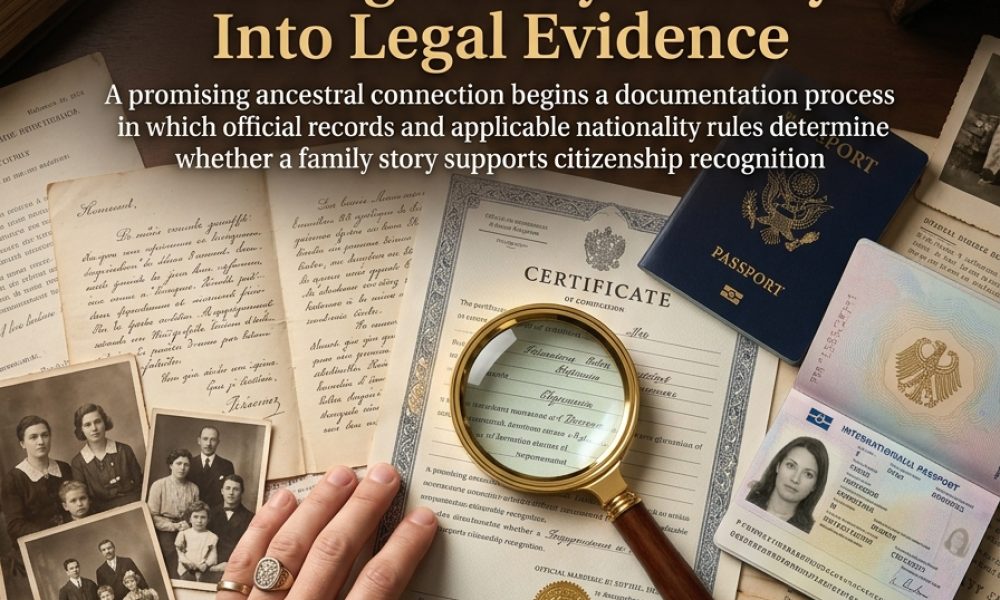
An ancestral connection may open a pathway to second citizenship. Still, birth certificates, naturalization records, marriage documents, and historical nationality laws must establish a legally recognized chain of descent before family heritage can become an official citizenship claim.
WASHINGTON, DC, November 1, 2026 — Americans investigating second citizenship through ancestral connections are discovering that family history can provide more than personal knowledge about earlier generations, as historical records may establish legally significant nationality rights that remain relevant decades after relatives emigrated.
For applicants tracing ancestors to Italy, Ireland, Canada, Poland, and other countries that recognize citizenship through descent, the process involves turning family stories into documentary evidence that meets government requirements for ancestry, nationality transmission, and historical legal status.
Although a foreign-born grandparent or great-grandparent may provide the starting point for an investigation, citizenship eligibility ultimately depends on the applicable nationality legislation, the circumstances surrounding each generation, and the authenticity of the records submitted.
The growing interest in ancestry-based citizenship reflects broader demand for lawful international residence opportunities, professional flexibility, educational access, and family security, particularly among Americans seeking additional nationality rights without necessarily relocating immediately or making substantial investments.
However, successful applications require a clear distinction between genealogical discovery and legal entitlement, because identifying an ancestor from another country does not automatically establish that the ancestor’s citizenship passed uninterrupted to the present applicant.
Family Heritage Becomes Relevant When Nationality Law Recognizes Descent
Citizenship by descent generally refers to nationality acquired or recognized through legally qualifying family relationships. However, the exact requirements vary significantly between countries and can depend on legislation in force at different times.
Some individuals may have acquired another citizenship automatically at birth without knowing it. In contrast, others must complete formal registration, recognition, or naturalization procedures before the relevant government considers them citizens under its laws.
This distinction determines whether an application seeks evidence of an existing nationality or requests citizenship through a separate statutory pathway, potentially affecting eligibility, processing procedures, and subsequent transmission to children.
An applicant whose grandfather was born abroad must therefore establish more than geographical ancestry, because nationality laws may require proof that the grandfather possessed citizenship and retained the ability to transmit it when the next generation was born.
A Family Tree Is the Starting Point, Not the Final Evidence
Genealogical research can identify family relationships, migration dates, surname changes, and ancestral birthplaces, creating a preliminary framework for determining which countries might offer a lawful citizenship pathway based on descent.
However, an informal family tree assembled from conversations, online genealogy platforms, or historical estimates generally does not replace certified civil records when an authority requires documentary proof of parentage and legal nationality transmission.
Applicants usually need to connect each generation with authentic evidence, showing that the person identified in one birth certificate matches the parent or grandparent named in later records.
When family members migrated repeatedly, married under different surnames, or registered personal information in several languages, establishing this documentary chain can be more demanding than initially discovering the qualifying ancestral connection.
Birth Certificates Establish the Core Generational Connection
Birth certificates frequently provide the foundation of citizenship-by-descent applications because they establish parent-child relationships, record dates and locations, and identify individuals whose nationality may determine the eligibility of subsequent generations.
For example, an applicant claiming citizenship through a foreign-born grandmother may need the grandmother’s official birth certificate, the intervening parent’s birth record, and the applicant’s own certificate.
Additional documentation may become necessary when civil records omit parental information, contain inconsistent names, or reference individuals whose identities cannot be reliably connected through the available sequence of official documents.
The relevant citizenship authority determines which records meet its standards, so it helps to distinguish genealogical evidence suggesting a family relationship from civil documentation legally sufficient to establish that relationship.
Naturalization Records Can Determine Whether Citizenship Continued
One of the most consequential questions in ancestral citizenship research concerns whether an immigrant ancestor became a United States citizen and whether that naturalization affected the ancestor’s original nationality under the law then applicable.
For certain historical citizenship systems, the timing of foreign naturalization can determine whether nationality was transmitted to a child, especially when the ancestor acquired American citizenship before or after the child’s birth.
The U.S. National Archives guidance on locating historical naturalization records explains how researchers can investigate court petitions, declarations, and other materials, while recognizing that different archives and government agencies may hold relevant records.
The National Archives also distinguishes an unsuccessful search of its own holdings from conclusive evidence that naturalization never occurred, an important limitation when applicants require reliable proof of an ancestor’s historical citizenship circumstances.
Historical Dates May Carry More Weight Than Family Recollections
Citizenship eligibility can turn on the precise date of a birth, marriage, foreign naturalization, or legal recognition event, making approximate family recollections insufficient where a statutory rule applies to a particular historical period.
An ancestor who naturalized several months before a child’s birth may create a different nationality question from an ancestor whose naturalization occurred several months afterward, depending on the citizenship legislation then in force.
Similarly, a parent who completed citizenship registration before having children may have transmitted nationality differently from someone who registered after their children were born, where the relevant law makes registration timing decisive.
These examples demonstrate why investigators must reconstruct a chronological record rather than relying exclusively on family narratives, particularly when government officials require evidence that citizenship existed at the legally relevant moment.
Italy’s Citizenship Changes Demonstrate Why Current Law Matters
Italy has historically attracted ancestry-based applicants from the United States and countries with substantial Italian diaspora populations, but legislative changes adopted in 2025 significantly altered eligibility for certain foreign-born descendants possessing another citizenship.
A Reuters report on Italy’s decision to restrict citizenship by descent published March 28, 2025, described the government’s concerns about increasingly distant ancestral claims and the expanding commercial market surrounding nationality recognition.
The resulting legislation, Law No. 74 of May 23, 2025, established additional restrictions and exceptions involving qualifying parental or grandparental citizenship, certain parental residence histories, and applications protected under specified transitional arrangements.
Consequently, discovering an Italian great-grandparent no longer establishes the same potential pathway that might have existed under earlier administrative practices, making legal assessment essential before applicants invest heavily in historical document retrieval.
Ireland Demonstrates the Importance of Registration Timing
Ireland’s nationality framework offers another example of how ancestry can support citizenship, particularly for individuals with qualifying Irish parents or grandparents whose family relationships satisfy the relevant statutory requirements.
For certain applicants born abroad with Irish-born grandparents, entry into the Foreign Births Register can establish citizenship. Still, the requirements differ from cases where an individual automatically acquired Irish nationality through a qualifying parent.
When citizenship transmission depends on parental registration before the next generation’s birth, the timing of that registration becomes legally significant. It can determine whether a child qualifies through an otherwise well-documented ancestral connection.
Families considering Irish citizenship should therefore review official birth records alongside prior registrations and parental nationality status, rather than assuming every identified Irish ancestor creates identical rights for descendants.
Canadian Reforms Reveal How Legislation Can Change Eligibility
Canada’s December 2025 changes to citizenship-by-descent rules illustrate how revised nationality legislation can make historical family relationships newly relevant for individuals previously affected by generational restrictions on citizenship transmission.
Certain people born abroad before the changes took effect may now qualify under expanded provisions. At the same time, different rules apply to some children born abroad afterward, including a substantial connection requirement involving parental physical presence in Canada.
These distinctions mean that applicants researching Canadian parents or grandparents must examine the relevant birth dates, citizenship histories, and statutory conditions rather than relying on generalized claims that ancestral Canadian citizenship now passes without limitation.
For families planning long-term mobility, the Canadian example underscores the importance of verifying current legislation and determining whether the law recognizes citizenship from birth or requires a different process to acquire nationality.
Marriage Records Help Reconcile Historical Name Changes
Marriage certificates can become essential when ancestral lines include surname changes, particularly when women’s birth names differ from those recorded in immigration documents, later civil registrations, or American naturalization files.
An applicant may find a grandmother listed under her birth surname in a European birth certificate but under a married surname in later American documents, requiring official evidence linking those identities.
Historical variations can also arise from transliteration, local language conventions, clerical mistakes, or voluntary changes after immigration, creating discrepancies that must be addressed without altering authentic records or inventing explanations.
Properly certified marriage documents, supplemental civil records, and officially accepted corrections can help establish continuity, although each issuing authority determines what evidence is sufficient for the particular nationality application.
Passenger Lists and Census Records Provide Supporting Clues
Historical passenger manifests can reveal approximate arrival dates, former residences, family relationships, and places of origin, helping researchers locate additional records relevant to an ancestor’s migration and potential citizenship status.
American census schedules may identify immigration years or describe an ancestor as naturalized. Still, such entries were not necessarily based on verified citizenship documents and may contain inaccuracies introduced during data collection.
These materials can therefore guide investigations toward more authoritative evidence without independently establishing that an individual possessed a particular nationality or completed the American naturalization process.
Researchers should compare information from multiple historical sources before treating an apparent discrepancy as decisive, particularly when spelling variations, approximate ages, or incomplete household details complicate the Identification of an ancestor.
Changing National Borders Can Complicate Ancestral Claims
Ancestral citizenship investigations become especially complicated when relatives were born in territories whose political borders or nationality laws changed during the twentieth century, including parts of Central and Eastern Europe.
A birth certificate identifying a historical town may not establish an ancestor’s nationality at the time, because residence in a particular territory and legal citizenship were not always equivalent.
Subsequent changes involving state succession, migration, military service, or acquisition of another nationality may raise additional questions about whether citizenship survived and could legally pass to later generations.
Applicants tracing ancestry through these regions should seek qualified legal interpretation of the relevant historical legislation rather than applying present-day national borders retrospectively to every event in their family’s history.
Maternal Citizenship Lines Can Raise Historical Legal Questions
Some historical nationality laws treated transmission through mothers differently from transmission through fathers, creating potential complications for individuals whose qualifying ancestral connection passes through a woman during a period of unequal citizenship rules.
Italy provides a prominent example because certain claims involving maternal transmission before January 1, 1948, have historically required special legal consideration rather than following the conventional administrative recognition process.
Italy’s 2025 reforms also introduce current restrictions that must be considered, meaning historical maternal transmission arguments cannot be evaluated without examining newer eligibility provisions and transitional arrangements.
The broader principle extends beyond one country because nationality claims must be assessed against the legislation applicable to each generation, including legal developments affecting marriage, parentage, and citizenship recognition.
Adoption and Legal Parentage Require Separate Examination
Citizenship through adoption can involve different requirements from nationality transmitted through biological parentage, particularly when historical adoptions were completed under legal systems with differing standards for recognizing parental relationships.
Some countries provide specific citizenship pathways for qualifying adopted children. In contrast, others require evidence concerning the adoption date, the child’s age, the adoptive parent’s nationality, and the legal recognition of the relevant judgment.
Confidential adoption records may create additional documentary challenges when applicants need evidence establishing a qualifying parent-child relationship but cannot freely obtain or disclose the original records maintained by the relevant authority.
Appropriate legal assistance can help determine which official documents are required and whether alternative evidence is accepted, without assuming that biological ancestry or informal family relationships automatically satisfy nationality law.
DNA Testing Is Not a Substitute for Citizenship Documentation
Commercial genetic ancestry testing has encouraged many individuals to investigate previously unknown family connections, but estimates of ethnic heritage generally do not establish the legal nationality of identifiable ancestors.
A report indicating substantial ancestry from Ireland, Italy, Germany, or another region does not prove that a particular parent or grandparent held citizenship under the legislation in force at the time.
Genetic findings may help guide genealogical research in appropriate circumstances, particularly when identifying possible family relationships, but official citizenship recognition ordinarily depends on legally acceptable records and governing nationality requirements.
Applicants should therefore distinguish scientific or genealogical indications of ancestry from the documentary evidence required to establish a qualifying chain of legal descent, especially when commercial advertisements imply that ethnicity alone creates passport eligibility.
Certified Records, Translations, and Authentication Matter
Citizenship authorities often require official civil records rather than ordinary photocopies, and documents issued abroad may need certified translations, legalization, or other authentication procedures before the receiving government accepts them.
An apostille can authenticate the origin of a qualifying public document for use under applicable international arrangements. Still, it does not independently establish that every factual statement within the document is accurate.
This distinction matters when historical certificates contain clerical errors, because authenticating a document’s official origin does not necessarily resolve discrepancies involving names, dates, parentage, or historical nationality.
Applicants should verify the receiving authority’s requirements before purchasing document services, especially when historical records require specialized retrieval or correction through the government office originally responsible for registration.
Missing Records Do Not Automatically End an Investigation
Genealogical research can encounter destroyed archives, incomplete civil registers, missing naturalization certificates, or historical documents that were never digitized, creating practical challenges even where family relationships appear well established.
The absence of a record in one database does not necessarily mean the underlying event never occurred, particularly when earlier administrative systems distributed documents among courts, local authorities, churches, and national repositories.
Depending on the governing citizenship rules, applicants may pursue additional archival searches, obtain recognized alternative evidence, or request formally authorized corrections to existing records.
However, applicants should not assume that an informal affidavit or reconstructed family history will automatically replace mandatory official evidence, because the receiving government retains authority to determine whether the application satisfies its requirements.
Recognition of Citizenship Is Different From Passport Issuance
An individual may establish eligibility for nationality through descent without immediately possessing a passport, because citizenship recognition and the issuance of travel credentials can involve separate administrative processes.
In some jurisdictions, an applicant already qualifies as a citizen under existing law and needs official recognition. In contrast, another applicant must complete registration or another legally required procedure before acquiring nationality.
Once the responsible authority recognizes or confers citizenship, the individual may need to satisfy additional Identification and application requirements before receiving the country’s passport or other national documents.
This distinction protects applicants from misleading suggestions that collecting ancestral certificates alone guarantees a passport, because the underlying nationality claim must satisfy the official legal process before travel documentation can follow.
Electronic Passport Security Does Not Replace Government Recognition
Modern biometric passports include electronic chips and cryptographic security features that can help verify the integrity of stored identity information and assess specific aspects of document authenticity.
Amicus International Consulting explains these functions in its guide to scanning a passport’s NFC chip and interpreting the results, distinguishing electronic data reading from authentication and confirmation of a document’s current travel status.
A successful electronic verification may provide confidence concerning the apparent origin and integrity of passport data. Still, it does not independently demonstrate how the holder acquired nationality or whether a historical descent claim was legally valid.
Applicants should consequently rely on the appropriate government’s citizenship and passport issuance procedures, rather than treating a smartphone scanning result or a commercial provider’s technical demonstration as conclusive proof of legal status.
American Dual Nationals Retain Existing Legal Responsibilities
Americans who establish another citizenship through descent generally retain their United States nationality unless a separate legally effective event results in its loss, creating circumstances in which an individual holds rights and responsibilities under two national legal systems.
Acquiring another passport does not automatically end American tax obligations, change existing financial reporting requirements, or eliminate the responsibility to use a valid United States passport when entering or leaving the country.
Additional nationality may also create obligations related to military service, civil registration, or other matters under the issuing country’s legislation, so understanding both legal systems matters before pursuing recognition.
For internationally mobile families, these considerations reinforce the distinction between acquiring additional lawful options and assuming that another citizenship replaces the legal commitments already associated with American nationality.
Children and Future Generations May Benefit Differently
Citizenship recognition can carry implications extending beyond the original applicant, particularly when the country’s legislation permits nationality to pass to children or subsequent descendants under specified conditions.
However, transmission may depend on the parent’s citizenship status at the child’s birth, required registration procedures, residence history, or other statutory conditions that vary considerably between countries.
Families should therefore determine whether existing children qualify independently and whether future descendants will need additional documentation, rather than assuming that recognition of one ancestor’s citizenship guarantees unlimited transmission.
Early investigation may help when registration timing affects future eligibility, but each family member’s position must be evaluated under the relevant law and the circumstances of their birth.
Professional Research and Legal Advice Serve Different Purposes
Professional genealogists can locate historical records, reconstruct family relationships, and identify missing documentation, while qualified nationality lawyers or appropriately authorized representatives assess whether those findings satisfy legal requirements.
These responsibilities can complement one another, but applicants should understand that discovering a potentially qualifying ancestor does not guarantee recognition and that a family history report cannot replace an official government decision.
Service agreements should clearly explain whether fees cover archival research, document procurement, legal analysis, translations, application preparation, or government charges, particularly when the investigation requires substantial work across several jurisdictions.
Claims promising guaranteed citizenship solely because an ancestor was born abroad deserve scrutiny, especially where nationality legislation has changed, or historical events may have interrupted the legal transmission of citizenship.
Citizenship by Descent Requires Evidence Before Expectations
The renewed interest in ancestral nationality demonstrates how family history can create meaningful international opportunities. Still, those possibilities must be assessed through legislation and documentary record, not assumptions based on surnames or ancestral birthplaces.
For some Americans, an investigation may reveal an existing legal entitlement to another citizenship, while others may discover that naturalization, generational restrictions, or changes in nationality law prevent recognition.
Even where eligibility is established, applicants must understand that acquiring or confirming citizenship does not automatically determine foreign tax residence, guarantee access to banking services, or eliminate professional licensing requirements abroad.
The practical value of citizenship by descent can nevertheless extend far beyond a second passport, potentially providing lawful residence, employment, educational, and family opportunities that remain relevant throughout an individual’s lifetime.
Ultimately, citizenship by descent becomes legal only when authentic civil records, reliable historical documentation, and applicable nationality legislation establish a qualifying connection that the responsible government is authorized to recognize.




